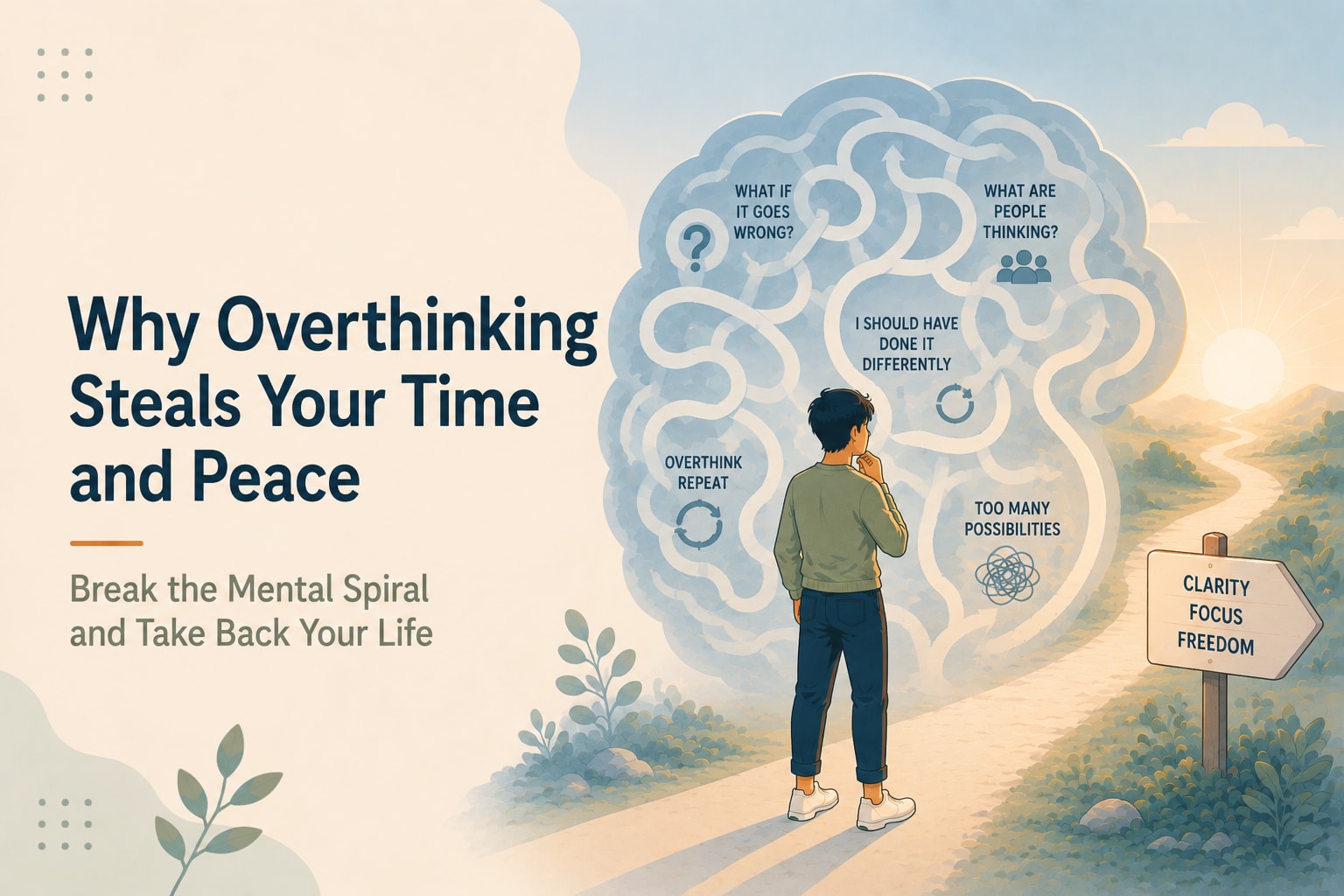
Why You Trust Others More Than Yourself
Why you trust others more than yourself often becomes visible in small decisions before it appears in larger ones.
You already know what you think.
You have noticed the pattern.
You have considered the available information.
You may even have reached a clear conclusion.
Then someone else gives a different opinion.
Your certainty weakens.
Their confidence feels more convincing than your reasoning.
You begin reviewing your decision as though their perspective must contain something yours does not.
Sometimes outside advice is useful.
Other people can see risks, possibilities, and blind spots that are difficult to notice from inside a situation.
The pattern becomes limiting when another person’s certainty automatically carries more weight than your own observation.
You stop using advice as information.
You begin using it as permission.
A decision does not feel complete until someone agrees with it.
A concern does not feel valid until another person confirms it.
An idea does not feel strong until someone else approves it.
Over time, this can make your own judgment feel increasingly unfamiliar.
The more often you hand decisions outward, the less evidence you collect that you can evaluate situations yourself.
This is how the pattern connects with broader self-sabotage patterns, especially when reassurance and overthinking loops quietly replace self-trust.
Free Psychology Guide
Download The Truth Pill Guide to Self-Sabotage Patterns to recognise the hidden loops that weaken confidence, increase reassurance-seeking, and make your own judgment feel difficult to trust.
What This Behavior Actually Is
Trusting others more than yourself is not always a lack of intelligence or independence.
Often, it is a habit of assigning greater authority to external certainty.
You may understand a situation well.
You may have direct experience.
You may have already considered the likely consequences.
Yet the moment someone speaks confidently, their opinion begins to feel more reliable.
This happens because confidence is visible.
Reasoning is not.
You can hear the certainty in another person’s voice.
You can see how quickly they answer.
You notice that they do not appear conflicted.
Your own judgment feels different because you experience every stage behind it.
You remember the hesitation.
You see the unanswered questions.
You know which parts remain uncertain.
When you compare your private thought process with someone else’s public conclusion, their answer can appear stronger.
But visible confidence does not always mean better judgment.
A person can sound certain while missing important information.
You can feel uncertain while still making a careful and reasonable assessment.
The distortion begins when certainty itself becomes evidence.
The mind assumes:
"They sound sure, so they probably understand the situation better than I do."
That assumption can gradually override your own observations.
Why the Brain Does This
The brain often looks outward when uncertainty becomes uncomfortable.
A personal decision carries responsibility.
If the outcome goes badly, you may feel that you should have predicted it.
Seeking another opinion reduces some of that pressure.
The decision begins to feel shared.
If another person agrees, the choice appears safer.
If they disagree, hesitation can feel justified.
This is one reason reassurance feels relieving.
It temporarily reduces the burden of deciding.
The problem is that relief can become reinforcing.
Each time you rely on someone else to settle internal uncertainty, the brain learns that your own conclusion is not enough.
The next decision becomes harder to hold.
You may understand the facts, but you no longer trust yourself to interpret them without external confirmation.
Past criticism can strengthen this pattern.
If your decisions were frequently questioned, corrected, or dismissed, you may have learned to review your judgment through other people’s reactions.
Instead of asking:
"What does the evidence suggest?"
You begin asking:
"What will other people think of this choice?"
The focus shifts from understanding the situation to avoiding disapproval.
Fear of failure can deepen the loop.
A wrong decision no longer feels like an ordinary mistake.
It feels like proof that you should not have trusted yourself.
When the stakes become personal, handing authority outward feels safer than accepting uncertainty directly.
Where It Appears in Everyday Life
The pattern appears in ordinary decisions as well as significant ones.
Someone knows they want to decline an invitation but asks several people whether saying no would seem rude.
A professional has a clear view during a meeting but waits for someone senior to express the same opinion first.
A person notices repeated problems in a relationship but distrusts their observations when friends say the partner seems pleasant.
A creator likes the work they produced until another person responds without enthusiasm.
Someone chooses an outfit, changes it after receiving a comment, then feels uncomfortable in the replacement.
A business owner understands their audience but abandons a reasonable strategy because someone outside the business sounds more confident.
The details differ.
The structure remains similar.
An internal conclusion forms.
Uncertainty appears.
Another person offers an opinion.
Their certainty receives greater weight.
The original judgment weakens.
More reassurance is sought.
The decision becomes harder to own.
This can also appear after a choice has already been made.
You decide.
Someone questions it.
You begin reopening the entire process.
That is why this pattern often overlaps with Why You Second-Guess Your Choices and Why You Question Yourself After Deciding.
The decision may have been reasonable.
The doubt grows because another person’s reaction becomes more important than the evidence that shaped your original choice.
The Hidden Cost
The most obvious cost is indecision.
The deeper cost is dependence on external certainty.
When you repeatedly ask others to settle your uncertainty, your own judgment receives less practice.
You gather advice instead of gathering experience.
You wait for agreement instead of observing outcomes.
You become skilled at consulting but less comfortable deciding.
This can create a quiet contradiction.
You may appear thoughtful because you consider many opinions.
Internally, you may feel increasingly disconnected from what you actually think.
The person begins adjusting decisions to avoid disagreement.
They choose what is easier to explain.
They suppress observations that others may challenge.
They delay action until someone else confirms the direction.
Over time, even simple decisions can become mentally expensive.
There is also a relational cost.
Other people may begin influencing choices they do not fully understand.
They see part of the situation.
You live with the consequences.
Their advice may reflect their values, fears, preferences, or history rather than yours.
A cautious person may advise you to avoid every uncertain opportunity.
A highly ambitious person may encourage risks that do not suit your priorities.
Someone who tolerates poor treatment may tell you that your standards are unrealistic.
The advice may be sincere.
That does not make it automatically relevant.
When self-trust is weak, the difference between receiving advice and surrendering judgment becomes difficult to see.
The Pattern Most People Miss
Most people think they trust others more because other people know more.
Sometimes they do.
But the deeper pattern often involves unequal standards.
You judge your own thinking by its uncertainty.
You judge another person’s thinking by its conclusion.
You notice your doubts.
You notice their confidence.
You remember your mistakes.
You often do not see theirs.
This creates a distorted comparison.
The sequence often looks like this:
A decision appears.
You form an initial judgment.
Uncertainty remains.
You seek another opinion.
Their confidence creates temporary relief.
Your own conclusion feels less sufficient.
You seek more reassurance next time.
Self-trust weakens through lack of use.
The next decision feels even harder to make alone.
The pattern is self-reinforcing.
You trust yourself less because you have fewer experiences of making a decision, living with it, adjusting, and discovering that uncertainty was manageable.
The absence of those experiences then appears to justify greater dependence on outside opinions.
This is where The Action Reduces Fear Loop becomes useful.
Action creates evidence.
A small decision made without repeated reassurance allows you to observe what happens next.
The outcome may be imperfect.
You may still need to adjust.
But adaptation is part of judgment.
Self-trust does not come from always being right.
It develops from seeing that you can evaluate, decide, respond, and revise without handing the entire process to someone else.
Final Reflection
Trusting others more than yourself can look like humility.
It can look like openness.
It can look like careful decision-making.
Sometimes it is all three.
The pattern changes when your own judgment becomes automatically less credible simply because it belongs to you.
You see your uncertainty from the inside.
You see other people’s confidence from the outside.
That difference can make their opinions feel more complete than they really are.
The sequence is quiet.
You notice something.
You form a conclusion.
Uncertainty remains.
Someone else speaks confidently.
Your judgment weakens.
You seek reassurance.
Temporary relief appears.
Your own voice becomes slightly harder to hear next time.
Nothing dramatic happens.
Self-trust simply becomes less familiar through repeated disuse.
The goal is not to ignore other people.
Outside perspectives remain valuable.
The important distinction is whether advice informs your judgment or replaces it.
You can listen carefully without treating another person’s confidence as proof.
You can remain uncertain without assuming uncertainty makes your reasoning invalid.
You can consider advice while still recognising that you are the one who sees the full situation and lives with the result.
Self-trust is not certainty.
It is the ability to make a reasonable judgment without needing every outside voice to agree with it first.
Why do other people’s opinions feel more reliable than mine?
You experience every uncertainty behind your own judgment, while you usually hear only the final version of another person’s opinion. Their confidence can therefore appear more complete.
Is asking for advice a sign that I do not trust myself?
Not necessarily. Advice becomes a self-trust issue when you cannot make or maintain a reasonable decision without repeated external approval.
Why do I change my mind when someone disagrees with me?
Disagreement can activate fear of making a mistake or being judged. The other person’s certainty may then feel safer than holding your own unresolved position.
Can low self-trust come from past criticism?
Yes. Repeated criticism, dismissal, or correction can teach you to evaluate your judgment through other people’s reactions rather than through evidence and experience.
Why does reassurance only help for a short time?
Reassurance reduces uncertainty temporarily but does not strengthen your ability to tolerate and evaluate uncertainty yourself. The need for confirmation therefore returns.
Does trusting yourself mean ignoring better advice?
No. Self-trust includes considering relevant information, recognising genuine expertise, and changing your mind when new evidence supports it. It does not require rejecting outside input.
Related Patterns
