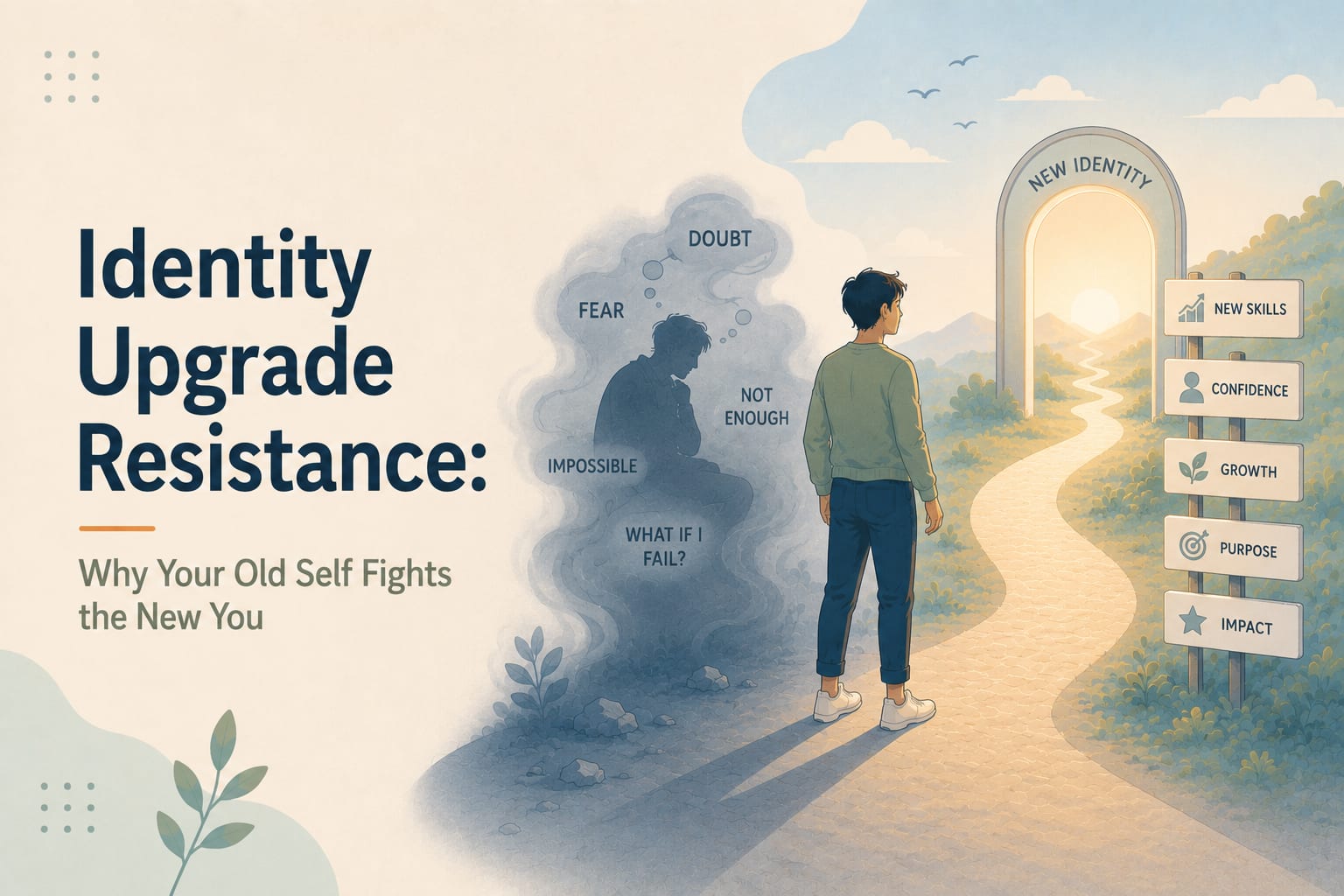
Why You Question Yourself After Deciding
Why you question yourself after deciding is a pattern many people recognize but rarely understand.
You spend days, weeks, or even months thinking through a decision.
You compare options.
You weigh the risks.
You imagine different outcomes.
Eventually, you decide.
For a brief moment, everything feels settled.
Then something unexpected happens.
The doubt begins after the decision has already been made.
You start wondering whether you missed something important.
Another option suddenly looks more attractive.
The reasons that once felt convincing seem weaker.
You imagine future problems that never occurred to you before.
It feels as though the decision created uncertainty instead of resolving it.
You might assume this means the choice was wrong.
But if you look closely, the sequence repeats across careers, relationships, businesses, purchases, and everyday decisions.
The doubt often follows commitment—not because the decision is necessarily bad, but because commitment changes how the mind processes uncertainty.
Understanding this pattern also helps explain why it frequently overlaps with broader systems like self-sabotage patterns and overthinking loops.
Free Psychology Guide
Download The Truth Pill Guide to Self-Sabotage Patterns to learn how hidden behavioral loops quietly influence decisions, confidence, and progress long before you recognize them.
What This Behavior Actually Is
Questioning yourself after deciding is not always a sign of poor judgment.
More often, it is a shift in how the brain allocates attention.
Before deciding, attention is divided between possibilities.
Each option remains available.
The mind compares advantages and disadvantages without committing to one future.
Once a decision is made, those alternatives disappear.
The chosen path becomes real.
The rejected paths become imagined possibilities.
At that moment, the brain begins evaluating something different.
Instead of asking which option seems strongest, it begins asking whether the chosen option can survive future uncertainty.
This changes the direction of attention.
Small risks become easier to notice.
Potential mistakes feel more significant.
Information that supports alternative choices suddenly becomes more interesting.
The decision itself has not changed.
The mind's relationship to the decision has.
That subtle shift is why post-decision doubt often feels stronger than the uncertainty that existed beforehand.
Why the Brain Does This
The brain prefers flexibility while uncertainty remains manageable.
A decision removes flexibility.
It transforms possibility into commitment.
Commitment introduces consequences.
Once a path is chosen, other outcomes become unavailable.
The brain naturally begins checking whether the chosen direction still appears safe.
This is not necessarily irrational.
It is a prediction system attempting to reduce future risk.
The difficulty begins when normal evaluation becomes continuous evaluation.
Instead of adjusting to the decision, the mind repeatedly reopens it.
Questions return that have already been answered.
New possibilities are searched for.
Alternative scenarios become increasingly detailed.
The person begins reviewing the decision instead of living with it.
This explains why post-decision doubt frequently overlaps with self-doubt.
The mind quietly shifts from evaluating the decision to evaluating the decision-maker.
"Did I overlook something?"
"Maybe someone else would have chosen differently."
"Perhaps I acted too quickly."
The conversation is no longer about the choice.
It becomes about identity.
Fear of failure often strengthens this pattern.
If a decision becomes connected to personal worth, uncertainty feels more threatening.
Perfectionism adds another layer by suggesting that the correct decision should feel completely certain.
Real decisions rarely provide that kind of certainty.
Where It Appears in Everyday Life
The pattern appears almost everywhere important decisions exist.
Someone accepts a new job and immediately begins wondering whether they should have stayed where they were.
A business owner finally launches a product but spends the following weeks questioning every strategic decision.
Someone ends an unhealthy relationship and later begins remembering only the positive moments.
A student chooses a university and starts comparing it with every alternative they declined.
A home buyer signs the paperwork and immediately notices other properties that suddenly appear more attractive.
A creator publishes an article and rereads it repeatedly, focusing on sentences that could have been written differently.
The situations vary.
The structure remains familiar.
Decision.
Commitment.
Increased evaluation.
Growing uncertainty.
Repeated checking.
The mind behaves as though certainty can still be found after the decision has already been made.
This is why the pattern often connects with The Output Over Refinement Framework, where repeated reconsideration quietly replaces forward movement.
The Hidden Cost
Questioning yourself after deciding rarely changes the decision itself.
It changes how much attention remains available for living with it.
Energy that could be invested in execution becomes invested in review.
The person continues thinking instead of adapting.
Instead of learning from the chosen path, they repeatedly compare it with imagined alternatives.
That comparison is difficult to resolve because the alternatives remain hypothetical.
Reality always contains imperfections.
Imagined alternatives usually contain possibilities.
The comparison therefore becomes unfair.
This is one reason post-decision doubt often feeds overthinking.
The mind keeps searching for information capable of removing uncertainty completely.
That information rarely exists.
Repeated review also delays confidence.
Confidence often develops through experience.
The person who continually questions the decision gathers less experience because attention remains focused on whether they should have decided differently.
The result is subtle.
The person appears thoughtful.
Internally, they remain psychologically undecided.
Over time this can reinforce hesitation in future decisions.
If every commitment becomes followed by prolonged doubt, deciding itself begins to feel unsafe.
The Pattern Most People Miss
Many people believe doubt comes before decisions.
In reality, an important form of doubt begins afterward.
The sequence often looks like this.
Several options exist.
A decision is made.
Commitment removes alternative futures.
The brain increases monitoring.
Normal uncertainty becomes self-questioning.
Attention returns to rejected options.
The chosen path receives less confidence.
Execution slows.
The lack of progress appears to justify the original doubt.
The cycle quietly repeats.
Notice where the loop turns.
It does not begin because the decision was objectively poor.
It begins because commitment changes what the brain starts monitoring.
Instead of searching for the best option, it searches for evidence that the chosen option might fail.
That distinction explains why many people continue questioning decisions even when objective evidence suggests they made reasonable choices.
You can see this more clearly in the case study High Effort, Low Output Pattern, where attention shifts away from execution and back toward repeated evaluation.
It also connects with Completion Resistance Definition, which explains why committing to a finished choice often feels more psychologically difficult than continuing to prepare.
Final Reflection
Questioning yourself after deciding is not necessarily a sign that your judgment failed.
Often it is a predictable response to commitment itself.
Before the decision, uncertainty belongs to the options.
After the decision, uncertainty belongs to the future.
The mind naturally begins examining that future more carefully.
The sequence is quiet.
A choice is made.
Commitment removes alternatives.
Attention shifts toward possible mistakes.
Self-questioning increases.
Execution slows.
Experience develops more slowly.
Confidence struggles to grow.
The person concludes they chose poorly.
Yet the decision may never have been the true source of the discomfort.
The uncertainty simply changed location.
Once you recognize that sequence, post-decision doubt becomes easier to identify.
It stops looking like reliable evidence.
It begins looking like one of the recurring psychological patterns that often appears whenever possibility becomes commitment.
The feeling may still arise.
The difference is that you can now recognize the loop before it quietly begins directing your behavior.
Is it normal to doubt a decision after making it?
Yes. Many people experience increased uncertainty after committing to an important decision. The feeling often reflects the brain adjusting to commitment rather than proof that the decision was wrong.
Why do other options seem better after I've already chosen?
Once one option is selected, the alternatives become idealized because they are no longer constrained by reality. The mind naturally imagines what might have been.
Is post-decision doubt the same as regret?
Not always. Doubt questions the decision while events are still unfolding. Regret usually develops after outcomes become clearer.
How is this connected to overthinking?
Overthinking repeatedly reopens decisions that have already been made. Instead of gathering new experience, the mind repeatedly searches for certainty that no longer exists.
Can confidence grow after a decision is made?
Yes. Confidence usually develops through living with a decision, adapting to it, and collecting real evidence rather than continually revisiting the moment of choice.
Related Patterns
