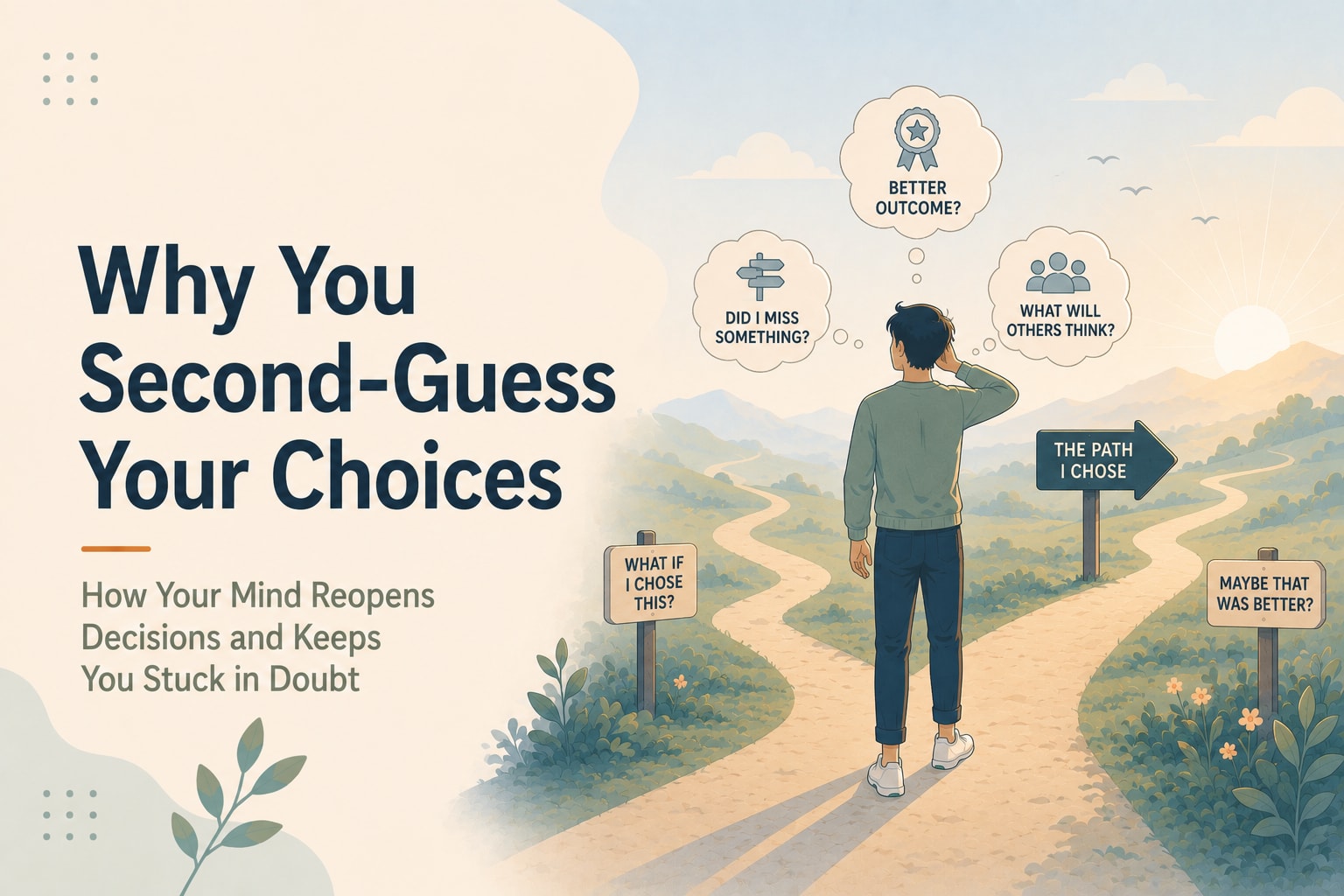
Why You Second-Guess Your Choices
Why you second-guess your choices is one of the most common psychological patterns behind hesitation, regret, and overthinking.
The decision has already been made.
You accepted the job.
You published the article.
You ended the relationship.
You invested the money.
You chose a direction.
For a brief moment, everything feels settled.
Then the questions begin.
"Did I choose too quickly?"
"What if the other option was better?"
"Maybe I overlooked something important."
The choice itself has not changed.
What changes is the way your mind begins observing it.
Many people assume this means they made the wrong decision.
More often, it means commitment has activated a different psychological process.
Instead of comparing possibilities, the mind begins monitoring consequences.
That shift can quietly transform ordinary uncertainty into persistent self-questioning.
It also explains why second-guessing often overlaps with larger behavioral systems like self-sabotage patterns and overthinking loops, where decisions continue long after they should have ended.
Free Psychology Guide
Download The Truth Pill Guide to Self-Sabotage Patterns to understand the hidden mental loops that quietly influence decisions, confidence, and progress before you recognize them.
What This Behavior Actually Is
Second-guessing is not simply thinking carefully.
Careful thinking usually ends once enough information has been gathered.
Second-guessing continues after the decision has already been made.
The purpose quietly changes.
Instead of deciding, the mind begins searching for reassurance.
It revisits information that has already been considered.
It imagines different outcomes.
It reconstructs conversations.
It remembers details that seemed unimportant before.
It searches for evidence that the decision was either completely right or completely wrong.
Because real life rarely offers absolute certainty, the search rarely ends.
This is why second-guessing feels productive while producing very little clarity.
The mind mistakes continued analysis for improved judgment.
In reality, it is often repeating the same evaluation from different angles.
The decision becomes psychologically unfinished even though it has already been completed.
Why the Brain Does This
Before making a decision, uncertainty belongs to the future.
Several possibilities remain available.
The brain compares them.
Once one option is chosen, flexibility disappears.
Commitment introduces consequences.
The brain naturally begins monitoring whether the chosen direction remains safe.
That response is useful in moderation.
It helps people notice genuine mistakes and adapt when new information appears.
The problem begins when monitoring never stops.
Every small uncertainty becomes a reason to reopen the decision.
A normal inconvenience becomes evidence that another option might have been better.
The mind quietly forgets something important.
Every alternative still exists only in imagination.
The chosen path exists in reality.
Reality includes effort, imperfection, and unexpected problems.
Imagined alternatives usually contain possibilities without limitations.
The comparison therefore becomes uneven.
The chosen decision is judged by real experiences.
The rejected choices are judged by imagined potential.
No real decision can consistently compete with an idealized alternative.
This is one reason second-guessing often feels endless.
The mind is comparing reality with imagination rather than reality with reality.
Fear of failure often strengthens this loop.
If making a mistake feels like a judgment of personal worth, every decision appears heavier than it actually is.
The person is no longer evaluating the decision.
They are evaluating themselves through the decision.
Where It Appears in Everyday Life
This pattern appears almost everywhere important choices exist.
Someone accepts a promotion and immediately wonders whether the extra responsibility was worth it.
A creator publishes a video, then spends hours thinking about edits that could still be made.
Someone leaves a difficult relationship but begins remembering only the positive moments.
A graduate chooses one career path and repeatedly imagines the success they might have achieved elsewhere.
A business owner launches a product but constantly compares it with ideas they never built.
Even ordinary decisions can trigger the pattern.
Choosing a restaurant.
Buying a phone.
Booking a holiday.
Sending an email.
The importance of the decision changes.
The structure remains remarkably similar.
A choice is made.
Commitment creates consequences.
Attention shifts toward uncertainty.
Alternative possibilities become increasingly attractive.
The chosen path begins losing confidence.
The person starts reviewing instead of living.
This is why second-guessing often connects with Why You Question Yourself After Deciding.
Both patterns begin after commitment.
The difference is that questioning focuses more on the decision-maker, while second-guessing repeatedly reopens the decision itself.
The Hidden Cost
Most people assume second-guessing only wastes time.
Its deeper cost is psychological.
When decisions never feel finished, confidence struggles to develop.
Confidence grows through experience.
Experience requires commitment.
Commitment becomes difficult when every choice remains psychologically reversible.
The person delays moving fully into the chosen direction.
Instead of learning from the decision, they continue evaluating whether it should have been made.
This reduces attention available for adaptation.
A business improves by serving customers.
A relationship develops through shared experiences.
A career grows through repeated practice.
Second-guessing quietly interrupts all three.
The person remains mentally positioned at the crossroads instead of walking down the path.
This pattern also strengthens procrastination.
Future decisions begin feeling heavier because previous ones never reached psychological closure.
The brain starts associating commitment with prolonged uncertainty.
Eventually the person may delay making choices altogether.
Not because they cannot decide.
Because they expect every decision to become another source of endless evaluation.
The Pattern Most People Miss
Most people think second-guessing happens because they lack confidence.
Often the opposite is true.
Confidence weakens because second-guessing repeatedly interrupts commitment.
The sequence usually unfolds like this.
Several options exist.
A decision is made.
Commitment removes alternative futures.
The brain increases monitoring.
Attention shifts toward possible mistakes.
Imagined alternatives become increasingly attractive.
The chosen path receives less attention.
Experience develops more slowly.
Confidence struggles to grow.
The original uncertainty appears justified.
Notice where the loop begins.
Not with failure.
Not with evidence.
With attention.
The moment commitment changes what the mind begins watching, second-guessing quietly takes over.
This pattern overlaps with Why Confidence Drops When It Matters, where increased importance shifts attention from the task toward self-monitoring.
It also appears inside The Action Reduces Fear Loop, which explains why continued movement often provides better psychological evidence than repeated evaluation.
The goal is not to eliminate uncertainty.
It is to recognize when uncertainty has quietly transformed into repetitive analysis that no longer improves the decision.
Final Reflection
Second-guessing often feels responsible.
It feels careful.
It feels intelligent.
But there is an important difference between reviewing a decision and repeatedly reopening it.
Healthy reflection gathers information and continues moving.
Second-guessing repeatedly returns to the same crossroads hoping certainty will eventually appear.
The sequence is subtle.
A decision is made.
Commitment increases attention.
The mind searches for possible mistakes.
Alternative futures become idealized.
The chosen path begins feeling weaker.
Confidence decreases.
The decision appears increasingly uncertain.
Yet nothing about the decision itself may have changed.
Only the way it is being observed.
Recognizing this pattern changes how second-guessing feels.
It stops looking like proof that something is wrong.
Instead, it begins looking like one of the recurring psychological loops that often appears whenever possibility becomes commitment.
The questions may still arise.
The difference is that you can recognize them before they quietly pull your attention back toward decisions that have already been made.
Is second-guessing the same as making a bad decision?
No. Second-guessing often reflects the mind adjusting to commitment rather than evidence that the original decision was poor.
Why do the options I rejected suddenly seem better?
Rejected options remain imaginary, making them easier to idealize. The chosen option exists in reality, where imperfections naturally become more visible.
How is second-guessing different from careful thinking?
Careful thinking helps you make a decision. Second-guessing repeatedly reopens that decision without producing meaningful new insight.
Can second-guessing reduce confidence?
Yes. Continually revisiting decisions prevents full commitment, limiting the experiences that normally strengthen confidence.
Why do I keep replaying important decisions?
Important decisions often carry emotional significance and future consequences. The brain responds by increasing monitoring, which can become repetitive when uncertainty feels difficult to tolerate.
Can confidence grow after committing to a decision?
Yes. Confidence usually develops through adapting to a decision and collecting real-world evidence rather than continually imagining alternative outcomes.
Related Patterns
- The Complete Guide to Self-Sabotage Patterns
- Overthinking Loops
- Why You Question Yourself After Deciding
- Why Confidence Drops When It Matters
- Why Self-Doubt Appears Before Growth
- The Action Reduces Fear Loop
- Completion Resistance Definition
