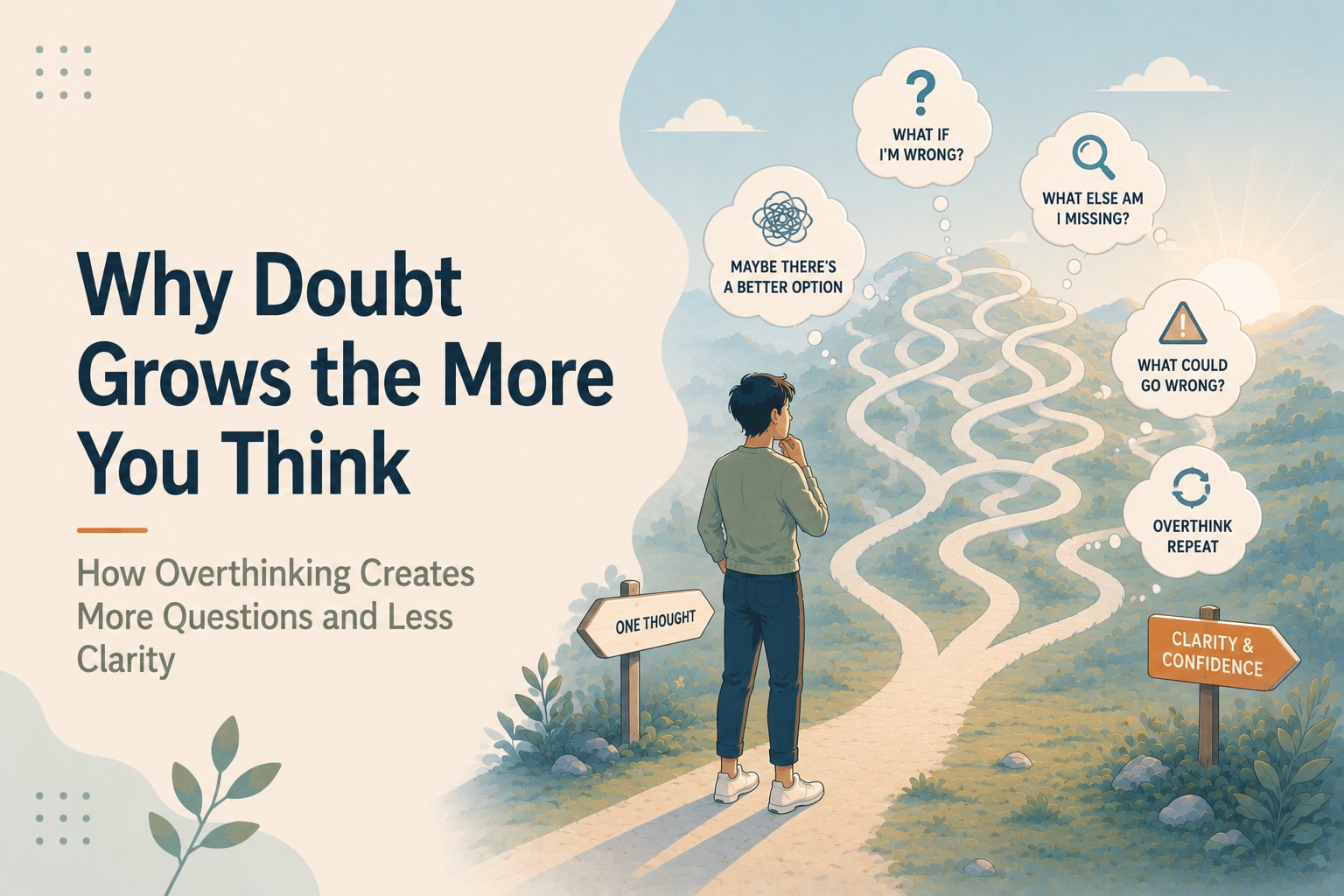
Why Doubt Grows the More You Think
Why doubt grows the more you think becomes easier to understand once you notice what repeated thinking actually does.
You begin with one question.
Should I accept the offer?
Was that the right decision?
Is this project ready?
Did I misunderstand the situation?
At first, thinking seems like the responsible response.
You review the facts.
You consider the risks.
You imagine what might happen next.
But instead of reaching clarity, the question begins producing more questions.
One possibility leads to another.
Every answer creates an exception.
Every reassuring thought is followed by a reason it might be wrong.
Eventually, you know more about the situation but feel less certain about what to do.
This is one of the most misleading parts of overthinking.
It creates the feeling that clarity must be one more thought away.
Yet the longer the process continues, the more uncertainty the mind generates.
The problem is not always that you lack information.
Sometimes the act of repeatedly examining the decision is expanding the number of possibilities you feel responsible for controlling.
This is why growing doubt often appears within broader self-sabotage patterns, especially when overthinking loops replace action with continuous mental checking.
Free Psychology Guide
Download The Truth Pill Guide to Self-Sabotage Patterns to recognize the hidden thinking loops that quietly turn uncertainty into hesitation, delay, and repeated self-questioning.
What This Behavior Actually Is
Repeated thinking is often mistaken for deeper thinking.
They are not always the same.
Deeper thinking improves the quality of a decision.
It identifies useful information, examines relevant risks, and eventually reaches a workable conclusion.
Repeated thinking often circles the same uncertainty without changing the available evidence.
The mind returns to the question because the answer does not feel certain enough.
It reviews the situation from another angle.
Then another.
Then another.
The process may sound thoughtful from the inside.
In practice, the same information is being rearranged.
This creates an important shift.
The purpose of thinking changes from understanding the situation to removing discomfort.
You are no longer only asking what the evidence suggests.
You are asking whether there is any possible interpretation that could make the decision unsafe.
That standard is impossible to satisfy.
Almost every decision contains uncertainty.
Almost every action can produce an unwanted outcome.
Almost every conversation can be interpreted in more than one way.
The more possibilities the mind generates, the more incomplete the original answer begins to feel.
Doubt grows because thinking has stopped narrowing the field.
It is expanding it.
Why the Brain Does This
The brain naturally tries to predict what will happen next.
When a situation feels important, prediction becomes more urgent.
The mind searches for information that could prevent mistakes, disappointment, embarrassment, or loss.
At first, this can be useful.
You notice a genuine risk.
You prepare for an overlooked problem.
You reconsider an assumption that deserves attention.
But once the obvious information has been reviewed, the brain does not always recognise that the useful part of thinking is complete.
If uncertainty remains, it may continue searching.
The search itself begins creating new material.
You imagine unlikely outcomes.
You analyse minor details.
You question your memory.
You wonder whether your confidence is making you careless.
Then you wonder whether your doubt is making you overly cautious.
The mind begins evaluating its own evaluation.
This creates a second layer of uncertainty.
The original question may have been simple.
The internal process surrounding it becomes complicated.
Fear of failure often strengthens this loop.
When making the wrong choice feels unacceptable, the mind treats every possible mistake as something that should have been predicted.
Perfectionism adds the belief that a good decision should feel completely certain.
Together, these patterns make normal uncertainty feel like unfinished work.
The person keeps thinking because doubt remains.
Doubt remains because the person keeps producing more possibilities to consider.
Where It Appears in Everyday Life
This pattern appears in decisions, relationships, work, and ordinary communication.
Someone receives a job offer and initially feels pleased.
Then they begin comparing the role with every possible future career path.
They search employee reviews.
They imagine regretting the salary.
They wonder whether accepting too quickly will limit future options.
What began as a reasonable decision becomes a prediction problem with no clear endpoint.
A person sends a message and immediately rereads it.
The wording seems normal.
After the fifth reading, one sentence appears too direct.
After the tenth, another seems too vague.
The message has not changed.
Repeated attention has made ordinary language feel suspicious.
A creator finishes an article but keeps editing because every rereading reveals something that could be improved.
The improvements may be real.
Yet each revision also introduces new details to evaluate.
Completion becomes harder because the mind is continually generating new standards.
The same thing happens in relationships.
A delayed reply produces one concern.
The concern leads to several interpretations.
Perhaps the person is busy.
Perhaps they are losing interest.
Perhaps the previous conversation went badly.
Perhaps the relationship was misread from the beginning.
Soon, the doubt feels larger than the event that created it.
In each situation, thinking begins as an attempt to understand.
It gradually becomes an attempt to eliminate every possible source of uncertainty.
The Hidden Cost
The clearest cost is delay.
Decisions remain open longer than necessary.
Messages are rewritten.
Applications are postponed.
Projects stay unfinished.
Conversations are rehearsed but never started.
Yet the deeper cost is that repeated thinking begins weakening trust in your own judgment.
Each time you reopen a reasonable conclusion, the mind learns that arriving at an answer is not enough.
The answer must also survive continuous inspection.
Because few conclusions remain emotionally comfortable under endless inspection, confidence begins to fall.
The person starts relying on reassurance.
They ask others what they would do.
They compare opinions.
They search for one final piece of information that will settle everything.
Reassurance may help briefly.
Then a new possibility appears.
This is how doubt becomes self-reinforcing.
Repeated analysis makes the decision feel more complicated.
The increased complexity makes the person feel less capable of deciding.
Reduced confidence creates more analysis.
The loop continues.
There is also an attentional cost.
Mental energy remains attached to situations that may already have enough information for action.
The person is physically present elsewhere while still reviewing an earlier decision.
Work becomes harder to begin.
Rest becomes less restful.
Even completed choices continue occupying attention.
This can create the appearance of carefulness while quietly reducing output, concentration, and psychological closure.
The Pattern Most People Miss
Most people assume that doubt causes overthinking.
Often, overthinking is also producing the doubt.
The sequence can look like this:
A question appears.
The mind searches for an answer.
A reasonable conclusion forms.
Uncertainty remains.
The mind interprets uncertainty as a reason to continue.
More possibilities are generated.
The decision feels more complicated.
Confidence decreases.
The new doubt appears to justify further thinking.
The pattern is easy to miss because each individual thought seems relevant.
One more comparison appears sensible.
One more review feels harmless.
One more imagined outcome seems responsible.
The problem becomes visible only when the thoughts are viewed as a sequence.
The process is no longer helping the person decide.
It is making the decision increasingly difficult to trust.
This is closely connected to Why You Second-Guess Your Choices, where the mind reopens decisions after commitment.
It also overlaps with Why You Question Yourself After Deciding, because repeated analysis often shifts attention from the choice to the person who made it.
A useful interruption appears in The Action Reduces Fear Loop.
Action does not guarantee the correct outcome.
It provides something repeated thinking cannot: new evidence.
The next conversation reveals more than another imagined version of it.
Publishing produces information that private editing cannot.
Making a reasonable choice creates experience that endless comparison postpones.
The interruption is not about thinking less in every situation.
It is about recognising when thinking has stopped improving the decision and started multiplying doubt.
Final Reflection
Doubt often grows the more you think because the mind is capable of generating more possibilities than reality can answer in advance.
Every situation contains alternative explanations.
Every decision contains risks.
Every future contains outcomes that cannot be fully predicted.
When thinking is used to understand what is knowable, it can create clarity.
When it is used to remove all uncertainty, it creates an endless task.
The sequence is quiet.
A question appears.
A reasonable answer forms.
Uncertainty remains.
The mind keeps searching.
More possibilities emerge.
The answer feels weaker.
Doubt grows.
The person assumes more thinking is needed.
Yet the increased doubt may not be evidence that the situation became less clear.
It may be evidence that the mind has moved beyond useful evaluation and into repetitive possibility generation.
That distinction changes how the pattern looks.
The presence of another thought does not always mean another problem has been discovered.
Sometimes it only means the mind is still searching after the available information has already said enough.
Why does thinking too much make me more confused?
Repeated thinking can generate more interpretations and possible outcomes than the available evidence can resolve. The decision begins feeling more complicated even when no meaningful new information has appeared.
Is overthinking the same as careful decision-making?
No. Careful thinking gathers relevant information and moves toward a conclusion. Overthinking repeatedly revisits the same uncertainty without producing proportionate clarity.
Why do I stop trusting decisions that initially felt right?
Continuous review makes ordinary uncertainty increasingly visible. The decision may not have changed, but repeated inspection can make it feel less reliable.
Does more doubt mean I have missed something important?
Not necessarily. Doubt can increase because the mind is generating additional possibilities, not because new evidence has revealed a genuine problem.
Why does reassurance only help temporarily?
Reassurance answers the current concern, but an overthinking loop often creates another concern afterward. The deeper problem is the repeated search for complete certainty.
Can action reduce overthinking?
Action can provide real information that mental simulation cannot. It replaces imagined possibilities with observable evidence, which can make the next decision clearer.
Related Patterns
