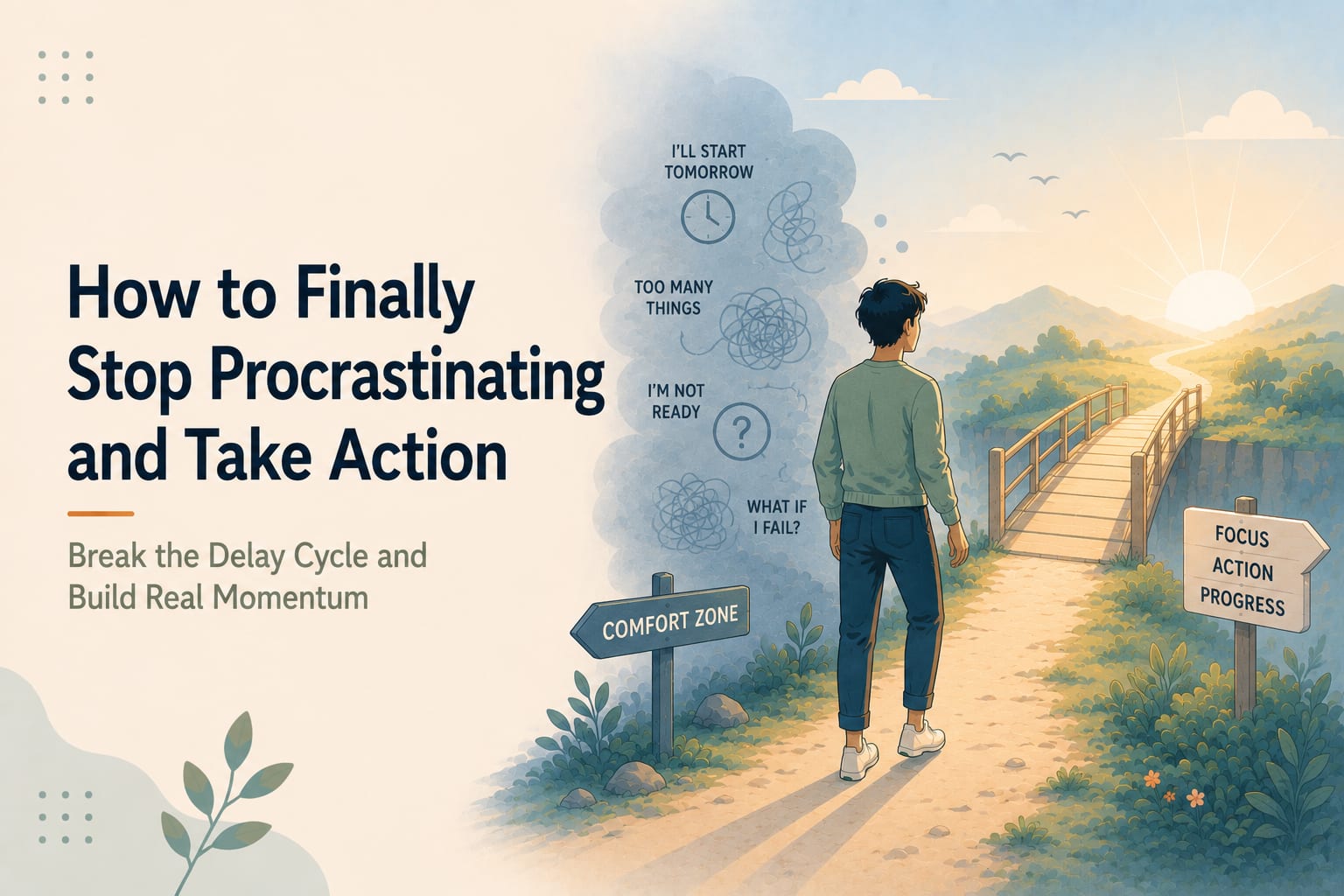
Why You Feel Less Capable Than You Are
Why you feel less capable than you are often has very little to do with your actual ability.
You may have experience.
You may have completed difficult tasks before.
Other people may trust your judgment, depend on your work, or describe you as competent.
Yet when something important appears, your internal assessment changes.
You notice what you do not know.
You remember the mistakes you have made.
You compare your private uncertainty with someone else’s visible confidence.
The evidence of your ability remains available, but it begins to feel less convincing.
This creates a strange gap between what you can do and what you believe you can do.
From the outside, your capability may be clear.
From the inside, it can feel conditional.
You trust yourself when the task is familiar, private, or low-risk.
You question yourself when the outcome matters, when other people are watching, or when the next step asks more of you than the previous one did.
That shift is not always an honest measurement of skill.
It is often a change in attention.
Instead of focusing on the task, the mind begins evaluating the person performing it.
This is why feeling incapable frequently overlaps with wider self-sabotage patterns, especially when uncertainty activates overthinking loops, perfectionism, fear of judgment, and repeated self-comparison.
Free Psychology Guide
Download The Truth Pill Guide to Self-Sabotage Patterns to recognize the quiet behavioral loops that distort confidence, interrupt progress, and make familiar abilities feel less reliable.
What This Behavior Actually Is
Feeling less capable than you are is often a problem of distorted self-assessment.
Your ability has not necessarily decreased.
Your attention has simply moved toward different evidence.
When you feel secure, you tend to notice what you understand.
You remember what you have completed.
You respond to problems as they appear.
When doubt becomes active, the mind changes its search pattern.
It begins looking for gaps.
What have I missed?
What if this is beyond me?
Why does everyone else seem more certain?
What if my previous success was accidental?
The mind is still gathering information, but it is no longer gathering it evenly.
Evidence of competence is discounted.
Evidence of limitation receives greater weight.
A successful outcome becomes luck.
A mistake becomes proof.
A compliment is treated as politeness.
A difficult moment is treated as an accurate description of overall ability.
This uneven evaluation creates the feeling of being less capable.
The person is not inventing every concern.
There may be genuine areas where more experience is needed.
The distortion appears when those areas are used to erase everything already known.
Capability becomes defined by what is missing rather than by the full picture.
Why the Brain Does This
The brain often becomes more cautious when identity feels exposed.
A routine task does not require much self-evaluation.
You simply do it.
An important task feels different because the outcome may affect how you see yourself or how you believe others see you.
The presentation becomes evidence of intelligence.
The interview becomes evidence of professional worth.
The relationship becomes evidence of emotional maturity.
The opportunity becomes evidence of whether you truly belong.
Once the task begins carrying that meaning, the mind increases monitoring.
You stop asking only:
"What does this situation require?"
You begin asking:
"What will this situation reveal about me?"
That second question creates pressure.
Normal uncertainty begins to feel personal.
Learning something new feels like discovering a weakness.
Needing help feels like evidence of inadequacy.
Watching someone more experienced creates the impression that you should already be at their level.
This is why capability often feels lowest in situations where growth is actually taking place.
Growth introduces unfamiliar demands.
Unfamiliar demands expose the limits of current experience.
The mind may interpret those limits as proof that the entire ability is missing.
But not knowing everything is not the same as knowing nothing.
The brain often collapses that distinction when the outcome feels important.
Where It Appears in Everyday Life
The pattern appears whenever a person enters a situation that increases visibility or responsibility.
Someone is promoted after years of reliable work and immediately begins wondering whether management made a mistake.
A writer who has published consistently starts doubting their ability when asked to produce something for a larger audience.
A business owner handles daily operations well but feels unqualified when speaking to investors or experienced executives.
A student understands the material in private but begins assuming everyone else is more intelligent once discussion becomes public.
Someone manages personal problems effectively but feels incapable when family members begin depending on them.
The same pattern appears in smaller moments.
You receive a positive opportunity and focus on everything you have not done before.
You compare your first attempt with someone else’s refined result.
You explain your success through timing, luck, or support while explaining your mistakes through personal weakness.
You wait for complete confidence before accepting responsibilities that require confidence to develop through experience.
The situation changes.
The internal sequence remains similar.
A new demand appears.
Uncertainty increases.
Attention turns inward.
Gaps become more visible.
Past competence is discounted.
The person feels less capable.
That feeling then influences behavior.
They speak less clearly.
They hesitate before contributing.
They avoid taking ownership.
They overprepare for tasks they already understand.
They may even decline opportunities that match their demonstrated ability.
The Hidden Cost
The main cost is not the uncomfortable feeling itself.
It is the way that feeling changes participation.
When people feel less capable, they often reduce their exposure.
They stop volunteering ideas.
They wait for someone else to decide.
They choose smaller tasks despite being ready for larger ones.
They continue researching after enough information has been gathered.
They ask for reassurance they do not fully believe when it arrives.
These behaviors produce less visible evidence of capability.
A person who speaks less is less likely to see their ideas taken seriously.
Someone who avoids leadership gathers less leadership experience.
A creator who keeps work private receives less feedback and fewer opportunities to improve.
The reduced participation then appears to confirm the original belief.
"Maybe I really am not capable."
This is how self-doubt becomes self-reinforcing.
The feeling changes behavior.
The behavior limits evidence.
The lack of evidence strengthens the feeling.
The pattern can also create a high-effort, low-output cycle.
The person works hard behind the scenes but avoids the final point of exposure.
They refine.
Prepare.
Check.
Reconsider.
The effort is real, but much of it is used to manage uncertainty rather than produce a visible result.
Over time, exhaustion may be mistaken for proof that the task is beyond them.
In reality, constant self-monitoring is consuming part of the energy that would normally support performance.
The Pattern Most People Miss
Most people assume they feel incapable because they lack enough ability.
Often, they feel incapable because they are measuring themselves under distorted conditions.
They compare their internal process with someone else’s external result.
They compare current uncertainty with past confidence.
They compare the beginning of a new level with the familiarity of the previous one.
They expect themselves to feel experienced before experience has been gathered.
This creates an impossible standard.
The mind says:
"If I were capable, this would feel easier."
But many capable actions feel difficult when they are unfamiliar.
The difficulty may describe the level of novelty, not the level of ability.
The pattern often looks like this:
A new opportunity appears.
The stakes feel higher.
Attention shifts from the task to identity.
Limitations become more visible.
Existing competence is discounted.
Confidence drops.
Participation decreases.
Less evidence is gathered.
The person concludes they were never ready.
Notice that the conclusion appears after behavior has already changed.
The feeling did not simply observe capability.
It helped shape the conditions under which capability was expressed.
This connects closely with Why Confidence Drops When It Matters, where increased pressure divides attention between performance and self-evaluation.
It also appears in Why Self-Doubt Appears Before Growth, because the unfamiliar demands of progress can make existing skills feel temporarily unreliable.
Frameworks such as The Action Reduces Fear Loop interrupt this pattern by returning attention to observable behavior.
Not whether you feel capable.
Not whether every uncertainty has disappeared.
Only whether the next action can be completed with the information currently available.
Final Reflection
Feeling less capable than you are does not always mean your self-assessment is accurate.
Sometimes it means you are examining yourself through a narrow set of evidence.
You notice the uncertainty but not the preparation.
The mistake but not the adjustment.
The missing knowledge but not the ability to learn.
The person ahead of you but not the distance you have already travelled.
The pattern is quiet.
The situation becomes important.
Self-monitoring increases.
Weaknesses feel more visible.
Strengths become ordinary and therefore easier to ignore.
Confidence drops.
Behavior becomes cautious.
The person mistakes caution for incapability.
Yet capability is not always experienced as certainty.
Sometimes it appears as continuing while uncertain.
Sometimes it appears as solving the problem after it arrives.
Sometimes it appears as recognizing what you do not know without using that gap to erase everything you do know.
The feeling may still appear when the stakes rise.
But once the pattern becomes visible, it is easier to recognize that feeling incapable and being incapable are not always the same experience.
Why do I feel incapable even when other people think I am competent?
You see your uncertainty, mistakes, and unfinished thinking from the inside. Other people often evaluate your actions and results, giving them a different view of your ability.
Does feeling less capable mean I have low self-esteem?
Not always. The feeling may appear only in unfamiliar, visible, or high-pressure situations rather than reflecting your entire sense of self-worth.
Why do I discount my past achievements?
Self-doubt often explains success through luck, timing, or external support while treating mistakes as accurate evidence of personal ability.
Why do I feel capable until an opportunity becomes real?
A real opportunity introduces consequences, visibility, and uncertainty. Attention often shifts from performing the task to evaluating what the outcome might say about you.
Is this the same as imposter syndrome?
The patterns overlap. Imposter syndrome often involves feeling undeserving of success or fearing exposure, while feeling less capable can also appear in situations unrelated to recognition or status.
Can someone be capable and still need help?
Yes. Capability does not mean complete independence or knowing everything in advance. It often includes recognising gaps, finding support, and adapting as new demands appear.
Related Patterns
