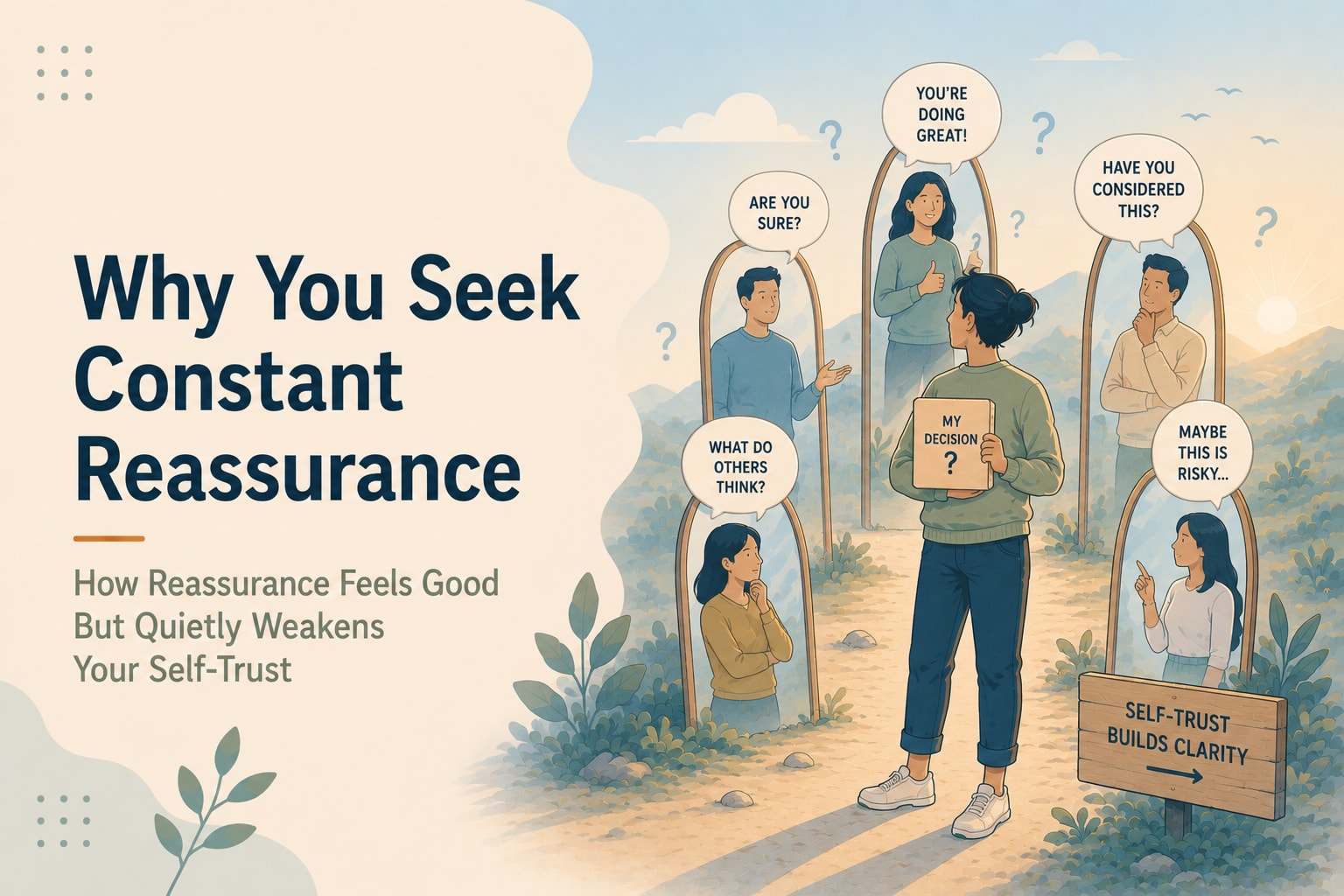
Why You Seek Constant Reassurance
Why you seek constant reassurance often becomes clear only after you notice how quickly the relief disappears.
You ask whether the decision was right.
Someone says yes.
For a moment, the uncertainty settles.
Then another question appears.
Maybe they were only being kind.
Maybe they did not understand the full situation.
Maybe you explained it badly.
Maybe someone else would see a problem they missed.
So you ask again.
Sometimes you ask a different person.
Sometimes you ask the same person in a slightly different way.
Sometimes you return to the question privately, searching messages, memories, facial expressions, or small details for confirmation.
The reassurance helps, but it does not stay.
This is what makes the pattern confusing.
You may believe you simply need a clearer answer.
Yet the real difficulty is often not the absence of an answer.
It is the mind’s growing inability to remain settled once an answer has been given.
Constant reassurance-seeking can appear thoughtful, careful, or emotionally responsible.
Underneath it, the mind is often trying to remove uncertainty completely.
Because complete certainty is rarely available, relief becomes temporary.
The pattern then connects with broader self-sabotage patterns, especially when reassurance becomes part of recurring overthinking loops that weaken self-trust instead of creating clarity.
Free Psychology Guide
Download The Truth Pill Guide to Self-Sabotage Patterns to recognise the quiet mental loops that turn uncertainty into repeated checking, reassurance-seeking, and hesitation.
What This Behavior Actually Is
Seeking reassurance is not always unhealthy.
Sometimes you genuinely need information.
You may ask whether you understood instructions correctly.
You may seek feedback before making an expensive decision.
You may want emotional support during a difficult moment.
The pattern changes when reassurance is no longer being used to gather information.
It is being used to regulate doubt.
You already received an answer.
Nothing meaningful has changed.
No new evidence has appeared.
Yet the original uncertainty returns.
The mind then asks for confirmation again, hoping the second answer will feel more permanent than the first.
This is why constant reassurance can take many forms.
You may ask directly:
"Do you think I made the right choice?"
You may ask indirectly:
"What would you have done?"
You may repeatedly explain the situation, waiting for the other person to reach the conclusion you need.
You may search online for opinions that confirm your decision.
You may reread a message to check whether someone still sounds interested.
You may monitor tone, response times, facial expressions, or small changes in behaviour.
The surface question differs.
The internal request is usually similar:
"Please remove the uncertainty I cannot settle by myself."
The difficulty is that reassurance cannot permanently remove uncertainty.
It can only interrupt it for a short time.
Why the Brain Does This
Reassurance creates relief.
That relief teaches the brain something.
A doubt appears.
The body becomes tense.
The mind feels unsettled.
You ask someone for confirmation.
The discomfort decreases.
Because reassurance reduced the distress, the brain begins treating reassurance as the solution.
The next time doubt appears, the urge to ask becomes stronger.
This is how a temporary coping response becomes a repeated psychological loop.
The brain does not necessarily learn that the original fear was inaccurate.
It learns that uncertainty is difficult to tolerate without outside help.
That lesson quietly weakens self-trust.
Instead of observing that doubt can rise and fall on its own, the person interrupts the process with reassurance.
They never fully discover that uncertainty can remain present without requiring immediate resolution.
Past experiences can deepen this pattern.
If your choices were frequently criticised, you may have learned to search for approval before trusting your judgment.
If affection or safety once felt inconsistent, small changes in another person’s behaviour may now feel significant.
If mistakes were treated harshly, uncertainty may feel like a warning that something must be corrected before it becomes visible.
Fear of failure also adds pressure.
A wrong choice may not feel like an ordinary error.
It may feel like proof that you are careless, incapable, or difficult to trust.
Reassurance then becomes a way of sharing responsibility.
If someone agrees with the decision, the choice feels less exposed.
Where It Appears in Everyday Life
Constant reassurance-seeking often appears in relationships.
You ask whether everything is fine after noticing a slight change in tone.
The person says yes.
Later, the reply feels shorter than usual.
The doubt returns.
You ask whether they are upset.
They reassure you again.
For a moment, you feel calmer.
Then you begin wondering whether they are hiding how they really feel.
The pattern also appears at work.
You complete a task and ask a colleague whether it looks right.
They approve it.
You check once more before submitting.
Then you ask whether the email sounds professional.
After sending it, you wonder whether the message was too direct.
Each question seems small.
Together, they reveal that completion does not feel secure without repeated confirmation.
Decision-making creates another version of the same loop.
You choose a course, accept a job, buy something important, or end a difficult situation.
Then you begin asking people whether they agree.
If one person questions the choice, their doubt may outweigh several supportive opinions.
You return to the decision as though the disagreement proves the matter is still unresolved.
Reassurance-seeking can also remain private.
You search symptoms repeatedly after already receiving an explanation.
You reread old conversations to confirm that someone once cared.
You revisit completed work to make sure no obvious mistake was missed.
You compare your behaviour with online advice, looking for proof that you responded correctly.
In each case, the mind is not simply collecting information.
It is trying to make uncertainty disappear.
The Hidden Cost
The immediate effect of reassurance is relief.
The longer-term effect is often reduced confidence.
Each time someone else is asked to settle your doubt, your own judgment receives less authority.
You may know what you think.
You may have already examined the evidence.
But the conclusion does not feel real until someone confirms it.
This can create dependence on other people’s availability and reactions.
If they respond warmly, you feel settled.
If they seem distracted, uncertain, or less enthusiastic than expected, the doubt becomes stronger.
Your internal stability begins depending on external signals that you cannot fully control.
There is also a relational cost.
The people around you may become responsible for repeatedly proving that everything is fine.
They may answer sincerely, yet feel that their previous answers were not trusted.
The reassurance request may sound like a question about the situation.
Over time, it can feel like a request for another person to manage your uncertainty.
This does not mean the need is manipulative.
Often, it is deeply sincere.
But repeated reassurance can create exhaustion on both sides.
The person seeking it never feels fully settled.
The person giving it may feel unable to provide an answer that lasts.
The pattern also increases indecision.
Before acting, you ask what others think.
After acting, you ask whether the choice was correct.
If the answers conflict, the mind gathers even more opinions.
Eventually, every perspective becomes another possibility to consider.
The reassurance intended to simplify the decision quietly makes it more complicated.
The Pattern Most People Miss
Most people assume they seek reassurance because their doubt is unusually strong.
Often, the doubt becomes stronger because reassurance is repeatedly used to remove it.
The sequence usually looks like this:
Uncertainty appears.
The mind interprets it as a problem.
Reassurance is requested.
Relief follows.
The brain learns that outside confirmation creates safety.
The next doubt feels harder to hold alone.
More reassurance is sought.
Self-trust receives less practice.
The original uncertainty returns more quickly.
The pattern reinforces itself without any dramatic moment.
The person simply becomes less familiar with allowing a question to remain unanswered.
This is closely connected to Why You Trust Others More Than Yourself, where external confidence receives more authority than personal observation.
It also overlaps with Why Doubt Grows the More You Think, because repeated checking generates more interpretations rather than permanent certainty.
The missing piece is often not a better answer.
It is the experience of allowing the discomfort to exist without immediately asking someone else to remove it.
This does not mean ignoring important concerns.
New evidence deserves attention.
Changed circumstances may require a new conversation.
The distinction lies in whether the question is being reopened because something changed or because the answer stopped feeling emotionally convincing.
Frameworks such as The Action Reduces Fear Loop show why lived evidence often creates stronger confidence than repeated verbal reassurance.
You make a reasonable decision.
You observe the outcome.
You adjust if necessary.
Through that process, self-trust develops.
Not because every choice is perfect, but because you see that uncertainty does not prevent you from responding.
Final Reflection
Constant reassurance-seeking often looks like a search for answers.
More quietly, it is a search for a feeling.
You want the decision to feel safe.
You want the relationship to feel secure.
You want the task to feel complete.
You want the future to feel predictable.
Someone offers reassurance, and for a moment, it works.
Then uncertainty returns because the feeling depended on an answer remaining emotionally convincing.
Once doubt begins searching for exceptions, almost any reassurance can be questioned.
They may not know everything.
They may have misunderstood.
They may be trying to protect your feelings.
The loop continues.
The pattern is not proof that you are incapable of making decisions.
It often means you have become used to treating uncertainty as something that must be removed before you can rest.
But certainty is not the same as safety.
Reassurance is not the same as self-trust.
The answer may already be clear enough even when the feeling remains unsettled.
Recognising this does not instantly remove the urge to ask again.
It reveals what the urge is trying to do.
Sometimes you need more information.
Sometimes you need support.
And sometimes the question has already been answered, but the mind is asking another person to make uncertainty disappear.
Why do I need reassurance even after receiving a clear answer?
The answer may reduce your uncertainty temporarily without changing how you respond to doubt itself. Once the relief fades, the mind seeks confirmation again.
Is reassurance-seeking always unhealthy?
No. Asking for support, clarification, or feedback can be useful. It becomes limiting when repeated confirmation is needed despite no meaningful change in the evidence.
Why does reassurance only make me feel better briefly?
Reassurance interrupts discomfort but does not teach the mind that uncertainty can be tolerated. The original doubt therefore returns when the relief wears off.
Can reassurance-seeking affect relationships?
Yes. Repeated requests for confirmation can make another person feel responsible for continually proving that the relationship, decision, or situation is safe.
Why do I keep asking different people the same question?
You may be searching for an answer that feels completely convincing. Different opinions can instead create more possibilities, making the original uncertainty stronger.
Is reassurance-seeking connected to low self-trust?
Often. Repeatedly asking others to settle your doubts can reduce opportunities to make decisions, observe outcomes, and build confidence in your own judgment.
How do I know whether I need information or reassurance?
Ask whether new evidence has appeared. If nothing has changed and you are reopening the same question mainly to feel calmer, you may be seeking reassurance rather than information.
Related Patterns
