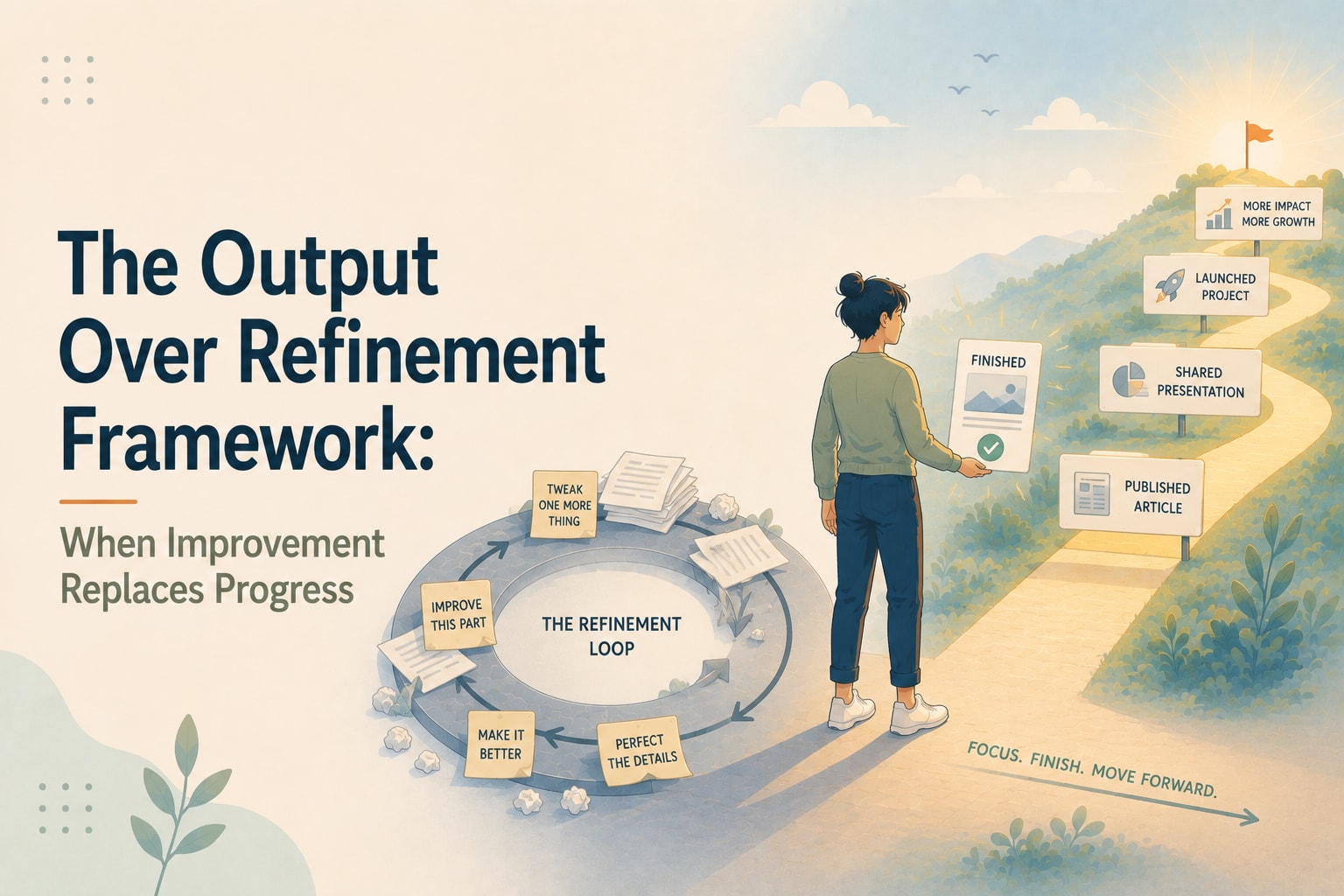
The Output Over Refinement Framework
The Output Over Refinement Framework describes what happens when improving a piece of work begins to replace releasing it.
You start with something useful.
The article communicates its central idea.
The presentation contains the necessary information.
The video says what it was meant to say.
The project is functional enough to enter the real world.
But instead of finishing and moving forward, you remain with it.
You adjust the wording.
Rearrange the structure.
Change the design.
Review details that most people may never notice.
The work becomes more polished, but the amount of work you actually complete begins to shrink.
You might not notice it at first.
Refinement still feels productive because effort is happening.
But if you look closely, the sequence repeats.
One project receives more and more attention while the larger body of work never develops.
That is where the loop begins.
What the Output Over Refinement Framework Describes
The Output Over Refinement Framework separates two forms of progress that can feel almost identical from inside the process.
The first is output progress.
Output progress creates another finished unit.
Another article is published.
Another application is submitted.
Another video is released.
Another decision enters reality.
The second is refinement progress.
Refinement progress improves something that already exists.
It corrects an error, increases clarity, or strengthens presentation.
Both kinds of work can be valuable.
The pattern becomes self-defeating when refinement repeatedly replaces output.
The person remains active, but the amount of completed work does not increase.
One project absorbs the time, attention, and emotional energy that could have produced several useful attempts.
The hidden shift is difficult to detect because the person is not avoiding effort.
They may be working harder than before.
But the effort remains concentrated inside a private space where nothing has to face reality.
This is one of the ways self-sabotage patterns can hide inside dedication.
Effort continues.
Exposure does not.
The Stages of the Output Over Refinement Loop
The framework becomes clearer when the behavior is mapped as a sequence.
Stage 1: A functional output is created
The main work is complete.
The article makes sense.
The presentation includes the important information.
The product performs its essential function.
There are imperfections, but the work can already serve its purpose.
This is the point where someone else could read it, use it, judge it, or respond to it.
Stage 2: A minor weakness gains emotional weight
You notice something that could be improved.
One paragraph feels ordinary.
One design choice appears inconsistent.
One sentence could sound more precise.
The weakness may be real.
But its emotional importance begins to exceed its practical effect.
The mind starts treating one imperfect detail as evidence that the entire output is not ready.
Stage 3: Refinement restores control
You correct the detail.
The work improves.
More importantly, the discomfort around releasing it decreases.
For a moment, you feel prepared again.
That relief quietly teaches the brain that refinement is safer than exposure.
The correction may be useful, but it also delays the point where the work must leave your control.
Stage 4: Attention becomes trained on flaws
After one improvement, another problem becomes visible.
The title feels weak.
The introduction feels too long.
The design could appear more professional.
The work may objectively be better than before, yet your confidence decreases.
This is where overthinking loops often enter the process.
Every review creates another question.
Every correction increases your sensitivity to what could still be corrected.
Stage 5: Output is quietly postponed
You tell yourself you are still finishing.
But the meaning of finishing has changed.
The project no longer needs to be useful.
It now needs to feel complete, polished, and protected from criticism.
Because those conditions are emotional rather than measurable, the finish line keeps moving.
The next article is not started.
The next video is not recorded.
The next application is not sent.
One output continues consuming the space where several outputs could have existed.
Stage 6: Limited output reinforces doubt
Because little work reaches reality, you receive little real feedback.
You cannot see which concerns mattered and which existed mainly in your imagination.
The lack of evidence makes you less certain of your judgment.
You refine more because you trust yourself less.
The sequence becomes self-reinforcing:
Limited output creates uncertainty.
Uncertainty creates more refinement.
More refinement produces even less output.
Why the Mind Repeats This Loop
The mind repeats this pattern because refinement offers control without requiring exposure.
While you are editing, you decide what happens.
You can change the wording.
Remove the weakness.
Delay the release.
Nothing has happened yet that you cannot revise.
Output is different.
Once the work enters reality, other people become part of the process.
They may misunderstand it.
Ignore it.
Criticize it.
Value a section you considered unimportant.
Their response may not match the outcome you imagined.
Refinement becomes attractive because it creates the feeling that enough preparation might control that uncertainty.
But uncertainty does not exist only because the work may contain flaws.
It also exists because people are unpredictable.
No amount of polishing can guarantee attention, approval, or success.
This is why the framework often overlaps with fear of judgment psychology.
The person may appear focused on quality while mentally preparing for an imagined audience.
A small flaw becomes a possible criticism.
Another revision becomes protection.
The brain also learns from temporary relief.
Each time publication is postponed, the tension decreases.
That relief reinforces the decision to keep refining.
The next time the work approaches completion, the same response returns.
Where This Pattern Appears in Daily Life
The Output Over Refinement Framework appears most clearly in work that can be revised repeatedly.
A writer spends two weeks polishing one article while several strong ideas remain unwritten.
A creator repeatedly edits one video instead of publishing consistently enough to learn what the audience responds to.
A job seeker perfects a résumé but submits very few applications.
A business owner keeps redesigning a website while avoiding conversations with real customers.
A student spends hours improving one section of an assignment while leaving other required work unfinished.
Someone rewrites an important message so many times that the final version says less than the original.
The pattern can also appear in personal development.
A person keeps researching the ideal routine, system, or strategy but rarely follows one long enough to produce evidence.
They become highly informed about action while remaining protected from the uncertainty of acting.
The same sequence appears in The Project That Was Always Almost Ready.
The project improves continuously.
Nothing about the effort looks lazy.
Yet every new refinement creates another reason the work should remain private.
The result is not poor-quality output.
It is almost no output at all.
What Keeps the Refinement Loop Going
Several hidden rewards keep the cycle active.
Perfectionism
The goal shifts from creating value to preventing flaws.
As explored in maladaptive perfectionism, the person becomes more concerned with what could be criticized than with what the work could contribute.
Identity protection
One carefully protected project can preserve the belief that you are highly capable.
Multiple released outputs create more evidence.
Some will be strong.
Others will be ordinary.
For someone whose self-worth is tied to performance, that variation can feel threatening.
Finishing ends private control and begins public consequence.
The work can now be accepted, rejected, ignored, or misunderstood.
This is why completion resistance often appears after the main work is already done.
The illusion of productivity
Refinement creates visible activity.
Hours are spent.
Changes are made.
Because effort is measurable, it can be difficult to admit that the larger goal has stopped moving.
Lack of real feedback
Unreleased work cannot show you how reality will respond.
Without that information, imagined weaknesses remain powerful.
The mind continues polishing against possibilities that may never occur.
Final Reflection
The Output Over Refinement Framework is not an argument against quality.
Refinement has a purpose.
It can improve clarity, usefulness, and trust.
The pattern begins when refinement no longer serves the output and starts replacing it.
The sequence looks like this:
Functional work.
A visible imperfection.
Additional refinement.
Temporary relief.
Another perceived weakness.
Delayed release.
Limited real feedback.
More uncertainty.
More refinement.
The work becomes better in private while progress becomes smaller in public.
That is the hidden trade.
The revealing question is not whether another improvement is possible.
Another improvement is almost always possible.
The more useful question is:
Is this refinement increasing the value of the output, or helping the mind avoid producing one?
The difference may be difficult to feel while you are inside the process.
Both can look like care.
Both can look like discipline.
But only one keeps moving the work into reality.
Once that distinction becomes visible, endless polishing stops looking like a mysterious commitment to quality.
It becomes a recognizable loop.
Related Patterns
If this loop feels familiar, it often connects to other patterns.
- The Done vs Perfect Scale maps the point where useful improvement becomes an impossible demand for flawlessness.
- The 80% Completion Rule explains why progress often slows after the work has already reached functional completion.
- Completion Resistance Definition explores why finishing can feel more threatening than continuing to prepare.
- The Project That Was Always Almost Ready shows how continuous improvement can quietly prevent meaningful output.
- The Complete Guide to Self-Sabotage Patterns connects this framework to the wider system of behaviors that preserve effort while interrupting progress.
