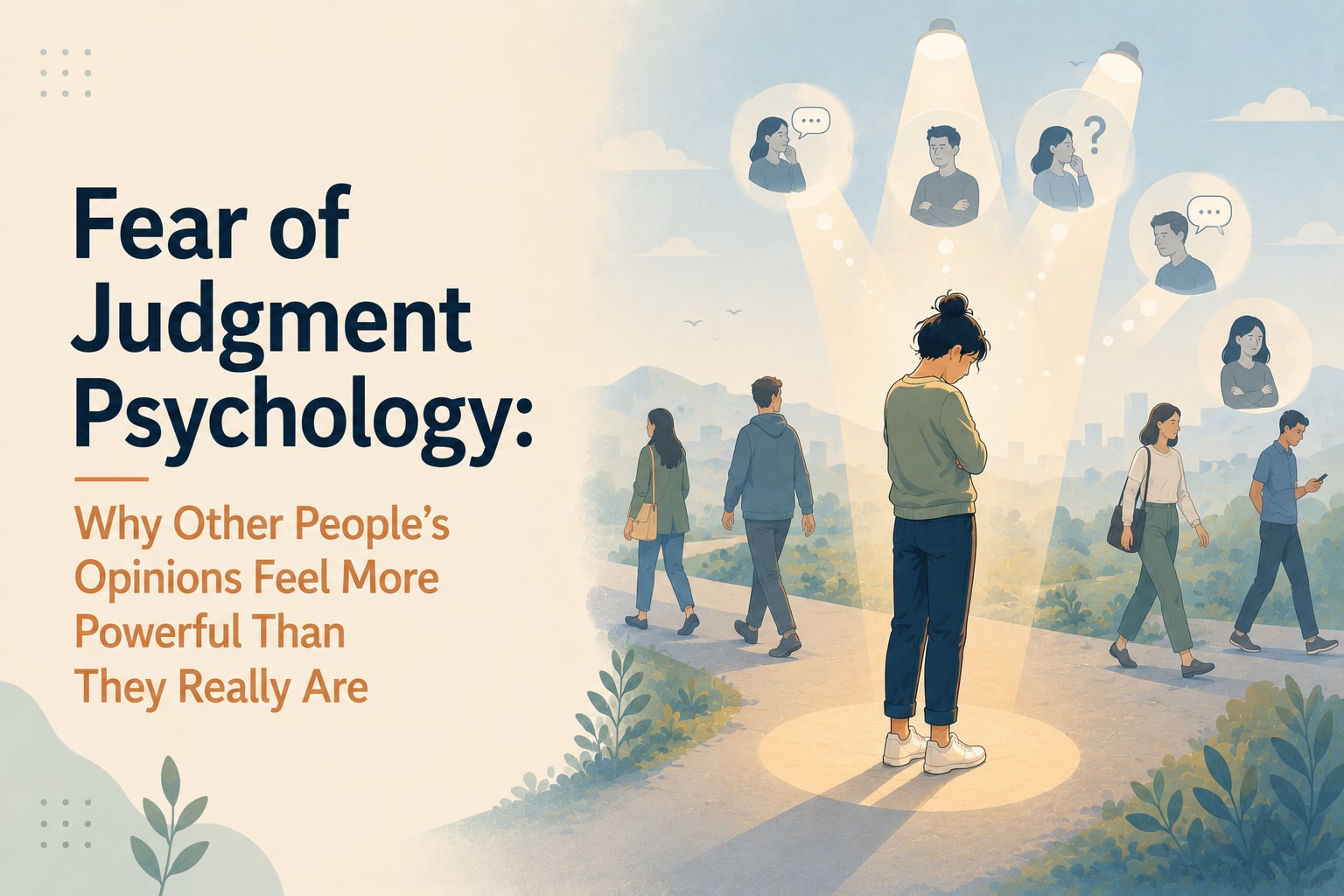
Fear of Judgment Psychology
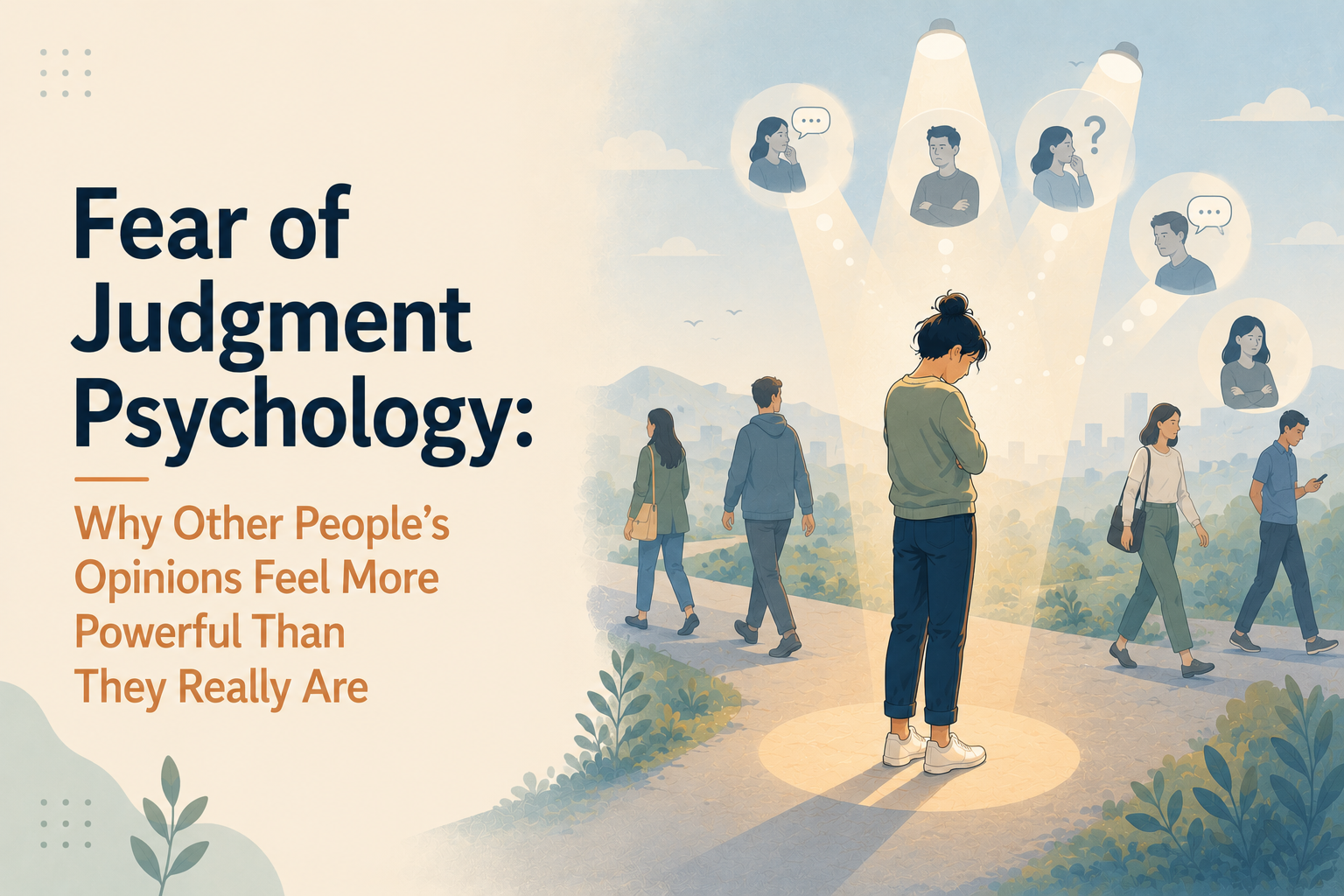
Fear of judgment psychology begins long before anyone actually judges you.
It begins in your imagination.
You hesitate before speaking.
You reread a message several times before sending it.
You replay a conversation after you leave.
You wonder whether people noticed something awkward that happened hours ago.
The interesting part is that none of this requires another person to say anything.
Your mind creates the audience all by itself.
You might not notice it at first.
It feels like caution.
Like maturity.
Like being socially aware.
But if you look closely, something interesting appears.
Much of your energy is not being spent on the conversation itself.
It is being spent imagining what everyone else might be thinking about you.
That is where the pattern begins.
The Behavior Most People Don't Notice
Fear of judgment rarely looks dramatic.
Most of the time, it hides inside completely ordinary behavior.
You stay quiet even though you have something meaningful to contribute.
You avoid asking a question because it might sound obvious.
You delay posting your work because someone might criticize it.
You wear something different from what you originally wanted because it feels safer.
You choose the opinion that attracts the least attention.
From the outside, these choices seem small.
Inside, they often share the same question.
"What will people think of me?"
The surprising part is that this question quietly becomes more important than the decision itself.
Instead of asking whether something reflects your values, you begin asking whether it will be accepted.
This is one of the quieter forms of self-sabotage patterns.
Nothing physically stops you.
The imagined reaction of other people becomes enough.
Why the Brain Does This
Human beings have always depended on belonging.
For most of history, being rejected by your group carried real consequences.
Safety often depended on acceptance.
Your brain still carries traces of that history.
It naturally pays attention to signs of approval and disapproval.
That instinct is useful.
It helps us cooperate.
Build relationships.
Understand social situations.
But the modern mind sometimes treats ordinary evaluation as though it carries the same emotional weight as exclusion.
A stranger's opinion begins to feel deeply significant.
A small criticism feels permanent.
An awkward moment feels unforgettable.
The brain quietly exaggerates how much other people are paying attention.
It assumes they are observing you as closely as you observe yourself.
That assumption creates an endless stream of imagined evaluations.
You picture their reactions.
Their facial expressions.
Their hidden opinions.
Soon, your mind is responding to thoughts rather than reality.
That process easily grows into overthinking loops.
You replay conversations.
Rewrite messages.
Mentally prepare explanations that nobody ever asks for.
The brain believes enough preparation can prevent judgment.
Life rarely offers that guarantee.
Where This Pattern Shows Up in Daily Life
Fear of judgment appears in places most people overlook.
You spend twenty minutes writing a short email.
You delete a social media post that already looked fine.
You avoid introducing yourself first.
You postpone launching a business because it still needs one more improvement.
You hesitate to raise your hand during a meeting.
You keep your creative ideas private.
You apologize for things that needed no apology.
You replay yesterday's conversation while walking to work.
Notice something interesting.
The situations are different.
The emotional question remains the same.
"Will people think less of me?"
Sometimes that question becomes so familiar that you no longer recognize it.
It simply feels like careful thinking.
But if you look closely, your decisions gradually become shaped by imagined reactions rather than genuine priorities.
You stop asking,
"What do I believe?"
And start asking,
"What will receive the least criticism?"
The shift is subtle.
Yet it quietly changes how you move through life.
The Hidden Effect of This Pattern
The obvious cost of fearing judgment is hesitation.
The hidden cost is something much deeper.
You slowly become disconnected from your own judgment.
When other people's imagined opinions become your primary reference point, your own preferences begin to feel less trustworthy.
You start waiting for external permission.
External approval.
External reassurance.
Over time, confidence becomes increasingly dependent on how you think others might respond.
Ironically, the fear of judgment often creates the very attention you hoped to avoid.
Not because people are watching you more closely.
But because your own awareness becomes permanently focused on yourself.
You monitor every word.
Every expression.
Every mistake.
Every silence.
That constant self-monitoring makes ordinary social situations feel emotionally exhausting.
You leave conversations feeling drained, not because anything bad happened, but because your mind never stopped evaluating itself.
Real connection becomes difficult when so much attention is directed inward.
What This Reveals About Human Behavior
Fear of judgment psychology reveals that the human mind often confuses possibility with probability.
It asks,
"Someone could judge me."
Then quietly transforms that into,
"Someone probably is judging me."
Eventually, it feels like,
"Everyone is judging me."
The evidence rarely changes.
Only the feeling does.
But if you look closely, something interesting appears.
Most people are doing exactly what you are doing.
Thinking about themselves.
Wondering how they are being perceived.
Replaying their own conversations.
Questioning their own choices.
The spotlight you imagine shining on you is usually much smaller than it feels.
Other people have their own imagined spotlight to manage.
This is one of the quiet ironies of human behavior.
Everyone believes they are being watched.
Meanwhile, most people are busy wondering whether they are being watched too.
Recognizing this does not eliminate the fear overnight.
It simply places it back into perspective.
Final Reflection
Fear of judgment psychology is not really about other people.
It is about the stories your mind creates before other people have the chance to think anything at all.
The brain believes it is protecting you.
It imagines criticism so you can avoid it.
It predicts rejection so you can prevent it.
Sometimes that instinct is useful.
Often, it quietly becomes a prison built from possibilities rather than reality.
The next time you hesitate before speaking, sharing, or trying something meaningful, pause for a moment.
Ask yourself:
Am I responding to something that has actually happened... or to something my mind is predicting?
Those are very different experiences.
One deserves your attention.
The other deserves your curiosity.
Because the opinions that shape your life most powerfully are not always the ones spoken aloud.
Sometimes they are the ones your own mind invents in complete silence.
Q: What is fear of judgment psychology?
A: Fear of judgment psychology describes the tendency to overestimate how much other people notice, evaluate, or criticize us. This can lead to hesitation, overthinking, and avoiding situations where we might be evaluated.
Q: Why do I care so much about what other people think?
A: The human brain evolved to value social acceptance because belonging once played an important role in survival. Today, that instinct can sometimes make ordinary opinions feel far more significant than they really are.
Q: Is fear of judgment connected to overthinking?
A: Yes. Fear of judgment often fuels overthinking loops by encouraging the mind to replay conversations, imagine criticism, and prepare for reactions that may never happen.
Q: Can fear of judgment become self-sabotage?
A: It can. When imagined criticism repeatedly stops you from speaking up, sharing your work, or taking opportunities, it becomes part of broader self-sabotage patterns, where the fear of evaluation quietly limits growth.
