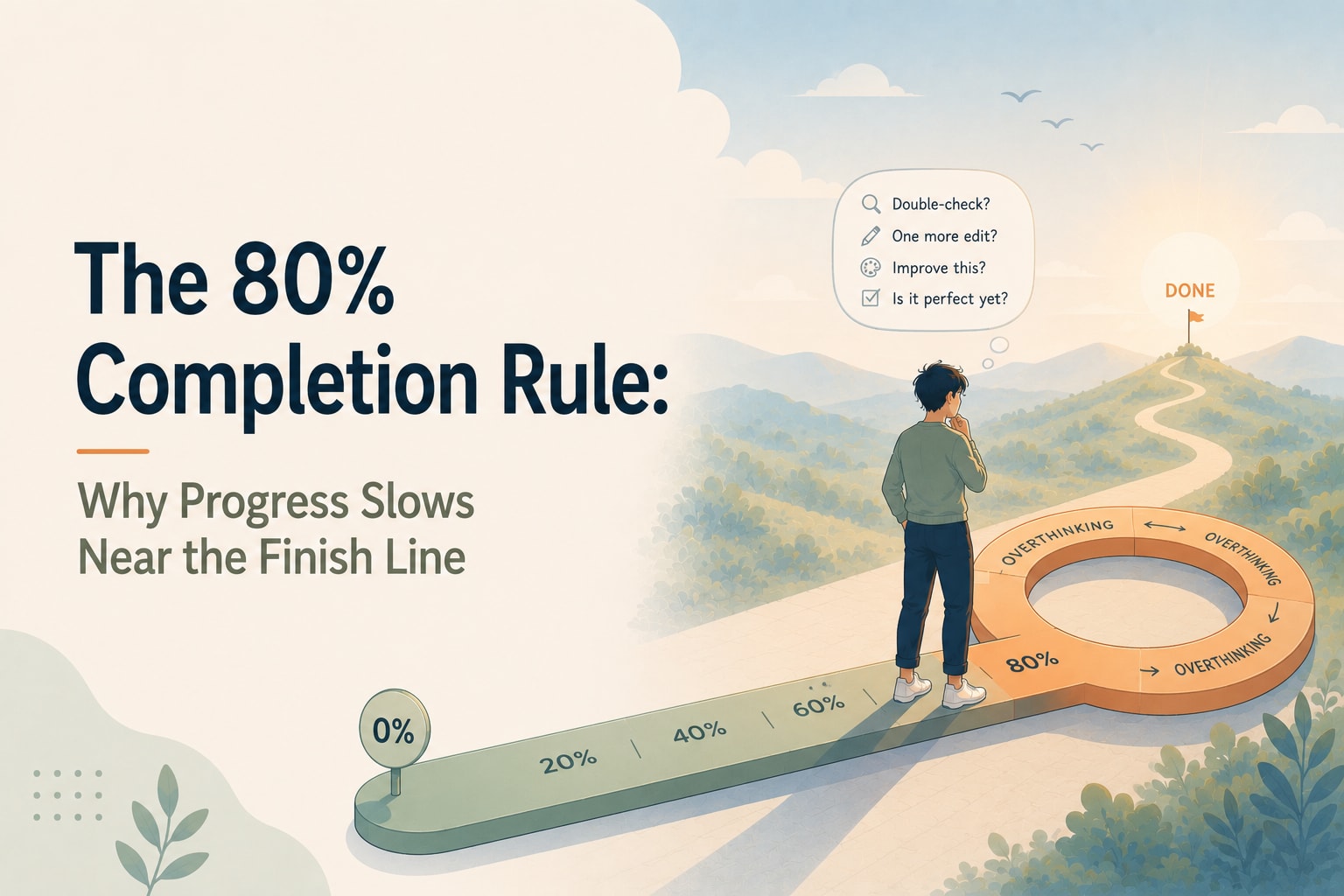
The 80% Completion Rule
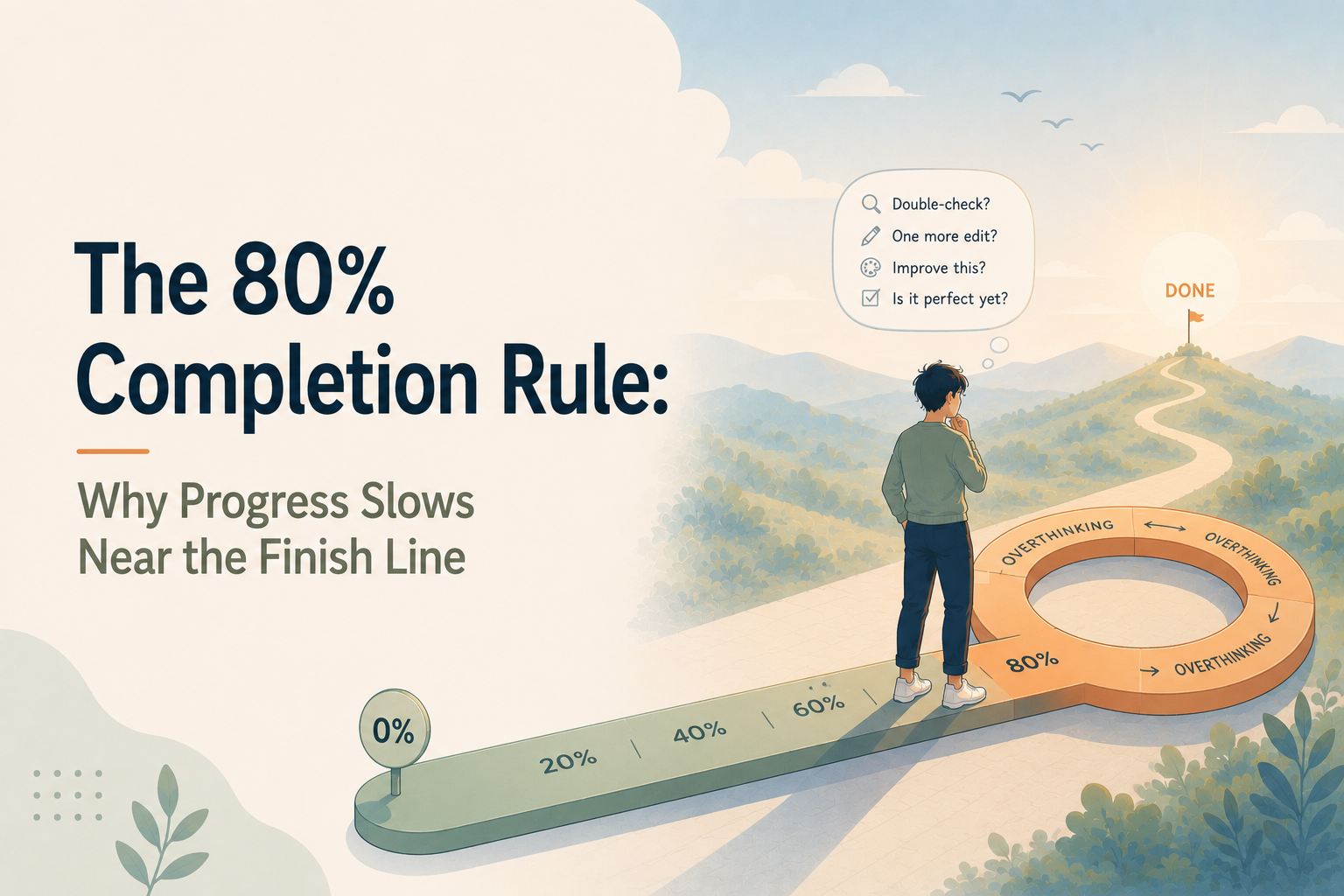
The 80% Completion Rule describes a pattern you may already know.
You begin a project with energy.
The early progress feels clear.
A blank page becomes an outline.
An idea becomes a plan.
A rough concept becomes something visible.
Then you reach the final stretch.
Most of the work is done.
The main decisions have already been made.
Only a few details remain.
Yet the project suddenly feels heavier.
You slow down.
You begin questioning choices that seemed reasonable before.
You notice flaws that were invisible during the earlier stages.
The remaining 20% starts taking as much time as the first 80%.
You might not notice it at first.
It feels like care.
It feels like responsibility.
But if you look closely, the sequence repeats.
That is where the loop begins.
What the 80% Completion Rule Describes
The 80% Completion Rule is not a precise mathematical law.
It is a framework for recognizing the point where a project changes psychologically.
During the early stages, you are building possibility.
During the final stage, you are preparing to release something specific.
That shift matters.
At the beginning, the project can still become many things.
There is room to experiment.
Mistakes feel temporary because everything is still in progress.
Near completion, the work has an identity.
It has become a particular article, business, application, design, decision, or conversation.
Finishing means accepting what it has become.
It also means allowing reality to respond.
People may value it.
Ignore it.
Question it.
Misunderstand it.
The remaining work may be smaller in practical terms, but larger in emotional terms.
That is why progress often slows near the finish line.
The difficulty is no longer just completing the task.
The difficulty is crossing from private possibility into visible reality.
This is one of the quieter ways self-sabotage patterns operate.
You do not abandon the goal.
You remain busy around it.
The Stages of the 80% Completion Loop
The pattern becomes easier to recognize when you see it as a sequence.
Stage 1: The beginning creates momentum
Early progress is rewarding because the change is obvious.
A blank document fills with words.
An empty workspace becomes organized.
A vague idea gains structure.
The brain can see movement, so effort feels meaningful.
There is also little pressure to be exact.
You are still exploring.
Stage 2: The project becomes specific
As the work develops, possibilities begin closing.
The article must take one direction.
The business must launch with certain features rather than every possible feature.
The decision must exclude other options.
This narrowing can feel uncomfortable.
The imagined project could be perfect.
The real project must become specific.
Stage 3: The work reaches functional completion
At roughly 80%, the core purpose has been achieved.
The article communicates its main point.
The presentation contains the necessary information.
The application is complete enough to submit.
The product performs its main function.
What remains may matter, but it is no longer the heart of the work.
This is where practical readiness and emotional readiness often separate.
The work may be ready.
You may not feel ready.
Stage 4: Small imperfections become unusually visible
A minor weakness catches your attention.
One sentence feels awkward.
One image looks slightly wrong.
One feature could be improved.
One answer could sound more impressive.
The detail may deserve attention.
But its emotional importance begins to exceed its practical importance.
The mind starts treating one imperfection as evidence that the entire project is unfinished.
Stage 5: Refinement creates temporary relief
You fix the issue.
For a moment, the discomfort decreases.
The work feels safer.
You feel more prepared.
That relief teaches the brain something important:
More revision reduces the tension associated with completion.
The edit may improve the work.
It also rewards the delay.
Stage 6: Attention searches for another problem
Once one detail is corrected, another appears.
A finished section is reopened.
A settled decision becomes uncertain again.
A new possible criticism enters your mind.
This is where overthinking loops often take control.
Each answer produces another question.
Each correction reveals another possible correction.
Stage 7: The final 20% expands
The original list of remaining tasks grows.
New improvements are added.
The finish line moves.
The project is still almost ready, but “almost” no longer has a clear endpoint.
The final 20% becomes a psychological space rather than an actual amount of work.
A project can remain there for days, months, or years.
Why the Mind Repeats This Loop
The mind repeats the 80% Completion Rule because unfinished work protects possibility.
As long as something remains incomplete, its potential remains untouched.
It has not fully succeeded.
It has not failed.
It has not been judged.
You can still imagine that the final version will be exceptional.
Completion changes that.
A finished project becomes real enough to evaluate.
Reality may reveal that the work is useful but imperfect.
Strong but ordinary.
Valuable in ways you did not predict.
For someone whose identity is closely attached to performance, that can feel threatening.
The mind responds by extending preparation.
This extension often looks responsible.
That is why it is difficult to recognize as avoidance.
The loop also overlaps with fear of judgment psychology.
Near completion, the mind begins imagining the audience.
A small imperfection becomes a future criticism.
A minor weakness becomes evidence that someone may think less of you.
The project is no longer simply a project.
It becomes a reflection of your competence, intelligence, or worth.
At that point, continuing to refine it feels safer than releasing it.
Where This Pattern Appears in Daily Life
The 80% Completion Rule appears wherever the final step makes private effort visible.
A writer completes the main article but spends several days rewriting the introduction.
A content creator records and edits a useful video but never publishes it because one sentence sounded awkward.
A job seeker prepares a strong résumé, then delays sending applications while making tiny changes.
A business owner builds a functional website but keeps adjusting fonts, colors, and page layouts instead of launching.
A student finishes an assignment but spends the final evening correcting details that will barely affect the result.
Someone writes an honest message, then edits it until the original meaning becomes less clear.
The pattern also appears in decisions.
You gather enough information to choose.
Then you continue researching.
Not because the new information is necessary, but because choosing closes the other possibilities.
What looks like careful analysis becomes a way of postponing commitment.
You can see the same sequence in The Project That Was Always Almost Ready.
The person is not inactive.
They work consistently.
The project improves.
Yet every improvement creates a new condition for completion.
Nothing is clearly abandoned.
Still, nothing is released.
That is what makes the loop difficult to see.
It hides inside effort.
What Keeps the Loop Going
Several psychological rewards quietly reinforce the 80% Completion Rule.
Temporary relief
Every additional revision postpones exposure.
The tension around finishing decreases briefly.
Because relief follows refinement, the brain learns to repeat the behavior.
Perfectionism
The standard changes from useful to difficult to criticize.
The project originally needed to work.
Later, it must appear flawless.
This is the pattern behind maladaptive perfectionism, where removing every weakness becomes more important than releasing something valuable.
Self-doubt
Each reopened decision weakens trust in the earlier decision.
You check again because you feel uncertain.
Then you become more uncertain because you keep checking.
The loop begins reinforcing itself.
Identity protection
An unfinished project protects the image of what you might be capable of.
A completed project provides evidence.
That evidence may be positive, but it will also be specific.
The work may be good rather than extraordinary.
For a mind that equates performance with identity, that can feel difficult to accept.
Completion resistance
Finishing does not simply end the task.
It begins the next stage.
The application can now be rejected.
The article can now be ignored.
The business must now operate in the real world.
This is why completion resistance often appears near the final step rather than the beginning.
The brain is not resisting the remaining work.
It is resisting what the finished work makes possible.
Final Reflection
The 80% Completion Rule explains why the last part of a project can feel heavier than everything that came before it.
The difficulty is not always in the remaining tasks.
Sometimes it is in what finishing represents.
Completion means the project can no longer remain ideal inside your imagination.
It must become real.
Specific.
Visible.
Imperfect.
The mind may respond by creating more work.
One more revision.
One more review.
One more concern that suddenly feels essential.
But if you look closely, the sequence repeats:
Momentum.
Functional completion.
Heightened attention to flaws.
Temporary relief through refinement.
A moving finish line.
Delay.
The important distinction is not between careless work and careful work.
It is between work that still needs improvement and work that is being used to postpone reality.
Once you can see that difference, the final 20% stops looking like a mysterious loss of discipline.
It begins to look like a recognizable loop.
Related Patterns
If this loop feels familiar, it often connects to other patterns.
- The “Done vs Perfect” Scale maps the point where useful improvement turns into endless refinement.
- Completion Resistance Definition explains why the final stage of a project can feel more emotionally difficult than the beginning.
- Why You Struggle to Finish Things explores the fears, identity concerns, and hidden meanings attached to unfinished goals.
- The Project That Was Always Almost Ready shows how repeated refinement can keep useful work permanently close to completion.
- The Complete Guide to Self-Sabotage Patterns connects this framework to the wider system of behaviors that quietly interrupt progress.
