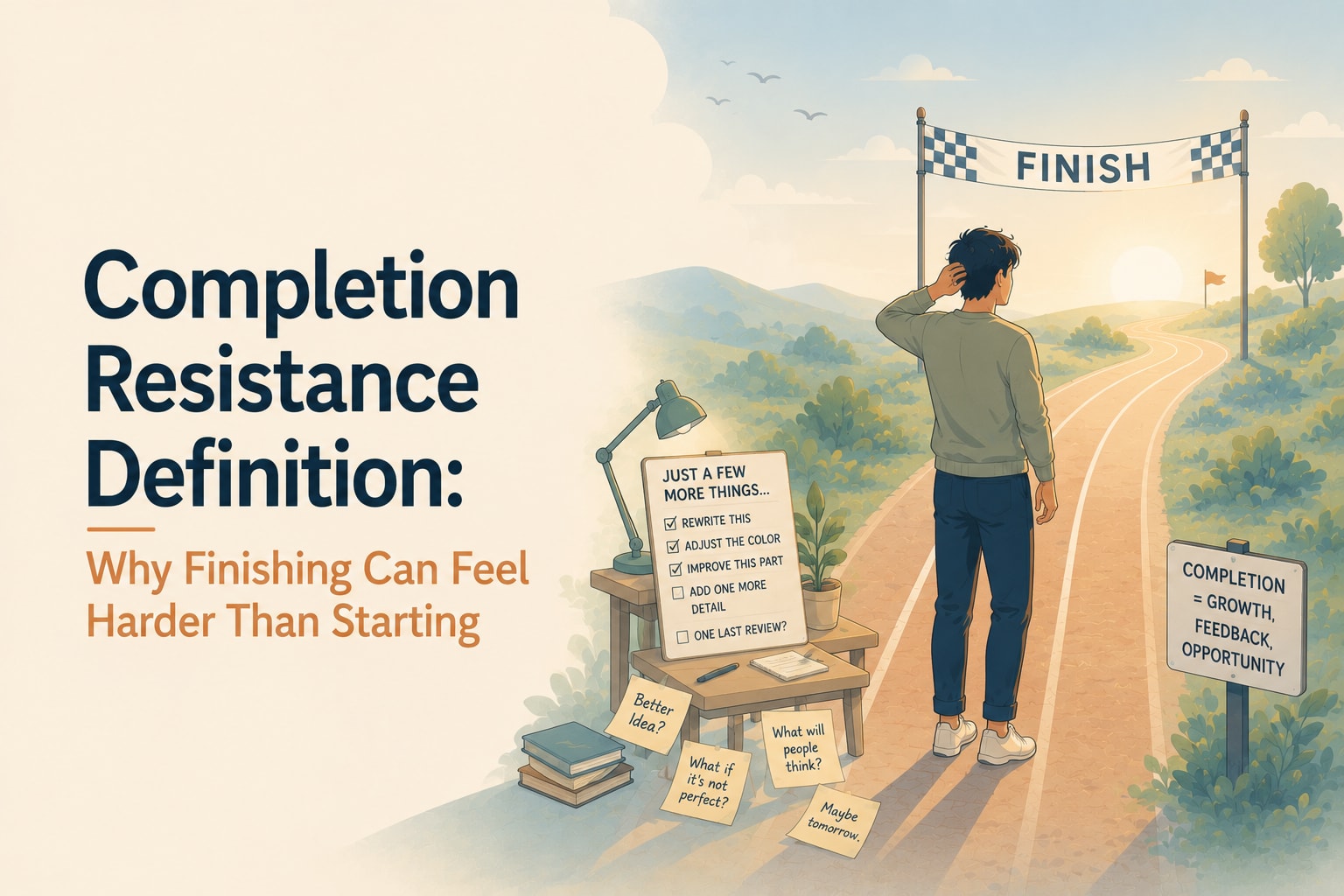
Completion Resistance Definition
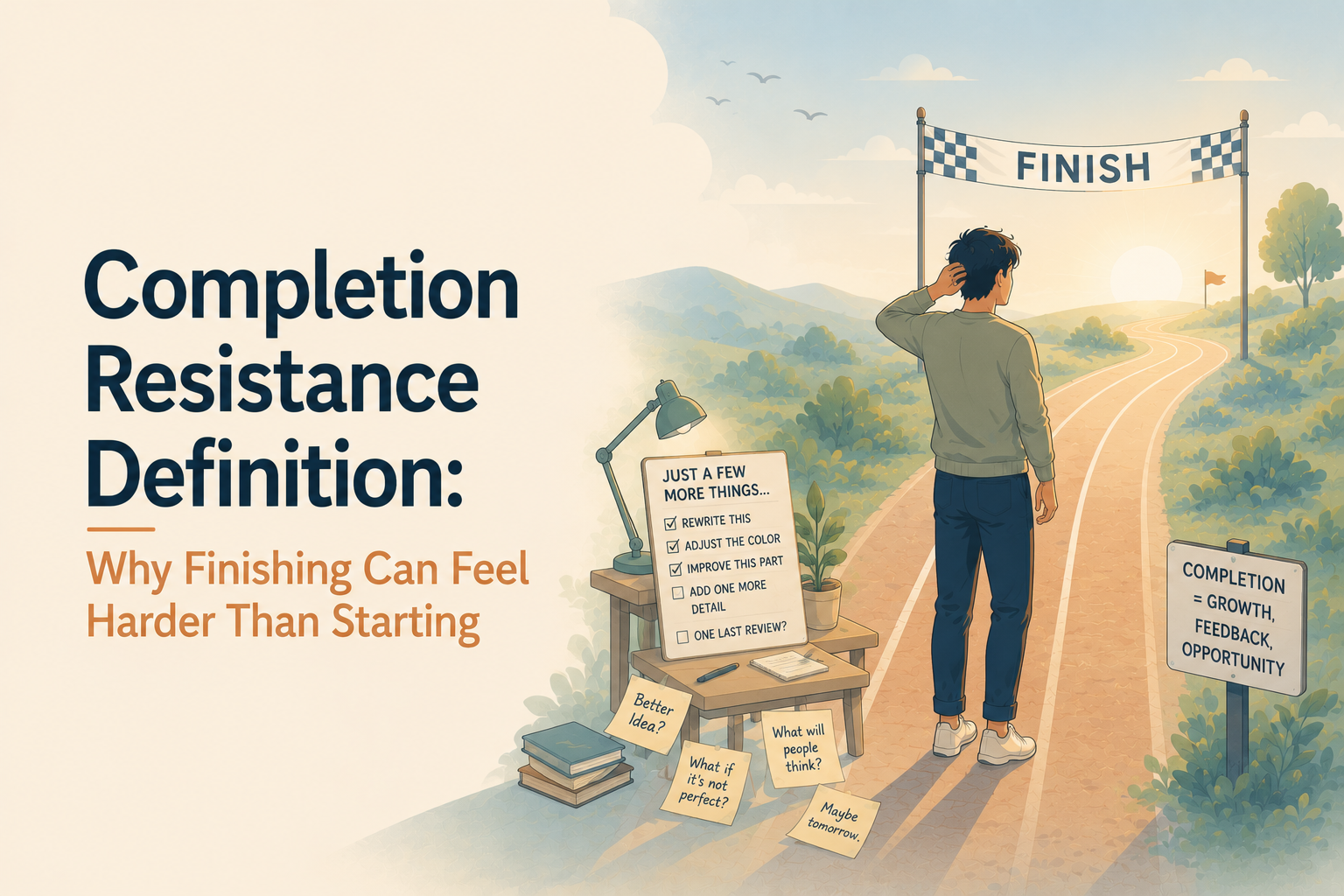
Completion resistance definition begins with a strange experience that many people mistake for procrastination.
You work on a project for weeks.
You are almost done.
Only a few small tasks remain.
Yet instead of finishing, you suddenly become interested in something else.
You reorganize your workspace.
You find another improvement.
You decide to do "just one more review."
Days pass.
The project remains almost complete.
You might not notice it at first.
It doesn't feel like avoiding the work.
It feels like making sure everything is ready.
But if you look closely, something interesting appears.
The closer you get to finishing, the harder finishing becomes.
That is where the pattern begins.
The Behavior Most People Don't Notice
Completion resistance is the quiet tendency to delay finishing something, even after most of the difficult work has already been done.
The resistance rarely appears at the beginning.
In fact, many people with completion resistance enjoy starting.
They enjoy planning.
Learning.
Building momentum.
The difficulty arrives near the end.
Suddenly, small details feel unusually important.
One more revision.
One more adjustment.
One more improvement.
From the outside, it looks like dedication.
Inside, something different is happening.
Finishing means releasing your work into the world.
Once it is complete, people can respond to it.
They can ignore it.
They can praise it.
They can criticize it.
While the project remains unfinished, none of those things can happen.
That is why completion resistance often becomes part of larger self-sabotage patterns.
The unfinished project quietly feels safer than the finished one.
Why the Brain Does This
The brain is not only trying to help you succeed.
It is also trying to protect you from emotional discomfort.
Completion creates uncertainty.
Before something is finished, the future still feels flexible.
After it is finished, reality begins.
A book can receive reviews.
A business can succeed—or fail.
An application can be accepted—or rejected.
A conversation can change a relationship.
Finishing transforms imagination into reality.
That transition feels emotionally significant.
The brain notices this.
It quietly begins looking for reasons to delay the moment.
"Maybe it could be slightly better."
"Maybe I should check it one more time."
"Maybe next week would be a better time."
Each thought reduces discomfort for a moment.
The project stays unfinished.
Which means the outcome stays unknown.
That temporary relief teaches the brain to repeat the pattern.
Over time, the resistance becomes automatic.
Instead of moving toward completion, the mind starts creating more reasons to postpone it.
This often develops alongside overthinking loops, where thinking continues long after it has stopped producing meaningful improvements.
Where This Pattern Shows Up in Daily Life
Completion resistance rarely announces itself.
It blends into ordinary routines.
A writer finishes an article but spends three more days changing words that readers would never notice.
A designer keeps adjusting colors after the design already communicates its purpose.
A student completes an assignment but waits until the final minutes before submitting it.
An entrepreneur spends months preparing to launch a business that is already functional.
A job seeker rewrites a résumé dozens of times instead of sending applications.
Someone records the final version of a video but never presses publish.
Notice something interesting.
The work itself is often complete.
What remains is emotional readiness.
The mind quietly believes that one more improvement will finally make finishing feel comfortable.
It rarely does.
Instead, every improvement creates another possibility to examine.
The finish line moves a little farther away.
You may tell yourself that you are simply being careful.
Sometimes that is true.
But carefulness has a destination.
Completion resistance often does not.
The Hidden Effect of This Pattern
The obvious consequence of completion resistance is unfinished work.
The hidden consequence is something much deeper.
You slowly stop trusting your ability to finish.
Each incomplete project becomes evidence that you are someone who almost completes things.
Over time, that story begins shaping your identity.
You become enthusiastic about beginnings but uncertain about endings.
Another hidden effect is invisible opportunity loss.
People cannot respond to work that remains private.
Employers cannot hire you for applications that are never submitted.
Readers cannot benefit from articles that are never published.
Ideas cannot improve through feedback if they never leave your desk.
Completion resistance quietly steals experiences before they have a chance to happen.
You might not notice it at first.
Because you are still working.
Still thinking.
Still refining.
The effort feels productive.
Yet nothing crosses the line into reality.
The project exists only in potential.
What This Reveals About Human Behavior
Completion resistance reveals that human beings do not only fear failure.
Sometimes we fear completion itself.
Completion removes possibility.
An unfinished project can still become anything.
A finished project becomes something specific.
That can feel surprisingly vulnerable.
Once your work is visible, it no longer belongs entirely to your imagination.
Reality becomes involved.
Feedback becomes possible.
Growth becomes unavoidable.
But if you look closely, something interesting appears.
Everything meaningful in life reaches this point.
Relationships become real after difficult conversations.
Businesses become real after launching.
Books become real after publishing.
Dreams become real after action replaces preparation.
The moment of completion is not the end of the journey.
It is the beginning of a new one.
The mind often treats completion as the final test.
Life treats it as the first lesson.
Final Reflection
Completion resistance definition is ultimately the story of a mind trying to postpone uncertainty.
It tells you that one more improvement will finally make you ready.
One more revision.
One more week.
One more adjustment.
Sometimes those improvements matter.
Often, they simply delay the moment when reality can begin teaching you what preparation never could.
The next time you notice yourself endlessly polishing something that is already functional, pause for a moment.
Ask yourself:
Am I improving this because it truly needs more work... or because finishing feels emotionally uncomfortable?
That question rarely has a loud answer.
It usually arrives quietly.
Because completion resistance is not really about unfinished projects.
It is about the moment your work becomes real.
And more often than not, that moment is exactly where growth has been waiting all along.
Q: What is completion resistance?
A: Completion resistance is the tendency to delay finishing work even when most of it is already complete. It often happens because finishing introduces uncertainty, feedback, and emotional vulnerability.
Q: Is completion resistance the same as procrastination?
A: Not exactly. Procrastination often delays starting a task, while completion resistance usually appears near the end, when the remaining work is small but emotionally significant.
Q: Why do I keep editing instead of finishing?
A: Many people continue editing because the brain believes more refinement will reduce the risk of criticism or failure. In reality, the extra revisions often postpone completion rather than meaningfully improve the work.
Q: How is completion resistance connected to overthinking?
A: Completion resistance frequently develops alongside overthinking loops, where repeated analysis creates the feeling of progress while delaying the moment the work is finally released.
