import Image from "next/image";
export const metadata = { title: "Why “Almost Ready” Never Ends: The Psychology of Endless Preparation", description: "Why almost ready never ends reveals how fear, perfectionism, and overthinking keep moving the point where action finally feels safe.", };
export const slug = "why-almost-ready-never-ends";
export const tags = [ "why almost ready never ends", "endless preparation", "readiness psychology", "overthinking loops", "perfectionism patterns", "self sabotage patterns", "fear of failure", "procrastination psychology" ];
Why “Almost Ready” Never Ends
It Becomes easier to understand when you notice how often readiness moves.
You decide to begin after one more adjustment.
One more week of preparation.
One more piece of information.
One more moment of confidence.
You get closer.
But instead of starting, your mind notices something else that needs attention.
The plan could be clearer.
Your skills could be stronger.
The timing could be better.
You are no longer completely unprepared.
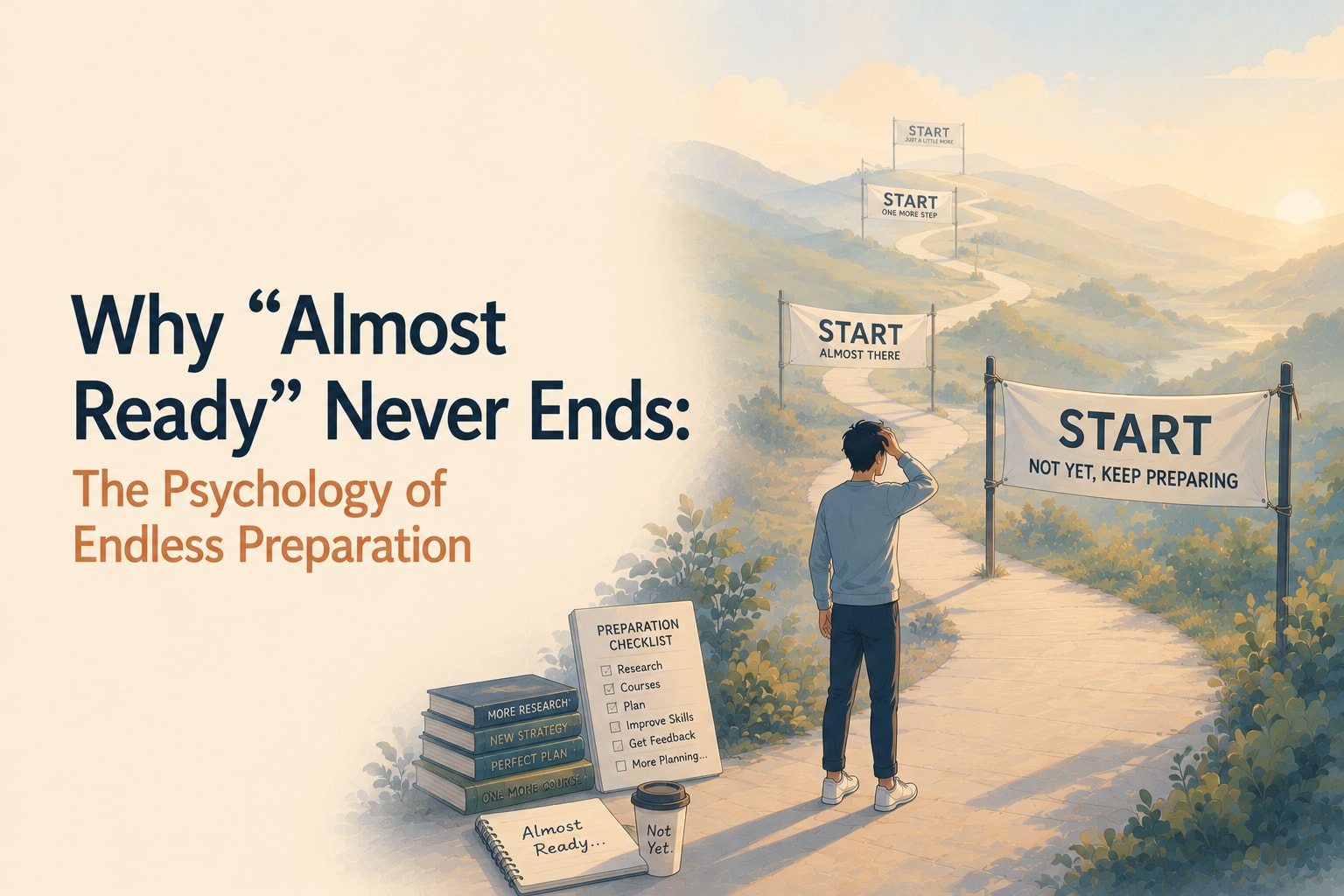
You are almost ready.
And strangely, you may remain almost ready for months.
You might not notice it at first.
But if you look closely, something interesting appears.
“Almost ready” is not always the stage before action.
Sometimes it is the place your mind uses to avoid action without admitting that it is afraid.
What This Concept Means
“Almost ready” describes a psychological pattern where you have enough information or ability to begin, but continue delaying because readiness does not yet feel complete.
The important distinction is between practical readiness and emotional readiness.
Practical readiness asks:
"Do I have enough information to take the next step?"
Emotional readiness asks:
"Do I feel completely confident, certain, and safe?"
Those questions produce very different answers.
You may be practically ready while still feeling uncertain.
But when the mind treats uncertainty as proof that more preparation is needed, the starting point keeps moving.
The standard is no longer based on what the task requires.
It is based on how comfortable you feel.
And comfort has no clear finishing line.
This is why “almost ready” often appears inside larger self-sabotage patterns.
The goal is not rejected.
It is kept close enough to preserve hope, but far enough away to avoid exposure.
Why the Brain Creates This Pattern
The brain prefers preparation because preparation is controlled.
You can research privately.
Plan privately.
Edit privately.
Nothing has to be judged yet.
Action is different.
Action creates feedback.
Once the application is submitted, someone can reject it.
Once the work is published, someone can criticize it.
Once the conversation begins, the response cannot be controlled.
Preparation protects possibility.
Action tests it.
That difference makes action feel emotionally heavier than planning.
Several psychological patterns often sit underneath the feeling of being almost ready.
Fear of failure makes waiting seem safer than testing.
Perfectionism convinces you that one more improvement will finally make the work good enough.
Self-doubt questions whether you can handle what happens after you begin.
And overthinking repeatedly reopens decisions that were already made.
This creates overthinking loops, where thought continues without producing new clarity.
The brain is not trying to sabotage you.
It is trying to protect you from uncertainty.
Unfortunately, that protection often becomes delay.
How This Pattern Appears in Daily Life
The “almost ready” pattern appears everywhere.
You keep editing your résumé but never apply.
You spend months planning a business without launching it.
You save dozens of content drafts but never publish them.
You rehearse an important conversation without having it.
You keep learning instead of practising.
You wait until you feel confident before offering skills you already possess.
Different situations.
The same pattern.
It usually follows this sequence:
Interest → Preparation → Near Readiness → New Requirement → More Preparation
Notice what is missing.
Action.
The project keeps improving inside your imagination but never enters reality.
The business never finds customers.
The writing never finds readers.
The application never reaches an employer.
Preparation feels productive.
But progress only happens after exposure.
Why People Often Miss It
The reason this pattern hides so well is because preparation looks almost identical to progress.
Both require effort.
Both produce visible work.
Both create the feeling of productivity.
The difference is subtle.
Progress changes reality.
Preparation changes your plan.
Another reason people miss the pattern is that every delay sounds reasonable.
One more revision.
One more course.
One more week.
One more improvement.
Each decision seems harmless on its own.
Viewed together, they become a psychological loop.
Preparation reduces discomfort.
Delay increases pressure.
Pressure creates more preparation.
The loop quietly feeds itself.
Over time, something else changes.
Your trust in yourself.
Each postponed beginning teaches the brain that intention does not necessarily lead to action.
Eventually the task feels larger than it really is.
Not because it changed.
Because your imagination has had months to expand it.
Final Reflection
“Almost ready” sounds temporary.
It suggests action is close.
But without a clear boundary, it can quietly become permanent.
The next improvement always feels necessary.
The next week always seems better.
The next version always promises greater confidence.
But confidence rarely arrives before action.
More often, it arrives because of action.
That is the quiet insight behind the Start Before Ready Model.
Readiness is often not the beginning of confidence.
It is the result of repeated experience.
The next time you hear yourself say,
"I'm almost ready."
Pause for a moment.
Ask yourself two questions.
What practical preparation is genuinely missing?
What uncomfortable feeling am I hoping will disappear before I begin?
One answer will improve your plan.
The other may reveal your pattern.
Q: Why do I always feel almost ready but never start?
A: You may already have enough practical preparation but still be waiting for emotional certainty. Because certainty rarely arrives first, the starting point keeps moving.
Q: Is endless preparation a form of procrastination?
A: Yes. Preparation becomes procrastination when it no longer improves your ability to act and instead delays exposure to uncertainty.
Q: How is “almost ready” related to perfectionism?
A: Perfectionism creates impossible standards for readiness. Since work can always be improved, the brain always finds another reason to wait.
Q: Is this connected to overthinking?
A: Very often. Endless preparation usually exists alongside Overthinking Loops, where thinking replaces testing.
Q: What should I read next?
A: Continue with The Complete Guide to Self-Sabotage Patterns, Overthinking Loops, and The “Start Before Ready” Model to understand how this pattern fits into the larger psychology of action and avoidance.
