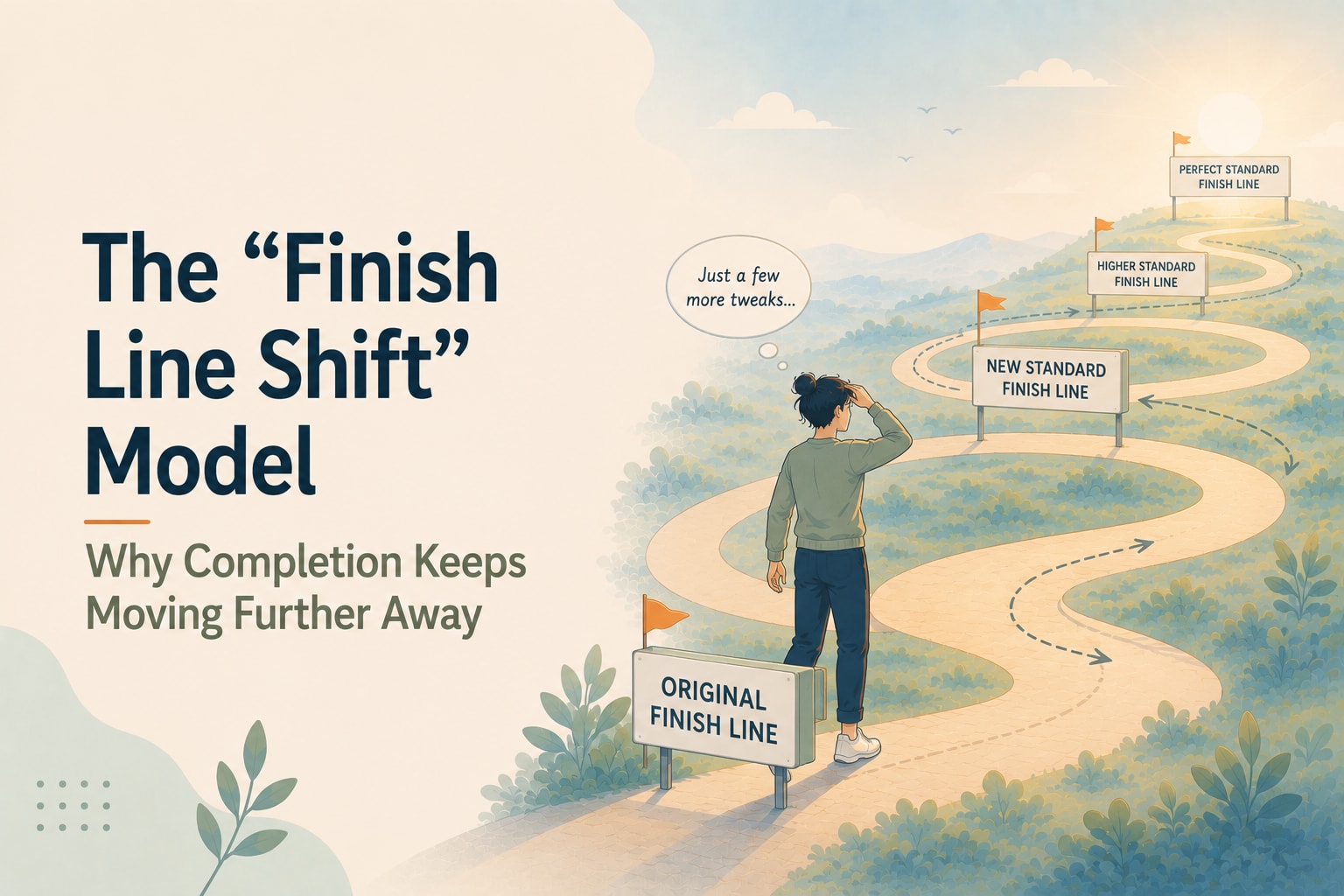
The “Finish Line Shift” Model
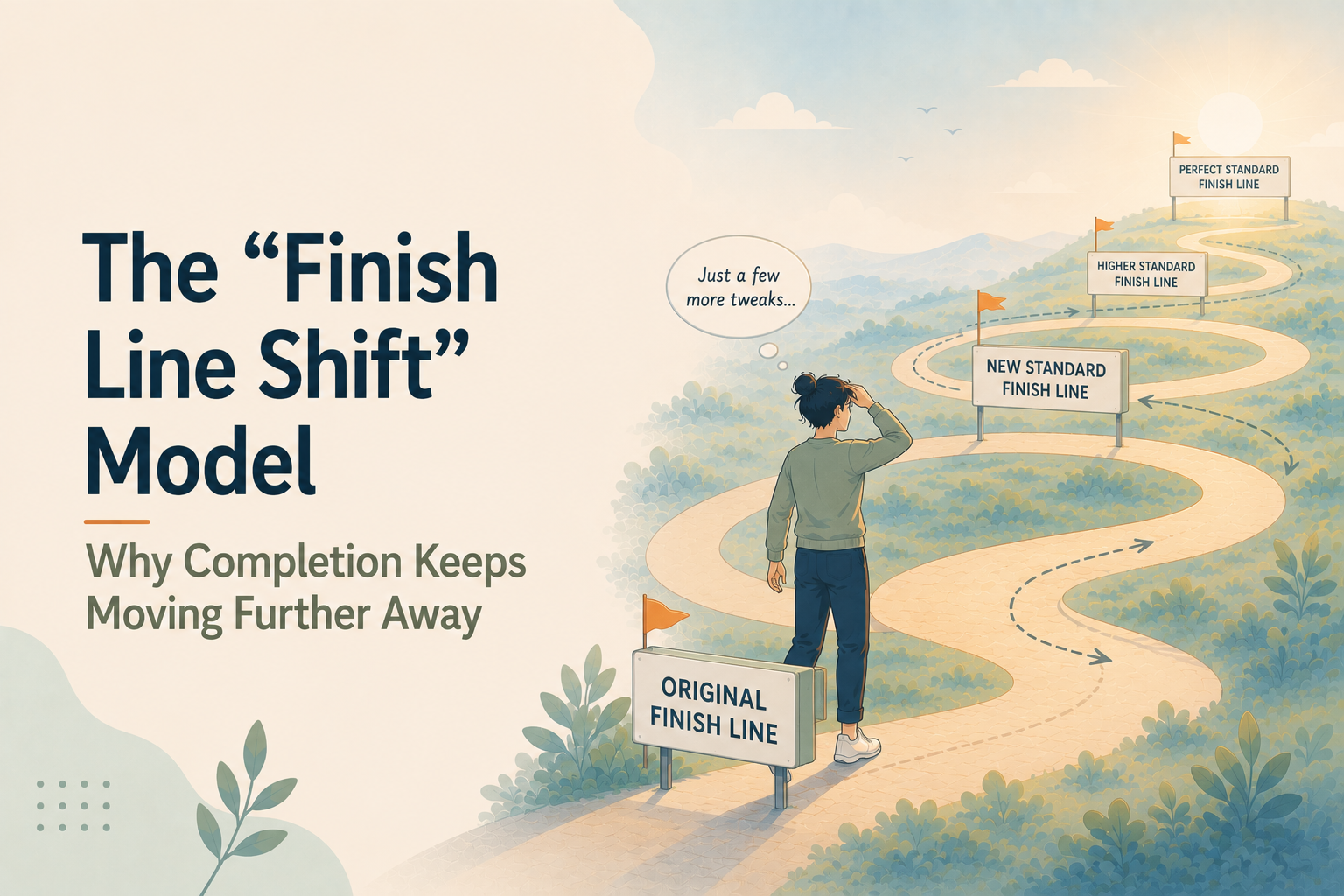
The Finish Line Shift Model describes what happens when the definition of completion changes while you are still working.
You begin with a clear goal.
Write the article.
Submit the application.
Launch the website.
Record the video.
At first, the finish line seems visible.
You know what needs to be done.
Then the project gets close to completion.
A new condition appears.
The article must not only be clear. It must also feel exceptional.
The application must not only be complete. It must make rejection almost impossible.
The website must not only work. Every detail must look fully established.
You meet the new condition.
Then another one appears.
You might not notice it at first.
It feels like the work is becoming better.
But if you look closely, the finish line is no longer where you originally placed it.
That is where the loop begins.
What the Finish Line Shift Model Describes
The Finish Line Shift Model is a framework for understanding why some projects remain almost complete for far longer than expected.
The problem is not always a lack of effort.
Often, the person is working consistently.
The project keeps changing.
New details are added.
Old decisions are reopened.
Improvements continue.
Yet completion never seems to arrive.
The reason is that the standard for “finished” keeps moving.
At the beginning, the goal is practical.
The work needs to communicate, function, or meet a clear requirement.
Near the end, the goal becomes emotional.
The work must feel safe from criticism.
It must remove uncertainty.
It must protect the person from regret, embarrassment, or disappointment.
Practical standards can usually be measured.
Emotional safety cannot.
There is always another possible criticism to prevent.
Another weakness to improve.
Another outcome to prepare for.
This is one of the quieter forms of self-sabotage patterns.
The project is not abandoned.
The conditions for finishing are simply changed until the project cannot satisfy them.
The Stages of the Finish Line Shift Loop
The pattern becomes easier to recognize when it is mapped as a sequence.
Stage 1: A clear completion standard is set
The task begins with a reasonable definition of done.
The report needs five sections.
The video needs to communicate one useful idea.
The website needs working pages and clear information.
The goal feels concrete because the project is still distant from evaluation.
At this stage, you are focused on building the work.
Stage 2: Progress brings the finish line closer
The core task is completed.
The main sections exist.
The necessary decisions have been made.
The project now resembles the thing you intended to create.
This should reduce uncertainty.
Instead, a different kind of uncertainty often appears.
The work is becoming real enough to release.
Stage 3: Completion creates emotional exposure
Once the finish line is close, the mind begins imagining what happens after it is crossed.
People may judge the work.
The application may be rejected.
The post may receive little attention.
The business may not perform as hoped.
The project stops feeling like a task and begins feeling like evidence.
Evidence of your ability.
Your judgment.
Your value.
This is the point where the original standard becomes emotionally uncomfortable.
Stage 4: A new requirement is added
The mind responds by extending the conditions for completion.
The article now needs more research.
The design needs another revision.
The video needs to be filmed again.
The application needs stronger wording.
The new requirement usually sounds reasonable.
That is what makes the shift difficult to detect.
It appears to be about quality.
But it also postpones exposure.
Stage 5: Meeting the new standard creates temporary relief
You complete the additional work.
For a moment, you feel safer.
The tension decreases.
You believe the project is finally close to ready.
But the relief does not last.
Your attention becomes more sensitive to what could still go wrong.
This is where overthinking loops often take over.
Each answer reveals another question.
Each correction makes another imperfection easier to notice.
Stage 6: The finish line moves again
Another condition is added.
Then another.
The work improves, but the definition of finished becomes increasingly difficult to satisfy.
Eventually, the project enters a strange state.
It is more polished than necessary but still not released.
The original task has been completed.
The emotional task—eliminating uncertainty—has not.
Because that task has no natural endpoint, the loop continues.
Why the Mind Repeats This Loop
The mind repeats the Finish Line Shift because moving the standard creates temporary protection.
As long as the work is unfinished, it cannot be fully evaluated.
Its potential remains intact.
You can still imagine what it might become.
You do not yet have to face what it actually is.
Completion removes that protection.
A finished project becomes specific.
It may be strong but imperfect.
Useful but overlooked.
Successful in one way and disappointing in another.
For a mind that connects performance to identity, this can feel more threatening than continuing to revise.
The shifted finish line provides an escape that does not look like escape.
You are not avoiding the project.
You are still working.
This is why the pattern can hide inside perfectionism.
In maladaptive perfectionism, the goal gradually changes from creating something valuable to preventing every possible flaw.
The more important the project feels, the more tempting it becomes to keep moving the standard.
The brain also learns from relief.
Each time a new task is added, the immediate pressure to finish decreases.
That reduction in discomfort reinforces the shift.
The next time completion approaches, the mind repeats the same strategy.
Where This Pattern Appears in Daily Life
The Finish Line Shift Model appears in projects, decisions, and personal goals.
A writer decides the article is complete when the argument is clear.
Later, it must also contain more examples.
Then every sentence must feel polished.
Then the title must be perfect.
A creator plans to publish once the video is edited.
After editing, the lighting feels inadequate.
After fixing the lighting, the delivery feels unnatural.
The video remains unpublished.
A job seeker plans to apply after updating a résumé.
Then they decide they need another course.
Then a better portfolio.
Then more experience.
The opportunity passes while the preparation continues.
A business owner plans to launch when the product works.
Once it works, the branding must be improved.
Then the website needs more pages.
Then the launch plan needs to be more detailed.
The business remains permanently close to beginning.
The same pattern appears in ordinary decisions.
You decide you will choose after gathering enough information.
Once you have enough, you decide you need certainty.
Because certainty is impossible, the decision remains open.
You can see this pattern clearly in The Project That Was Always Almost Ready.
Each stage of work creates a new condition for release.
The project is never clearly abandoned.
It simply remains on the near side of an endlessly moving finish line.
What Keeps the Loop Going
Several psychological forces keep the Finish Line Shift active.
Temporary relief
Adding another requirement delays the moment of exposure.
The mind feels calmer because the project is not being released yet.
Fear of judgment
A new standard can become a way of preparing for imagined criticism.
The work must be improved enough that nobody can question it.
This often overlaps with fear of judgment psychology, where imagined reactions become more influential than actual feedback.
Identity protection
An unfinished project protects the image of what you could produce.
A finished project reveals what you produced this time.
The difference can feel uncomfortable when self-worth is attached to performance.
Self-doubt
Each moved finish line implies that the previous standard was not trustworthy.
Over time, you lose confidence in your ability to recognize when something is complete.
You keep checking because you doubt yourself.
Then you doubt yourself more because you keep checking.
Completion resistance
Finishing begins the next stage.
The work can now be evaluated, used, ignored, accepted, or rejected.
As explained in Completion Resistance Definition, the mind may resist completion not because the final task is difficult, but because the finished state carries emotional consequences.
Final Reflection
The Finish Line Shift Model reveals a simple but easily hidden sequence:
A clear goal.
Visible progress.
Approaching completion.
Emotional exposure.
A new requirement.
Temporary relief.
Another shifted standard.
The work continues.
The finish line moves.
The pattern can look like dedication because effort is still present.
But effort alone does not prove that a project is moving toward completion.
Sometimes effort is being used to keep completion at a safe distance.
The revealing question is not:
Could this still be improved?
Almost everything could.
The more useful question is:
Is this improvement part of the original purpose, or did the finish line move when finishing began to feel uncomfortable?
That distinction does not remove every uncertainty.
It simply makes the sequence visible.
And once you can see the finish line moving, “almost done” stops feeling like a mysterious place you keep ending up.
It becomes a recognizable loop.
Related Patterns
If this loop feels familiar, it often connects to other patterns.
- The “Done vs Perfect” Scale explains how useful refinement gradually turns into an impossible search for flawlessness.
- The 80% Completion Rule maps the point where progress often slows after the core work is already complete.
- Completion Resistance Definition explores why finishing can feel more emotionally difficult than starting.
- The Project That Was Always Almost Ready shows how repeated changes to the completion standard keep useful work from entering reality.
- The Complete Guide to Self-Sabotage Patterns connects this model to the wider system of behaviors that quietly interrupt progress.
