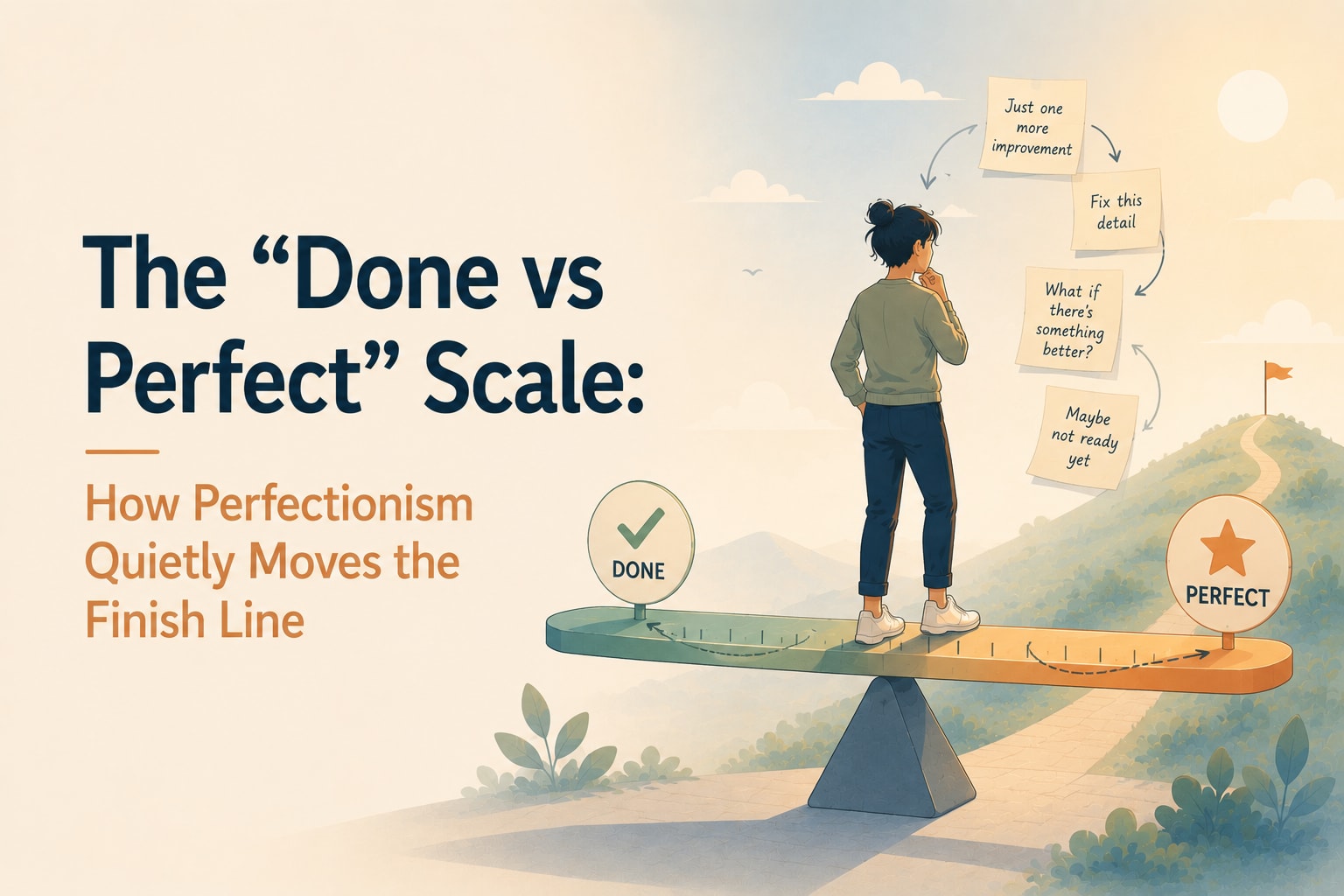
The “Done vs Perfect” Scale
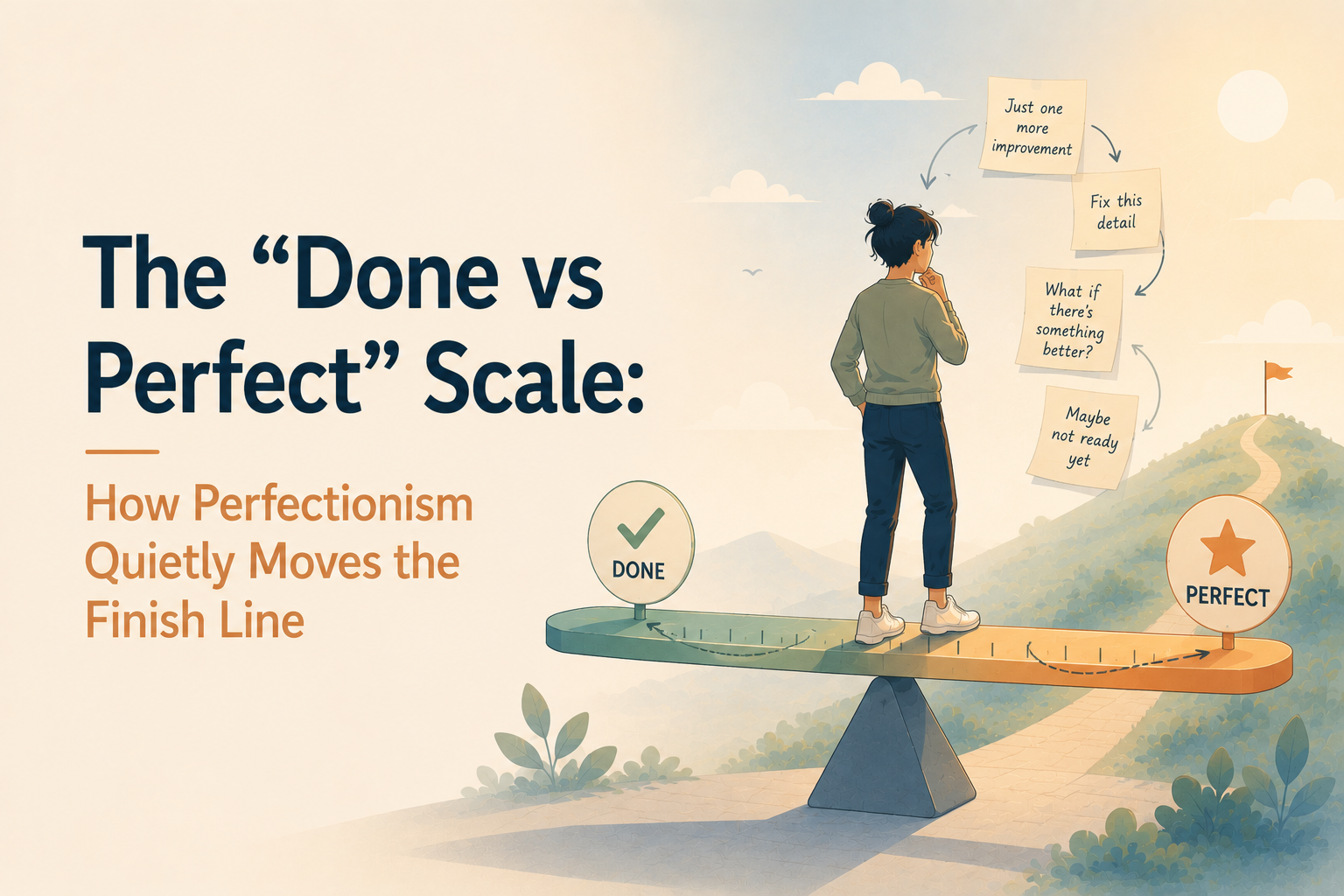
The Done vs Perfect Scale begins with a familiar moment.
You have finished most of the work.
The message is clear.
The project functions.
The article says what you wanted it to say.
Yet something inside you hesitates.
You notice a sentence that could be smoother.
A detail that could be cleaner.
A possibility you have not considered.
So you move the work slightly closer to perfect.
Then you notice something else.
You might not notice it at first, but the goal has changed.
You are no longer trying to complete the work.
You are trying to remove the discomfort of releasing it.
That is where the loop begins.
What the Done vs Perfect Scale Describes
The Done vs Perfect Scale is a framework for understanding what happens when useful improvement gradually turns into completion resistance.
At one end of the scale is done.
Done does not mean careless.
It means the work has reached its purpose.
The message communicates.
The product functions.
The application is ready to submit.
The decision has enough information behind it.
At the other end is perfect.
Perfect means there is nothing left to question, improve, criticize, or regret.
The problem is that this point rarely exists.
There is almost always another adjustment available.
Another perspective to consider.
Another small flaw to notice.
Most projects do not become trapped because the person lacks discipline.
They become trapped because the internal standard for completion quietly shifts.
At first, the question is:
"Does this work?"
Later, it becomes:
"Could this be better?"
Eventually, it becomes:
"Can I make sure nobody finds anything wrong with it?"
Those are three very different questions.
The first produces completion.
The second can produce improvement.
The third often produces delay.
This is one of the ways self-sabotage patterns repeat without looking like sabotage.
You are still working.
You are still trying.
But the work is no longer moving toward a meaningful endpoint.
The Stages of the Done vs Perfect Loop
The Done vs Perfect Scale becomes easier to recognize when you see it as a sequence.
Stage 1: The work reaches functional completion
The main task is finished.
The article is readable.
The presentation is clear.
The application contains everything required.
At this stage, the work may not feel flawless, but it serves its purpose.
There is enough value to release it.
This is the natural point of completion.
But emotionally, it may not feel complete.
Stage 2: A small imperfection becomes emotionally visible
You notice a minor weakness.
Perhaps the opening could be stronger.
The design could feel more polished.
One answer could sound more impressive.
The detail itself may be small.
What matters is the meaning attached to it.
The mind begins to treat the imperfection as evidence that the entire work is not ready.
Stage 3: Improvement creates temporary relief
You fix the detail.
For a moment, the discomfort decreases.
The work feels safer.
You feel more responsible.
More prepared.
More in control.
This relief is important because it teaches the brain that additional refinement reduces emotional tension.
The edit may improve the work.
But it also rewards the delay.
Stage 4: Attention searches for another flaw
Once one problem disappears, the mind looks for the next one.
A new sentence feels awkward.
A different color seems questionable.
Another possible reaction enters your imagination.
The work has improved, but your confidence has not.
Instead, your attention has become more sensitive to imperfections.
That is where overthinking loops often enter the sequence.
Each answer creates another question.
Each correction reveals another possible correction.
Stage 5: The standard for “done” moves
The original requirement is forgotten.
The work no longer needs to be clear, functional, or useful.
It now needs to feel emotionally safe.
But emotional safety is difficult to measure.
There is no obvious finish line.
You tell yourself you will stop when the work finally feels right.
The problem is that perfectionism rarely produces that feeling.
It produces a stronger ability to notice what is missing.
Stage 6: Completion is postponed
The project remains almost finished.
You may continue working on it.
Or you may become mentally tired and avoid it completely.
Either way, the work does not enter reality.
The loop ends where it began: with something valuable that is nearly ready but still withheld.
Then the same sequence appears in the next project.
Functional completion.
Small imperfection.
Temporary relief.
New flaw.
Moving standard.
Delay.
But if you look closely, the sequence repeats.
Why the Brain Repeats This Loop
The brain repeats the Done vs Perfect loop because unfinished work preserves possibility.
While something remains private, it can still become exceptional.
It has not been evaluated.
It has not disappointed anyone.
It has not proven whether your hopes were realistic.
Completion changes that.
Once the work is released, reality responds.
People may like it.
Ignore it.
Question it.
Misunderstand it.
That uncertainty can feel more threatening than the unfinished task itself.
So the mind creates a protective strategy.
Keep improving.
Improvement feels responsible, which makes the avoidance difficult to recognize.
This is also why the loop often overlaps with fear of judgment psychology.
The mind is not only looking at the work.
It is imagining the people who may evaluate it.
A tiny imperfection begins to feel like a future criticism.
Another force is completion resistance.
Finishing does not simply end the task.
It changes your identity from someone preparing to someone being evaluated.
That transition can create tension.
The brain discovers that postponing completion removes the tension for a while.
Temporary relief reinforces the behavior.
The next time the finish line approaches, the same resistance returns.
Where This Pattern Appears in Life
The Done vs Perfect Scale appears anywhere the final step exposes you to reality.
A writer completes an article but continues changing the introduction.
A content creator records a useful video but does not publish it because one sentence sounded awkward.
A job seeker improves a résumé for weeks while submitting very few applications.
A business owner delays launching because the branding still feels incomplete.
A student finishes an assignment but spends hours correcting details that will barely affect the result.
Someone writes an honest message but keeps editing until the emotional meaning disappears.
The pattern also appears in decisions.
You gather enough information to choose.
Then you search for more.
Not because the new information is necessary, but because choosing means giving up the safety of possibility.
In the case study The Project That Was Always Almost Ready, this loop becomes especially visible.
The person is not inactive.
They are constantly improving the project.
But each improvement raises the internal standard, which prevents the work from ever reaching the public.
The project becomes more polished and less real at the same time.
What Keeps the Loop Going
The Done vs Perfect loop survives because several psychological rewards are hidden inside it.
Temporary relief
Each revision delays exposure.
The mind experiences a small release from uncertainty.
That relief makes another revision feel necessary.
Identity protection
As long as the work remains unfinished, its potential remains intact.
You can still believe it might become exceptional.
Releasing it creates evidence.
The result may be good rather than extraordinary.
For someone who connects self-worth to performance, that can feel surprisingly difficult.
Fear of regret
The mind imagines noticing a mistake after publication and thinks:
"I should have checked once more."
To prevent future regret, it creates present delay.
Perfectionism
In maladaptive perfectionism, the absence of flaws becomes more important than the presence of value.
The person stops asking whether the work is useful.
They ask whether it is safe from criticism.
Self-doubt
Every reopened decision weakens trust in the previous decision.
The more often you reconsider finished work, the less certain you feel about recognizing completion.
The loop becomes self-confirming.
You keep checking because you do not trust yourself.
And you trust yourself less because you keep checking.
Final Reflection
The Done vs Perfect Scale does not suggest that quality is unimportant.
Quality matters.
Thoughtful revision matters.
Careful work matters.
The framework reveals something more specific.
There is a point where improvement stops serving the work and begins serving emotional avoidance.
The work may continue changing.
But the pattern remains exactly the same.
Finish.
Notice.
Refine.
Feel relief.
Notice again.
Delay.
The central question is not whether the work could be better.
Almost everything could be better.
The more revealing question is:
Has the next improvement earned its place, or is it helping the mind postpone completion?
The answer may not change the project immediately.
But it changes what you can see.
And once the sequence becomes visible, the unfinished work no longer looks like a mystery.
It looks like a loop.
Related Patterns
If this loop feels familiar, it often connects to other patterns.
- Perfectionism vs High Standards explains why healthy standards lead toward completion while perfectionism keeps moving the finish line.
- Completion Resistance Definition explores why the final stage of a project can feel more emotionally difficult than the beginning.
- Why Overthinking Feels Productive But Isn’t shows how mental activity can create the feeling of progress without producing movement.
- The Project That Was Always Almost Ready demonstrates how repeated refinement can keep useful work permanently close to completion.
- The Complete Guide to Self-Sabotage Patterns connects this framework to the wider system of hidden behaviors that quietly interrupt progress.
