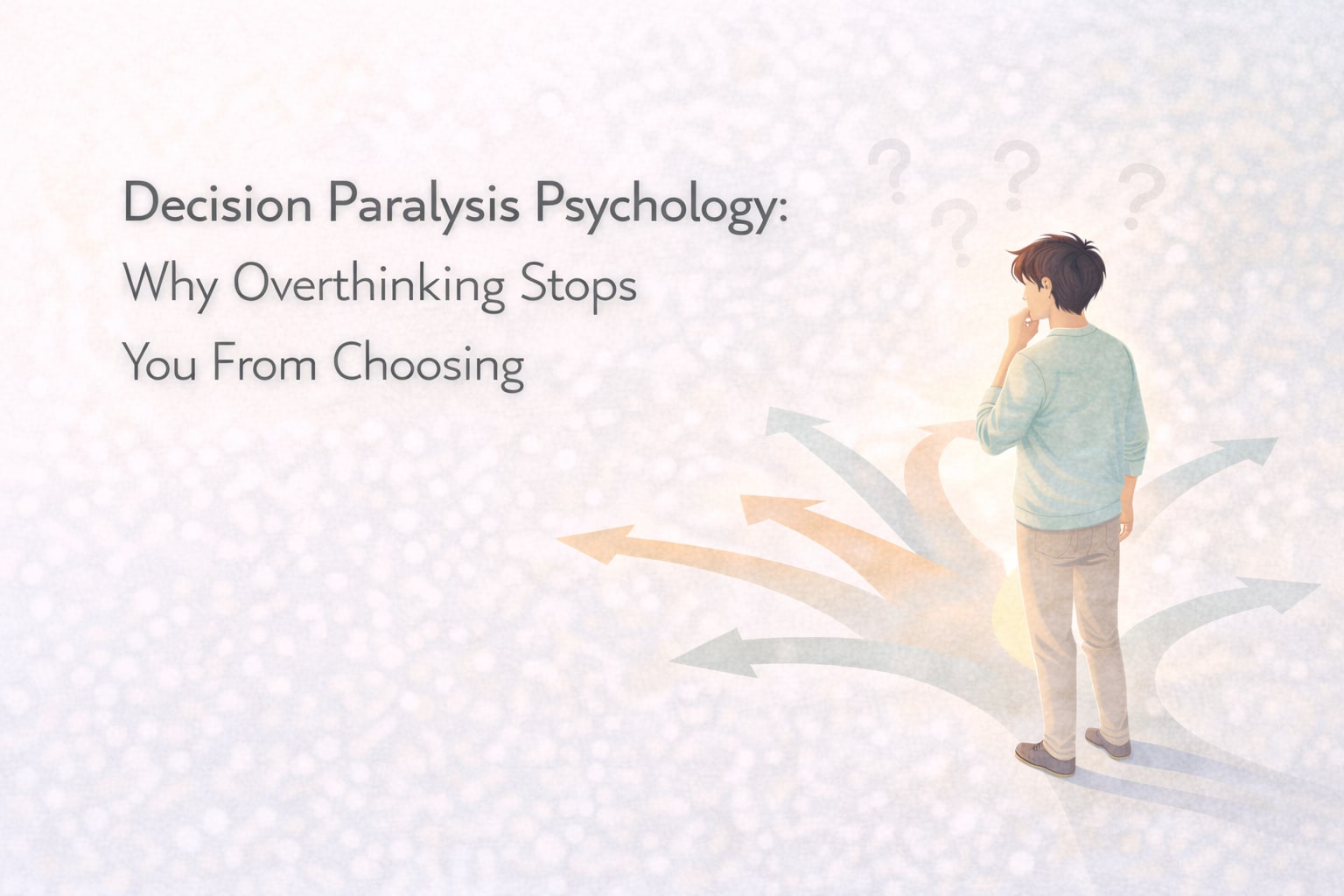
Decision Paralysis Psychology: Why Overthinking Stops You From Choosing
You sit with a decision that should be simple.
Maybe it's a work choice.
Maybe it's a message you need to send.
Maybe it's a project you want to start.
At first, you think about it carefully.
You weigh the options.
You consider the outcomes.
You imagine different scenarios.
That seems responsible.
But something strange happens.
Instead of clarity, the decision becomes heavier.
You revisit the same thoughts again.
You look for more information.
You tell yourself you'll decide later.
Later arrives.
The decision still sits there.
If this sounds familiar, you may be experiencing decision paralysis psychology — the behavioral pattern where thinking about choices becomes so intense that it prevents choosing at all.
Decision paralysis doesn't happen because someone lacks intelligence.
In many cases, the opposite is true.
People who analyze deeply often experience the strongest forms of decision paralysis.
And over time, this pattern can quietly turn into self-sabotage.
If you're exploring the broader patterns behind behaviors like this, the main guide explains the bigger picture:
The Complete Guide to Self-Sabotage Patterns
What Decision Paralysis Psychology Is
Decision paralysis psychology describes the mental and behavioral pattern where excessive analysis makes it difficult to choose between options.
Instead of helping the mind reach clarity, thinking becomes a loop.
Each new thought introduces another possible outcome.
Each possible outcome introduces another uncertainty.
Eventually the brain reaches a strange point.
Choosing feels riskier than delaying.
So the decision stays unresolved.
Decision paralysis psychology often appears in situations where:
There are many options.
The outcome feels important.
Mistakes seem costly.
Expectations are high.
Information feels incomplete.
Instead of choosing with available information, the brain tries to eliminate uncertainty entirely.
But uncertainty can never be fully removed.
This is why decision paralysis often connects with overthinking patterns.
When action pauses, the brain fills the space with more analysis.
You can explore this dynamic here:
Why the Brain Creates Decision Paralysis
Decision paralysis psychology exists because the brain tries to minimize potential regret.
In simple terms, the mind wants to avoid making the wrong choice.
Several psychological mechanisms contribute to this behavior.
Fear of regret
People often imagine how they will feel if a decision turns out badly.
The brain prefers delaying the decision rather than risking future regret.
Choice overload
When too many options exist, evaluating them becomes mentally exhausting.
The brain struggles to compare possibilities clearly.
Uncertainty intolerance
Humans naturally prefer certainty.
When outcomes remain unclear, the mind continues analyzing.
Identity protection
Some decisions feel connected to identity.
Career moves, public actions, or creative work may feel like reflections of who you are.
This increases pressure.
Perfection seeking
The brain sometimes believes there is a perfect option waiting to be discovered.
So it keeps searching.
Unfortunately, most decisions are not perfect decisions.
They are simply reasonable choices made with limited information.
But when the brain believes a perfect option exists, decision paralysis becomes more likely.
Signs You're Experiencing Decision Paralysis Psychology
Decision paralysis patterns can appear in many forms.
They often look like normal thinking at first.
But when the behavior repeats consistently, the pattern becomes clear.
Here are common signs.
You revisit the same decision repeatedly
Even after thinking about it many times, you feel no closer to choosing.
You constantly search for more information
Research continues long after enough information already exists.
You feel mentally exhausted by small decisions
The cognitive effort becomes draining.
You delay decisions until external pressure forces them
Deadlines become the only reason decisions happen.
You imagine multiple future scenarios
Your mind runs simulations of what might happen after each choice.
You worry about choosing incorrectly
The possibility of making a mistake feels overwhelming.
You keep asking others for reassurance
External opinions temporarily reduce uncertainty.
When these behaviors repeat regularly, they form a recognizable decision paralysis pattern.
How Decision Paralysis Turns Into Self-Sabotage
Decision paralysis psychology can seem harmless at first.
After all, thinking carefully is often a good thing.
But when analysis prevents action, the long-term consequences begin appearing.
Decision paralysis quietly shapes outcomes.
Missed opportunities
Many opportunities require timely decisions.
When choices remain unresolved, the opportunity may pass.
Reduced momentum
Progress depends on movement.
Without decisions, movement stops.
Growing anxiety
Unfinished decisions remain in the mind.
They create ongoing mental pressure.
Loss of confidence
Repeated hesitation can weaken trust in one's ability to choose.
Dependency on external guidance
Instead of trusting internal judgment, individuals may rely heavily on others.
This is why decision paralysis psychology often becomes a form of self-sabotage.
The person wants progress.
But the inability to decide prevents the actions required to create it.
The Decision Paralysis Loop
Decision paralysis psychology often follows a predictable cycle.
Once the loop becomes visible, interrupting it becomes easier.
The pattern usually looks like this:
Choice → Analysis → Doubt → More Analysis → Delay → Pressure → Restart
Let's break that down.
Choice
A decision appears.
Sometimes it's small.
Sometimes it's significant.
Analysis
You begin evaluating options.
This step is useful at first.
Doubt
Uncertainty appears.
You begin questioning whether the analysis is complete.
More Analysis
The mind continues searching for clarity.
New information appears.
New possibilities emerge.
Delay
Instead of deciding, the brain postpones the choice.
Pressure
Eventually external pressure appears.
Deadlines, consequences, or urgency force attention.
Restart
The next decision appears.
The cycle begins again.
Over time, the brain becomes accustomed to this loop.
And the pattern repeats automatically.
How to Break Decision Paralysis Psychology
Breaking decision paralysis doesn't mean abandoning thoughtful thinking.
It simply means placing boundaries around analysis so action can follow.
Here are several practical steps.
1. Define a decision deadline
Give yourself a clear time limit to evaluate options.
When the time ends, choose.
This prevents endless analysis.
2. Limit the number of options
Too many choices increase mental complexity.
Reducing options simplifies thinking.
3. Accept imperfect decisions
Most decisions are reversible.
Recognizing this reduces pressure.
4. Focus on the next step
Instead of solving the entire future, identify the next immediate action.
Clarity often appears after movement.
5. Write decisions down
Externalizing thoughts helps the brain organize information more clearly.
6. Separate thinking from acting
Set dedicated time for analysis, then shift deliberately into action mode.
These strategies interrupt the analysis loop before it becomes paralysis.
If you want to explore the broader psychology behind these behavior patterns, this guide connects the ideas together:
The Complete Guide to Self-Sabotage Patterns
Final Reflection
Decision paralysis psychology rarely appears as obvious fear.
It usually looks like careful thinking.
Responsible analysis.
Thoughtful preparation.
But sometimes thinking quietly replaces action.
And when that happens repeatedly, the pattern begins shaping outcomes.
Not because someone lacks intelligence.
But because the mind tries to protect itself from uncertainty.
The irony is that uncertainty doesn't disappear through thinking.
It usually fades through experience.
Through decisions.
Through movement.
Understanding decision paralysis psychology doesn't remove uncertainty.
But it changes something important.
You begin noticing when thinking becomes looping instead of helpful.
And in that moment, you gain a simple but powerful option.
To choose.
Next / Related
Q: What is decision paralysis psychology?
A: Decision paralysis psychology describes the mental pattern where excessive analysis makes it difficult to choose between options.
Q: Why do intelligent people experience decision paralysis?
A: People who think analytically often evaluate more possibilities and risks, which can make decisions feel heavier and harder to finalize.
Q: Is decision paralysis related to overthinking?
A: Yes. Decision paralysis often develops from overthinking loops where the mind repeatedly analyzes possible outcomes without reaching a conclusion.
Q: Can decision paralysis lead to self-sabotage?
A: It can. When important decisions remain unresolved, opportunities may pass and progress slows, creating unintended self-sabotage.
Q: How can someone stop decision paralysis?
A: Setting decision deadlines, limiting options, accepting imperfect choices, and focusing on the next action can help break the analysis loop.
Q: Is decision paralysis common?
A: Very common. Many people experience it when facing important choices or uncertain outcomes.
