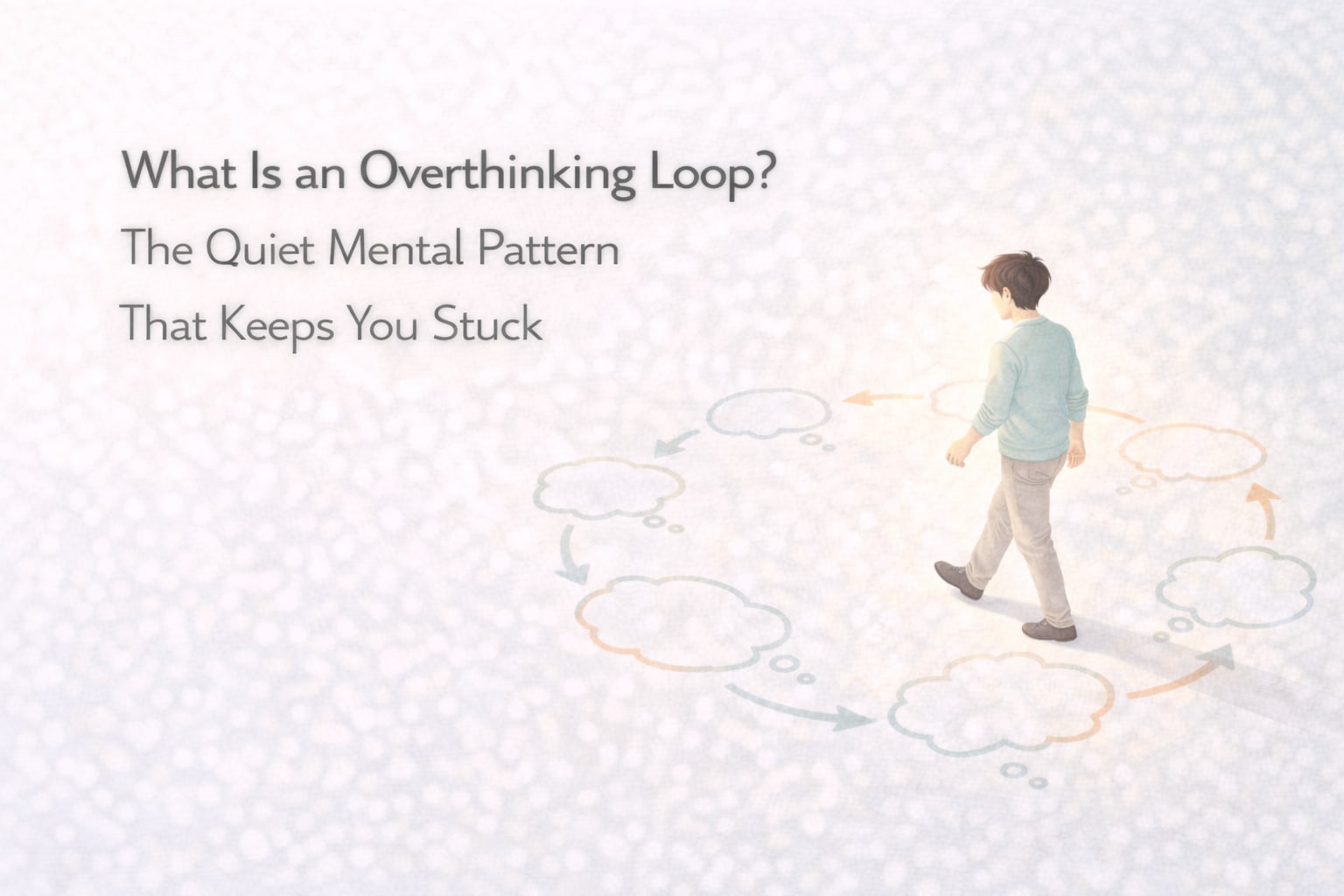
What Is an Overthinking Loop?
What is an overthinking loop?
Most people have experienced one without realizing it.
You replay a conversation in your head.
You rethink a decision you already made.
You imagine different outcomes of something that already happened.
At first, it feels like normal thinking.
You are just trying to understand something.
But then the thought returns again.
And again.
Hours later, your mind is still circling the same idea.
You might not notice it at first.
But if you look closely, something interesting appears.
The mind is not solving the problem anymore.
It is simply repeating it.
That’s where the overthinking loop begins.
The Behavior Most People Don’t Notice
An overthinking loop is a mental pattern where the mind repeatedly returns to the same thought without reaching a new conclusion.
The thought might be about:
• a past conversation
• a mistake
• a decision you made
• something you are afraid might happen
The mind treats the thought like an unfinished task.
So it keeps reopening it.
Maybe if I think about it again, I’ll finally understand it.
But something subtle happens.
Each time the brain returns to the thought, it often travels through the same mental path.
The same questions.
The same doubts.
The same imagined scenarios.
Instead of moving forward, the mind walks in a circle.
This pattern is closely connected to the dynamics explored in self-sabotage patterns.
Not because the brain wants to hurt you.
But because it believes more thinking will eventually create certainty.
Why the Brain Creates Overthinking Loops
The brain is designed to solve problems.
When something feels unresolved, the mind holds onto it.
It keeps it active in the background.
This mechanism is useful when a problem has a clear answer.
But many human situations do not.
Social interactions.
Future decisions.
Uncertain outcomes.
The brain cannot calculate them precisely.
So it keeps searching.
You might notice this especially at night.
Your body is tired.
But the mind is still running simulations.
What if I said the wrong thing?
What if I chose the wrong path?
What if something goes wrong tomorrow?
From the brain’s perspective, this is not a mistake.
It is protection.
If it can predict problems early enough, it believes it can prevent them.
But because many of these situations have no final answer, the mind never receives a signal to stop.
That is how a simple thought becomes one of the repeating cycles described in overthinking loops.
Where This Pattern Shows Up in Daily Life
Overthinking loops rarely appear as obvious mental spirals.
They hide inside ordinary moments.
After a conversation
You wonder if your tone sounded strange.
So you replay the interaction.
Then you imagine how the other person interpreted it.
The mind runs the scene again.
And again.
Before making a decision
You compare options.
Then compare them again.
And again.
Eventually the brain is no longer evaluating choices.
It is avoiding uncertainty.
Before sleep
The day is over.
There are no distractions left.
The mind finally opens all the tabs it kept running quietly in the background.
Old worries.
Unfinished questions.
Imagined futures.
This is why many people discover their strongest overthinking loops late at night.
The mind finally has space to wander.
The Hidden Effect of Overthinking Loops
At first, overthinking feels productive.
It feels like problem solving.
But if you observe closely, something else happens.
The brain begins to confuse thinking with progress.
You spend mental energy analyzing the same situation.
But nothing changes.
No new information appears.
No action happens.
Over time, the mind learns a subtle habit.
When something feels uncertain or uncomfortable, it returns to thinking.
Not doing.
Just thinking.
This is where overthinking quietly overlaps with the patterns described in self-sabotage patterns.
Not because a person wants to fail.
But because the brain believes safety comes from analysis.
Yet many real-life problems are solved through experience, not speculation.
Action breaks loops.
Thinking often reinforces them.
What This Reveals About Human Behavior
If you observe the mind long enough, you start to notice something surprising.
The brain does not always prioritize clarity.
Sometimes it prioritizes control.
Overthinking creates the illusion that we are preparing for every possibility.
It feels like we are staying one step ahead.
But human life rarely allows that level of control.
Conversations are unpredictable.
Decisions unfold over time.
Outcomes depend on factors we cannot calculate.
So the brain does something interesting.
Instead of accepting uncertainty, it keeps revisiting the thought.
As if repeating the question might eventually reveal a perfect answer.
But the loop itself becomes the trap.
The mind stays busy.
But nothing actually changes.
Final Reflection
Once you understand what an overthinking loop is, you begin to notice it more often.
A thought returns.
Then returns again.
At first, it seems important.
But if you pause and observe, you might see the pattern.
The mind is not discovering anything new.
It is simply replaying the same story.
You might not notice it immediately.
But over time, awareness changes how the loop feels.
The thought still appears.
But now you recognize it.
And when a pattern is recognized, something subtle shifts.
The mind no longer has to follow it every time.
Q: What is an overthinking loop in psychology?
A: An overthinking loop is a mental pattern where the brain repeatedly returns to the same thought, question, or situation without reaching a new conclusion. Instead of solving the issue, the mind keeps replaying the same analysis.
Q: Why do overthinking loops happen at night?
A: Overthinking loops often appear at night because distractions disappear. When the environment becomes quiet, unresolved thoughts that the brain has been holding in the background finally surface.
Q: Are overthinking loops the same as rumination?
A: They are closely related. Rumination usually focuses on past events or mistakes, while overthinking loops can involve both past situations and future possibilities.
Q: How can someone stop an overthinking loop?
A: Awareness is the first step. Once a person recognizes the pattern, small actions—such as writing the thought down, shifting attention, or taking practical steps—can interrupt the cycle.
