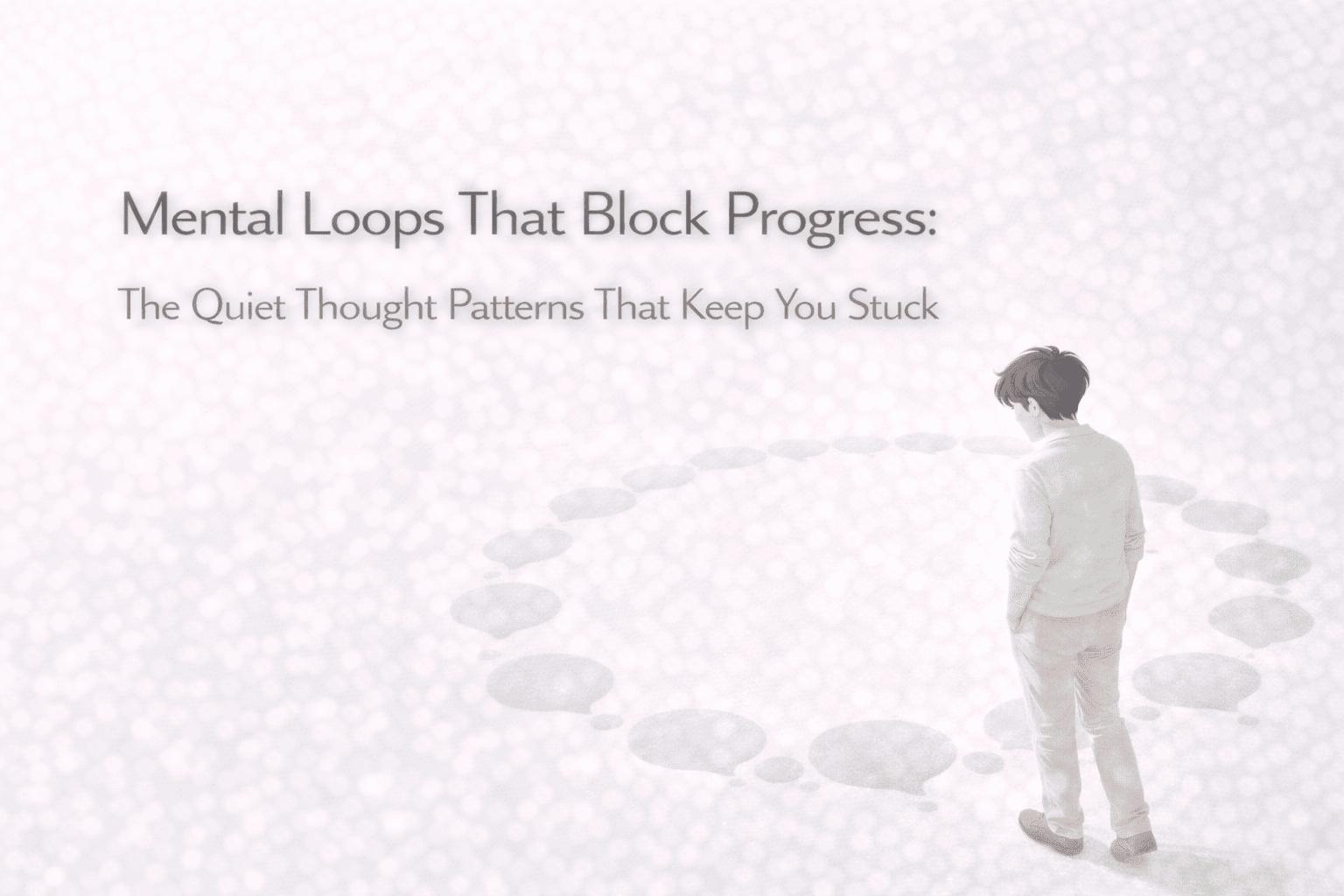
Mental Loops That Block Progress
Mental loops that block progress usually begin quietly.
You sit with an idea.
You think about the next step.
You analyze the possibilities.
You replay the situation in your mind.
At first, it feels responsible.
Thinking carefully seems like the right thing to do.
But after a while, something strange happens.
The thoughts begin repeating.
Different angles of the same idea.
Different versions of the same worry.
Different possibilities that lead to the same pause.
The mind feels busy.
But nothing actually moves forward.
That’s the nature of mental loops that block progress.
They create movement inside the mind while progress outside the mind stays still.
What This Behavior Actually Is
Mental loops that block progress are repeating thought patterns where the mind revisits the same ideas without producing new clarity or action.
The loop usually begins with a real problem.
A decision.
A conversation.
A task that matters.
The brain begins thinking about it.
This is normal.
Thinking helps evaluate possibilities and prepare for action.
But sometimes the thinking continues long after the useful insights have already appeared.
Instead of creating clarity, the mind circles the same ideas again and again.
The thoughts change slightly.
But the outcome stays the same.
No decision.
No action.
Just repetition.
This pattern is closely related to what psychologists describe as overthinking loops, which you can explore here:
Why the Brain Does This
Mental loops that block progress happen because the brain is trying to solve uncertainty.
Uncertainty makes the mind uncomfortable.
When something feels unresolved, the brain keeps searching for answers.
Several psychological mechanisms reinforce this behavior.
Problem-solving instinct
The brain is designed to solve problems.
When a problem feels unresolved, the mind keeps returning to it.
Control illusion
Thinking about something repeatedly creates the feeling of control.
Even if no action happens, the brain feels involved.
Risk protection
The mind wants to avoid mistakes.
Analyzing a situation longer feels safer than acting too soon.
Emotional avoidance
Sometimes action creates discomfort.
Thinking becomes a way to stay engaged without facing the emotional tension of moving forward.
This is one reason mental loops often appear in situations where the outcome matters.
The brain tries to think its way to certainty.
But certainty rarely arrives through thinking alone.
The Hidden Cost
Because mental loops feel like effort, the brain rarely recognizes them as a problem.
Thinking feels productive.
But over time, the cost becomes visible.
Progress slows.
Decisions remain unresolved.
Energy drains from repeated analysis.
Several subtle effects often appear.
Delayed action
Tasks remain unfinished because the mind keeps revisiting them.
Mental fatigue
Repeating the same thoughts drains attention.
Reduced confidence
When decisions remain unresolved, trust in your own judgment can weaken.
Missed momentum
Momentum depends on small consistent actions.
Mental loops interrupt that movement.
This is why these patterns often connect to self-sabotage behaviors.
Not dramatic sabotage.
Just quiet hesitation repeated over time.
If you want to explore the larger psychological framework behind these patterns, you can read the full guide here:
The Complete Guide to Self-Sabotage Patterns
A Small Shift That Changes the Pattern
Breaking mental loops that block progress does not require stopping thinking altogether.
Thinking is valuable.
The shift comes from recognizing when thinking becomes repetition.
A few small changes can interrupt the pattern.
Notice when thoughts repeat
Useful thinking produces new insights.
Loops repeat the same insights.
Recognizing that moment changes how the mind responds.
Create a boundary between thinking and action
Give yourself a clear window for thinking.
Once the thinking time ends, move toward action.
Even a small step breaks the loop.
Reduce the size of the next step
Large tasks create pressure.
Smaller actions make movement easier.
Often the first step is enough to restore momentum.
Over time, the brain learns something interesting.
Clarity often arrives after movement.
Not before it.
Final Reflection
Mental loops that block progress rarely look dramatic.
They look like careful thinking.
Thoughtful analysis.
Responsible consideration.
But sometimes the mind quietly crosses a line.
Thinking stops producing clarity.
And starts producing repetition.
The brain continues circling the same idea.
Not because the answer is far away.
But because the mind is trying to eliminate uncertainty completely.
And uncertainty rarely disappears that way.
Once you notice these loops, something subtle changes.
You begin recognizing when thinking becomes circular.
And in that moment, a small choice appears.
You can continue thinking.
Or you can step outside the loop and move.
Q: What are mental loops that block progress?
A: Mental loops are repeating thought patterns where the mind revisits the same ideas without producing new insights or action.
Q: Why do mental loops happen?
A: The brain tries to resolve uncertainty and avoid mistakes. When clarity doesn't appear quickly, the mind continues analyzing the same problem.
Q: Are mental loops the same as overthinking?
A: They are closely related. Overthinking loops are one of the most common types of mental loops that prevent decisions or action.
Q: How can someone break mental loops?
A: Recognizing repeated thoughts, setting limits for analysis, and taking small actions can interrupt the cycle.
