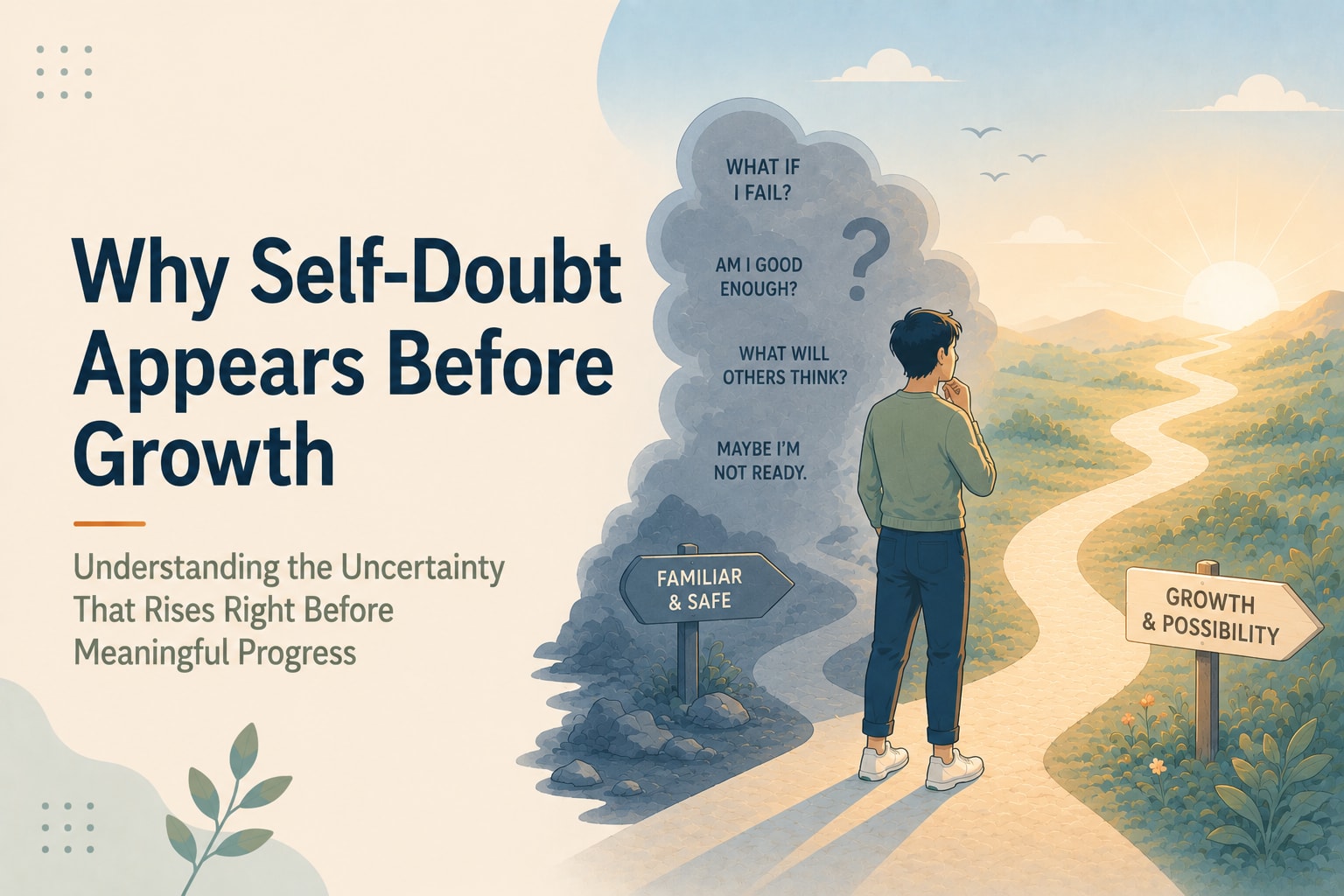
Why Confidence Drops When It Matters
Why confidence drops when it matters can feel confusing because confidence often seems stable until something important is about to happen.
You know how to do the task.
You have done similar things before.
You may have prepared carefully and performed well in less important situations.
Then the moment becomes significant.
The interview matters.
The presentation matters.
The application matters.
The conversation matters.
Suddenly, abilities that felt familiar begin to feel less reliable.
You reread what you prepared.
You question decisions that seemed reasonable earlier.
You become unusually aware of your voice, your timing, your appearance, or the possibility of making a mistake.
Nothing about your ability has necessarily changed.
What changed is the meaning attached to the moment.
The mind is no longer simply performing a task.
It is monitoring what the outcome might say about you.
That shift is why confidence can seem to disappear at the exact point when you most want it to remain.
It also explains why this experience often connects with broader self-sabotage patterns, especially when pressure activates overthinking loops, fear of failure, perfectionism, and self-doubt.
Free Psychology Guide
Download The Truth Pill Guide to Self-Sabotage Patterns to recognize the hidden mental loops that quietly affect confidence, decisions, and performance when the outcome feels important.
What This Behavior Actually Is
Confidence does not always disappear when pressure increases.
Often, attention simply changes direction.
During ordinary situations, most of your attention remains on the task.
You listen to the question.
You consider the information.
You respond.
You adjust as you go.
The process feels natural because you are not constantly evaluating yourself while performing.
When the moment becomes important, part of your attention turns inward.
You begin observing yourself from the outside.
How do I sound?
Am I speaking too quickly?
Was that answer good enough?
Do they think I am qualified?
What if I forget what I planned to say?
The task has not disappeared.
But it is now competing with self-monitoring.
This creates the experience people describe as losing confidence.
The ability is still present.
Access to it becomes less natural because attention is divided.
The person is trying to perform and evaluate the performance at the same time.
That is why confidence can feel stable during preparation but unstable during exposure.
Preparation happens privately.
Performance introduces observation, consequences, and uncertainty.
Why the Brain Does This
The brain pays more attention to situations that appear important.
Importance suggests consequences.
Consequences increase monitoring.
Monitoring is useful when it helps you notice relevant information.
It becomes disruptive when the mind starts treating every small signal as evidence about the outcome.
A pause in conversation becomes proof that the other person is unimpressed.
A forgotten sentence becomes evidence that the entire presentation is failing.
One difficult question begins to feel like confirmation that you were never prepared.
The brain is trying to detect risk early.
But under pressure, it can become overly sensitive.
The mind begins searching for signs that something is going wrong.
Because attention is now focused on mistakes, mistakes become easier to notice than competence.
This creates a distorted impression.
You may perform reasonably well while feeling as though you are failing.
The feeling then becomes additional evidence.
"If I were truly confident, I would not feel this nervous."
Now the person is no longer responding only to the situation.
They are responding to their reaction to the situation.
That second layer often creates more difficulty than the original pressure.
This is also where fear of failure becomes closely connected to confidence.
When the outcome is treated as information rather than judgment, uncertainty remains manageable.
When the outcome is treated as proof of intelligence, worth, talent, or readiness, every moment carries more weight.
Confidence begins carrying a responsibility it was never designed to hold.
Where It Appears in Everyday Life
The pattern appears in situations where the outcome feels connected to identity.
Someone speaks clearly in ordinary meetings but loses confidence when senior leaders enter the room.
A person answers practice interview questions easily but becomes uncertain during the real interview.
A creator shares ideas freely with friends but questions every sentence before publishing publicly.
A student understands the material during revision but begins doubting basic answers once the examination starts.
Someone communicates naturally with a person they barely know, then becomes unusually cautious once the relationship begins to matter.
A business owner explains their service confidently in casual conversation but becomes less certain when speaking to an important potential client.
The abilities are not necessarily different.
The psychological conditions are.
In the lower-pressure situation, the person focuses on communication.
In the higher-pressure situation, they focus on consequences.
The conversation changes from:
"What am I trying to say?"
to:
"What will happen if I say it badly?"
That small shift explains why people can feel competent one day and inadequate the next.
It also explains why confidence sometimes drops before opportunities that confirm growth.
The larger opportunity creates greater visibility.
Greater visibility increases self-monitoring.
Self-monitoring makes natural ability feel less automatic.
The person may interpret this discomfort as proof that they are not ready, even when the opportunity appeared because they had already shown that they were capable.
The Hidden Cost
The immediate cost of reduced confidence is discomfort.
The deeper cost is behavioral.
When confidence drops, people often change how they act.
They shorten their answers.
They avoid taking a clear position.
They add unnecessary explanations.
They soften ideas they previously believed in.
They speak less directly.
They delay submitting work.
They continue preparing after preparation is complete.
These behaviors are attempts to reduce exposure.
They also make the person less visible, less decisive, and less able to gather accurate feedback.
A qualified candidate may give vague answers because they are trying not to sound overconfident.
A capable creator may keep valuable work private because it does not feel polished enough.
Someone may avoid an important conversation because they are waiting to feel certain about every possible response.
The person believes the main problem is low confidence.
But the more important issue is what happens next.
Avoidance prevents evidence from developing.
Without experience, confidence has little new information to build on.
The person continues believing that they need to feel confident before acting.
This creates a quiet loop:
The moment becomes important.
Confidence drops.
The person reduces exposure.
Less experience is gathered.
Confidence remains fragile.
The next important moment feels even more threatening.
This is how temporary uncertainty can become a repeated behavioral pattern.
The Pattern Most People Miss
Most people think confidence should increase in a straight line.
You learn.
You practise.
You improve.
You become confident.
Then you perform.
Real behavior is less orderly.
Confidence can rise during preparation and fall during exposure.
It can exist when the outcome feels distant and weaken when the outcome becomes real.
This does not always mean confidence was false.
It means confidence is sensitive to context.
A person can trust their ability and still become uncertain when the stakes change.
The pattern often looks like this:
A meaningful opportunity appears.
The outcome becomes connected to identity.
Attention shifts from the task to the self.
Self-monitoring increases.
Normal mistakes feel unusually important.
Confidence appears to drop.
Behavior becomes cautious.
Limited action produces limited evidence.
The original uncertainty seems justified.
What most people miss is that the confidence drop occurs after attention changes.
It is not always an accurate measurement of ability.
It may be the result of watching yourself too closely.
This is similar to the pattern described in Why Self-Doubt Appears Before Growth, where unfamiliar progress creates uncertainty just before expansion.
It also connects with Why You Question Yourself After Deciding, because commitment often makes consequences feel more visible.
Frameworks such as The Action Reduces Fear Loop help interrupt this pattern by shifting attention back toward the next observable action.
The goal is not to manufacture certainty.
It is to reduce the amount of attention being spent measuring confidence while the task is still happening.
Final Reflection
Confidence often drops when it matters because the mind begins treating the moment as more than a task.
The interview becomes a judgment of competence.
The presentation becomes a test of intelligence.
The conversation becomes proof of worth.
The opportunity becomes a verdict on readiness.
Once the meaning expands, attention changes.
You stop simply doing the thing.
You begin watching yourself do it.
That divided attention makes familiar abilities feel less accessible.
The pattern is quiet.
The stakes increase.
Self-monitoring begins.
Small mistakes become highly visible.
Confidence appears to weaken.
Behavior becomes restrained.
The person assumes they were never capable.
Yet the ability may still be present beneath the monitoring.
This is why confidence is not always a reliable signal before an important moment.
Sometimes it reflects skill.
Sometimes it reflects familiarity.
Sometimes it simply reflects how closely the mind is watching itself.
Recognizing the difference does not remove pressure.
It reveals why the pressure changes your internal experience.
You may still notice the doubt.
But it becomes easier to see that the feeling is not always describing what you can do.
Sometimes it is only describing how much the outcome matters to you.
Why does my confidence disappear before important events?
Important events increase the mind's awareness of consequences. Attention often shifts from performing the task to monitoring how well you are performing, which makes confidence feel less stable.
Does low confidence mean I am not prepared?
Not necessarily. A person can be well prepared and still feel uncertain when the situation becomes more visible, meaningful, or difficult to control.
Why am I confident during practice but nervous during the real thing?
Practice usually carries fewer consequences. The real situation introduces evaluation, exposure, and uncertainty, which can increase self-monitoring.
How are confidence and overthinking connected?
Overthinking divides attention between the task and imagined outcomes. The more possibilities the mind monitors, the harder it becomes to act naturally.
Can someone perform well while feeling unconfident?
Yes. Internal confidence and actual performance do not always match. People can feel uncertain while still responding competently and producing a good result.
Why does confidence drop after receiving a good opportunity?
A larger opportunity can increase visibility and expectations. The person begins focusing on what could be lost rather than the abilities that helped them reach the opportunity.
Related Patterns
