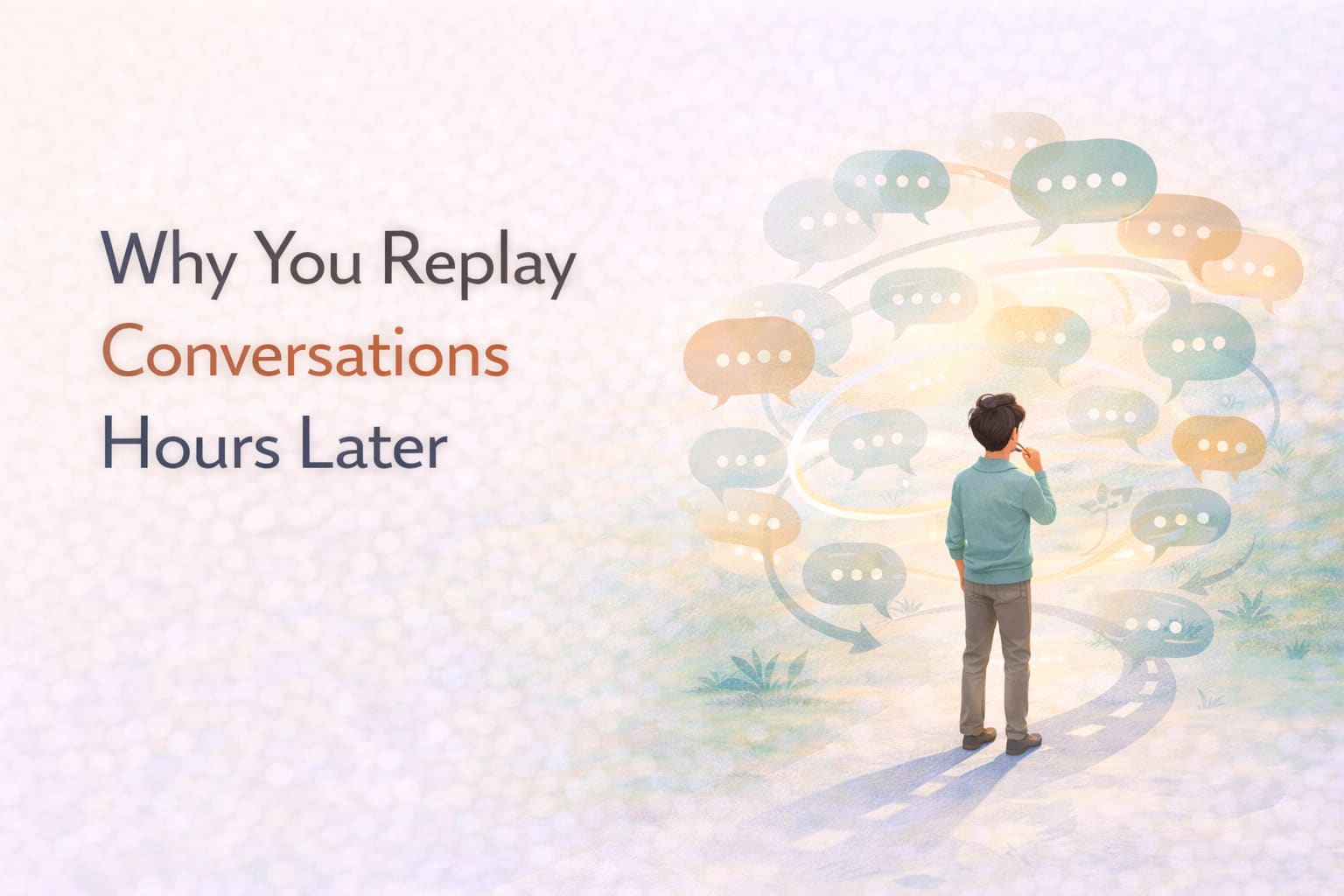
Why You Replay Conversations Hours Later
Why you replay conversations hours later usually doesn’t feel like a pattern at first.
It feels like reflection.
You leave a conversation.
Everything seems normal.
Then later, something starts replaying.
A sentence you said.
A moment you pause on.
A reaction you try to interpret.
You go over it once.
Then again.
Then from a slightly different angle.
You might not notice it at first.
But if you look closely, something interesting appears.
The conversation is over.
But your mind is still inside it.
If this pattern feels familiar, you may be noticing more than one loop at once.
Download The Self-Sabotage Pattern Recognition Guide: Identify the 7 Hidden Behavioral Loops Holding You Back.
What this pattern looks like
Why you replay conversations hours later often follows a predictable structure.
Step 1: Recall
A small part of the conversation returns.
Step 2: Focus
The mind zooms in on one detail.
Step 3: Reinterpretation
You begin asking what it meant.
Step 4: Adjustment
You imagine what you could have said differently.
Step 5: Repetition
The loop restarts.
The conversation doesn’t change.
But the mind keeps working on it.
Why this pattern forms
This pattern is not random.
It comes from how the brain handles social uncertainty.
Conversations involve interpretation.
Tone.
Timing.
Reaction.
The brain tries to make sense of it after the moment has passed.
But something subtle happens.
Instead of resolving the interaction, the mind keeps analyzing it.
Several mechanisms are active.
Social evaluation awareness
The brain tries to understand how you were perceived.
Self-doubt cycles
You question whether your response was “right.”
Fear of judgment
You imagine how the other person interpreted your words.
Overthinking loops
The same interaction is processed repeatedly.
You can explore this deeper here:
Thinking feels like clarity.
But it often becomes repetition.
How this connects to other self-sabotage patterns
This pattern rarely exists alone.
It connects to broader self-sabotage patterns.
Not obvious ones.
Quiet ones.
Self-doubt cycles
You begin questioning your own social judgment.
Perfectionism patterns
You expect conversations to be handled perfectly.
Fear of failure
You treat small social moments as high-stakes.
Procrastination behavior
You delay future conversations because of past analysis.
You can explore the full system here:
The Complete Guide to Self-Sabotage Patterns
These patterns don’t feel like sabotage.
They feel like awareness.
But over time, they shape behavior.
Real-life examples
This pattern appears in ordinary situations.
After a meeting, you replay something you said.
After a text exchange, you reread your message.
After a social interaction, you wonder if you said too much or too little.
Nothing dramatic happened.
But the mind continues processing it anyway.
In some cases, the same conversation is replayed hours later.
Sometimes days later.
This is not about the conversation itself.
It’s about what the mind is trying to resolve.
What’s happening underneath
Underneath the replay is something simple.
The brain is trying to complete the interaction.
But social interactions rarely have clear endings.
There is no final confirmation.
No exact signal that everything was interpreted correctly.
So the mind keeps working.
It tries to predict how the other person felt.
It tries to correct small details.
It tries to remove uncertainty.
But uncertainty doesn’t disappear through thinking alone.
So the loop continues.
The hidden cost of this pattern
At first, replaying conversations seems harmless.
But over time, something shifts.
You begin second-guessing yourself more often.
You hesitate before speaking.
You become more cautious in interactions.
Confidence changes slightly.
Not in a dramatic way.
But in a subtle one.
The mind begins associating conversations with analysis instead of flow.
This is how a simple habit turns into a pattern.
Not through obvious mistakes.
Through repeated mental loops.
How to recognize it
The pattern becomes easier to spot once you know what to look for.
You’re not recalling the conversation once.
You’re repeating it.
You’re not gaining new insight.
You’re revisiting the same moment.
You’re not preparing for future action.
You’re reworking something that already happened.
That’s the difference.
How to interrupt it
There’s a simple way to interrupt this pattern.
Not by stopping the thought.
But by recognizing it.
When the replay begins, ask:
“Am I learning something new… or repeating the same moment?”
If it’s repetition, the loop is active.
That recognition alone can reduce its intensity.
Over time, the brain learns something important.
Not every interaction needs to be resolved mentally.
Some experiences are complete, even if they feel unfinished.
Final reflection
You might not notice it at first.
Replaying conversations feels normal.
It feels like awareness.
It feels like improvement.
But if you look closely, something interesting appears.
The mind is not always trying to understand.
Sometimes, it’s trying to feel certain.
And certainty in human interaction is rare.
Once you see that, the pattern becomes clearer.
The conversation ends once.
The loop continues afterward.
FAQ
Q: Why do I replay conversations hours later?
A: The brain tries to understand how you were perceived and reduce social uncertainty, which leads to repeated mental analysis.
Q: Is replaying conversations a form of overthinking?
A: Yes. It is a type of overthinking loop where the mind revisits the same interaction without gaining new clarity.
Q: Why does this pattern feel hard to stop?
A: Because the brain is trying to resolve uncertainty. Since conversations don’t have clear conclusions, the mind keeps processing them.
Q: Does this affect confidence?
A: Over time, repeated analysis can lead to self-doubt and hesitation in future interactions.
Explore Related Patterns
If this pattern feels familiar, it often connects to other loops.
You might notice how replaying conversations links with self-doubt cycles or subtle fear of judgment.
There are also simple ways to interrupt these loops once they’re recognized.
You can see how this pattern plays out in real life here:
Case Study: The Decision That Took 3 Months
And if you look deeper, this connects to something larger.
A system of mental loops that shape behavior quietly over time.
Related Patterns
- Overthinking Loops
- Self-Doubt Cycles
- Fear of Judgment Patterns (coming soon)
- The Complete Guide to Self-Sabotage Patterns
