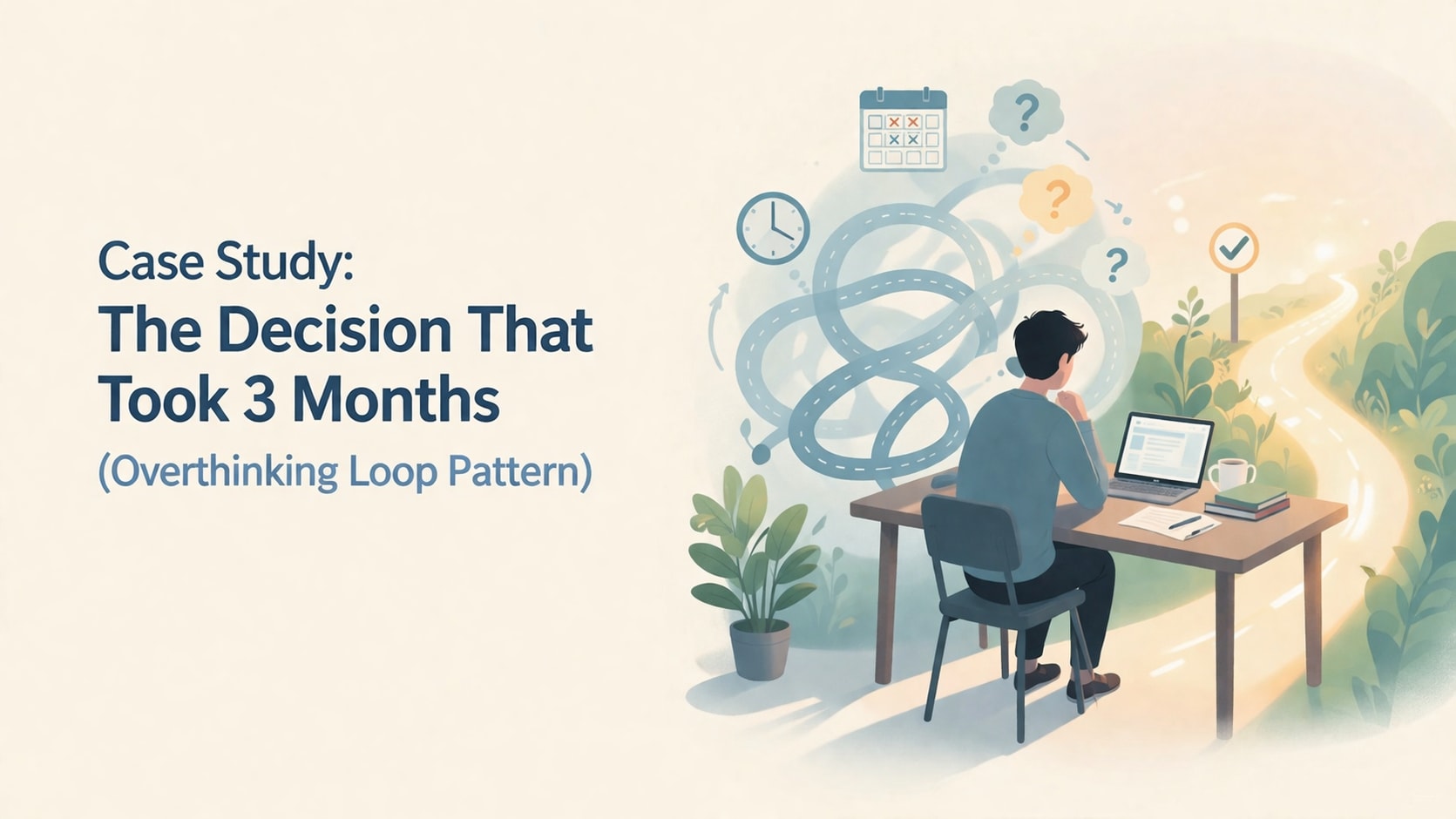
Case Study: The Decision That Took 3 Months
A decision was identified early.
The options were clear.
The next step was known.
The outcome was uncertain, but not unfamiliar.
The decision should have taken a few days.
It took three months.
The situation
The individual needed to make a career-related decision.
Two paths were available.
One offered stability and predictability.
The other offered growth but included uncertainty.
The individual gathered information.
They compared both options.
They spoke to others.
They reviewed similar cases.
After a short period, the conclusion became clear.
The second option aligned better with long-term goals.
But no action followed.
The decision remained open.
The pattern that appeared
The delay did not come from lack of information.
It came from repetition.
The same decision was revisited multiple times.
Each review followed a similar structure.
Step 1: Re-evaluation
The individual re-examined the same options.
Step 2: Scenario simulation
They imagined possible outcomes, both positive and negative.
Step 3: Doubt introduction
New questions appeared, even after previous clarity.
Step 4: Temporary conclusion
The same answer returned.
Step 5: Delay
No action was taken.
The loop restarted.
This repeated for weeks.
The thinking changed slightly.
The conclusion did not.
This is how overthinking loops operate in real situations.
You can explore the full pattern here:
Why the mind reacted this way
The behavior was not random.
It followed a predictable structure.
The decision itself was not the problem.
The consequences of the decision were.
The second option introduced uncertainty.
It required adaptation.
It included the possibility of visible failure.
The brain responded to this in a specific way.
It attempted to reduce risk through thinking.
Several mechanisms were active.
Uncertainty avoidance
The mind tried to eliminate unknown outcomes before acting.
Fear of failure
The cost of making a wrong decision was mentally amplified.
Self-doubt cycles
The individual questioned their ability to handle the outcome.
Perfectionism patterns
The decision was expected to feel completely certain before action.
Because certainty was incomplete, the brain continued thinking.
But thinking could not remove uncertainty entirely.
So the loop continued.
Where this pattern connects
This pattern rarely exists alone.
It connects to several other behavioral loops.
Overthinking loops
The mind repeated analysis beyond usefulness.
Fear of failure
The decision carried perceived risk.
Self-doubt cycles
Confidence in handling the outcome was unstable.
Procrastination patterns
Action was delayed while thinking continued.
All of these are part of broader self-sabotage patterns.
Not through obvious mistakes.
Through repeated hesitation.
You can explore that system here:
The Complete Guide to Self-Sabotage Patterns
What this case reveals about human behavior
The most important detail in this case is simple.
The answer appeared early.
The delay happened after clarity.
This is where many people misinterpret the problem.
They assume they need more information.
In reality, the issue is not clarity.
It is tolerance for uncertainty.
The brain attempts to convert uncertain decisions into certain ones.
But some decisions cannot be made that way.
They require action before certainty.
When the mind does not accept this, it continues thinking.
Not to find the answer.
But to delay the moment where the answer must be acted on.
This is how ordinary decisions become extended loops.
Final reflection
This case does not stand out.
It is common.
The timeline changes.
The situation changes.
The pattern remains the same.
A decision is understood.
The mind continues thinking.
Action is delayed.
Eventually, the decision is made.
But not because the thinking created clarity.
Because time forced movement.
Once you see the pattern clearly, something changes.
You begin noticing when thinking stops helping.
And when delay begins.
Related Patterns
This pattern often appears alongside others.
- Overthinking Loops
- Decision Paralysis Psychology
- Self-Doubt Cycles (coming soon)
- Pattern Interruption Framework (coming soon)
- The Complete Guide to Self-Sabotage Patterns
