export const metadata = { title: "Overanalysis Patterns (Overanalysis Psychology)", description: "Overanalysis psychology explains why the mind keeps rethinking decisions and how hidden mental loops create hesitation, doubt, and delayed action." }
export const slug = "overanalysis-patterns"
export const tags = [ "overanalysis psychology", "overthinking patterns", "self sabotage patterns", "decision making psychology", "mental loops", "analysis paralysis", "human behavior", "cognitive patterns" ]
import Image from "next/image"
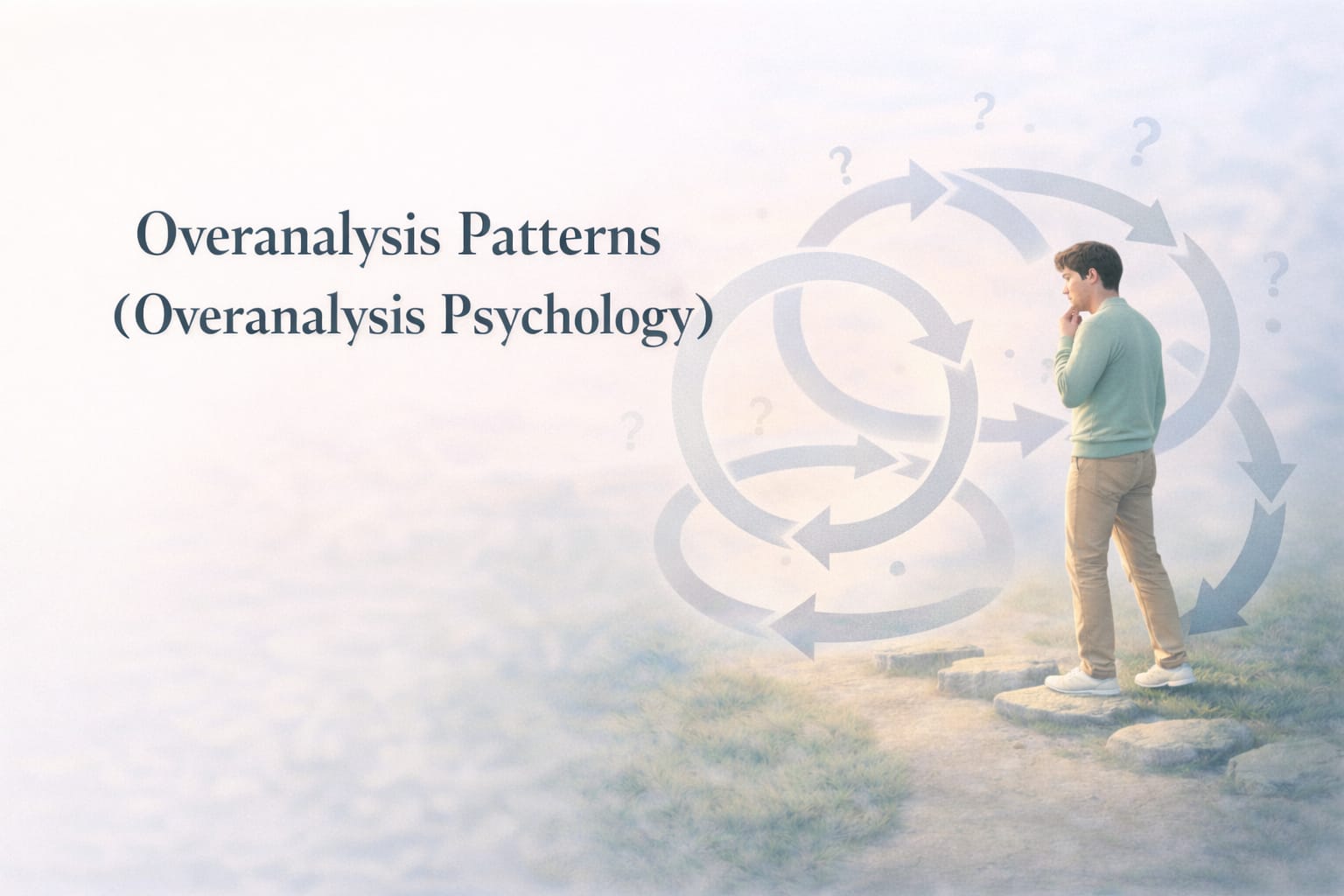
<Image src="/images/overanalysis-patterns-banner.jpg" alt="Minimal illustration of a person surrounded by looping thoughts and decision paths, symbolizing overanalysis and mental loops" width={1600} height={900} priority style={{ width: "100%", height: "auto", borderRadius: "16px", marginTop: "1rem", marginBottom: "2rem" }} />
Overanalysis Patterns (Overanalysis Psychology)
Overanalysis psychology is something most people experience without realizing it has a pattern.
It doesn’t feel like a problem.
It feels like thinking.
Careful thinking.
Responsible thinking.
You go over a decision…
then go over it again.
You consider different angles…
then revisit the same ones.
You try to get clarity…
but end up feeling less certain.
You might not notice it at first.
But if you look closely, something interesting appears.
The thinking is not moving forward.
It is circling.
And that’s where the pattern begins.
Before you go further
If this feels familiar, you may be noticing more than one pattern.
→ Download: The Self-Sabotage Pattern Recognition Guide
Identify the 7 hidden behavioral loops that quietly shape your decisions, delay progress, and keep you stuck in familiar cycles.
What this behavior actually is
Overanalysis psychology describes a mental pattern where thinking continues beyond usefulness.
It is not about lack of intelligence.
In many cases, it is the opposite.
The mind keeps processing…
even after a decision could have been made.
You replay options.
You imagine outcomes.
You refine your reasoning.
But the thinking does not lead to resolution.
It leads to repetition.
The same thoughts appear again…
slightly rearranged.
Slightly reframed.
But essentially unchanged.
It feels productive.
But it rarely produces movement.
That’s what makes overanalysis difficult to recognize.
It looks like effort.
But functions like a loop.
Why the brain does this
The brain is trying to reduce uncertainty.
That is its priority.
Not speed.
Not action.
But certainty.
When a decision feels unclear…
the mind keeps working.
It searches for a point where everything feels resolved.
Where no risk remains.
Where the outcome feels predictable.
But that point rarely exists.
So the thinking continues.
The brain believes more analysis will create clarity.
But in many cases, it creates the opposite.
Because each new thought introduces another angle.
Another possibility.
Another variable.
So instead of closing the loop…
the mind expands it.
That’s why overanalysis psychology often feels endless.
The brain is not trying to confuse you.
It is trying to protect you from making a wrong move.
But in doing so, it keeps you in place.
Where it appears in everyday life
Overanalysis hides in normal decisions.
You see it when:
You reread messages before sending them
You rethink a decision you already made
You delay action to “think a bit more”
You imagine multiple outcomes before acting
You question your choices after committing
It also appears in small moments.
Choosing what to say.
What to post.
What to start.
What to stop.
Even simple actions can become complex.
Not because they are complicated…
but because the mind keeps adding layers.
You might notice something else.
The more you think…
the less certain you feel.
That is the signal.
The thinking is no longer clarifying.
It is looping.
The hidden cost
Overanalysis does not always look harmful.
It looks like caution.
It looks like depth.
It looks like intelligence.
But over time, it creates subtle effects.
Decisions take longer.
Opportunities pass quietly.
Confidence weakens.
Not because you lack ability…
but because you keep revisiting what was already clear.
Action becomes delayed.
Not by fear alone…
but by thinking that never concludes.
The mind creates a loop:
Question → Analyze → Expand → Doubt → Repeat
Each cycle feels like progress.
But it rarely leads to movement.
And slowly, this becomes a pattern.
You begin to trust thinking more than action.
You begin to delay decisions by default.
And without noticing, the pattern shapes your outcomes.
The pattern most people miss
Most people believe overanalysis comes from complexity.
That the situation is simply difficult.
But if you observe closely, something interesting appears.
The pattern shows up even when the decision is simple.
The same looping thinking appears across different areas.
Different situations.
Different levels of importance.
That consistency is the clue.
It is not about the situation.
It is about the pattern.
The mind is trying to reach a level of certainty that does not exist.
So it continues thinking.
Not because it needs more information…
but because it is avoiding the moment of decision.
That’s where the pattern shifts.
Overanalysis is not just about thinking too much.
It is about delaying commitment.
Final reflection
Overanalysis psychology does not feel like a problem while it is happening.
It feels like effort.
Like careful thinking.
Like responsibility.
But if you look closely, something interesting appears.
The thinking repeats.
The clarity does not increase.
The decision does not arrive.
And the same loop continues.
You might not notice it at first.
But once you see it,
the pattern becomes easier to recognize.
Not in theory.
But in real time.
In the moment where thinking starts to circle.
And that awareness changes something.
Not by stopping the thinking…
but by revealing it.
What is overanalysis psychology?
It is a mental pattern where thinking continues beyond usefulness, creating loops that delay decisions instead of clarifying them.
Is overanalysis the same as overthinking?
They are closely related. Overanalysis focuses more on repeated evaluation of decisions, while overthinking can include broader mental loops.
Why do I keep analyzing the same decision?
Because the brain is trying to reduce uncertainty. It keeps searching for complete clarity, which often does not exist.
How can I tell if I’m overanalyzing?
If your thinking repeats without leading to a decision, and clarity does not increase over time, you are likely in an overanalysis loop.
Does overanalysis affect decision-making?
Yes. It delays action, reduces confidence, and can cause missed opportunities due to prolonged hesitation.
Related patterns
→ Overthinking Loops: Why Your Mind Won’t Let Decisions Go
→ The Complete Guide to Self-Sabotage Patterns
→ Why Starting Feels Harder Than Continuing
→ What Is Psychological Resistance
