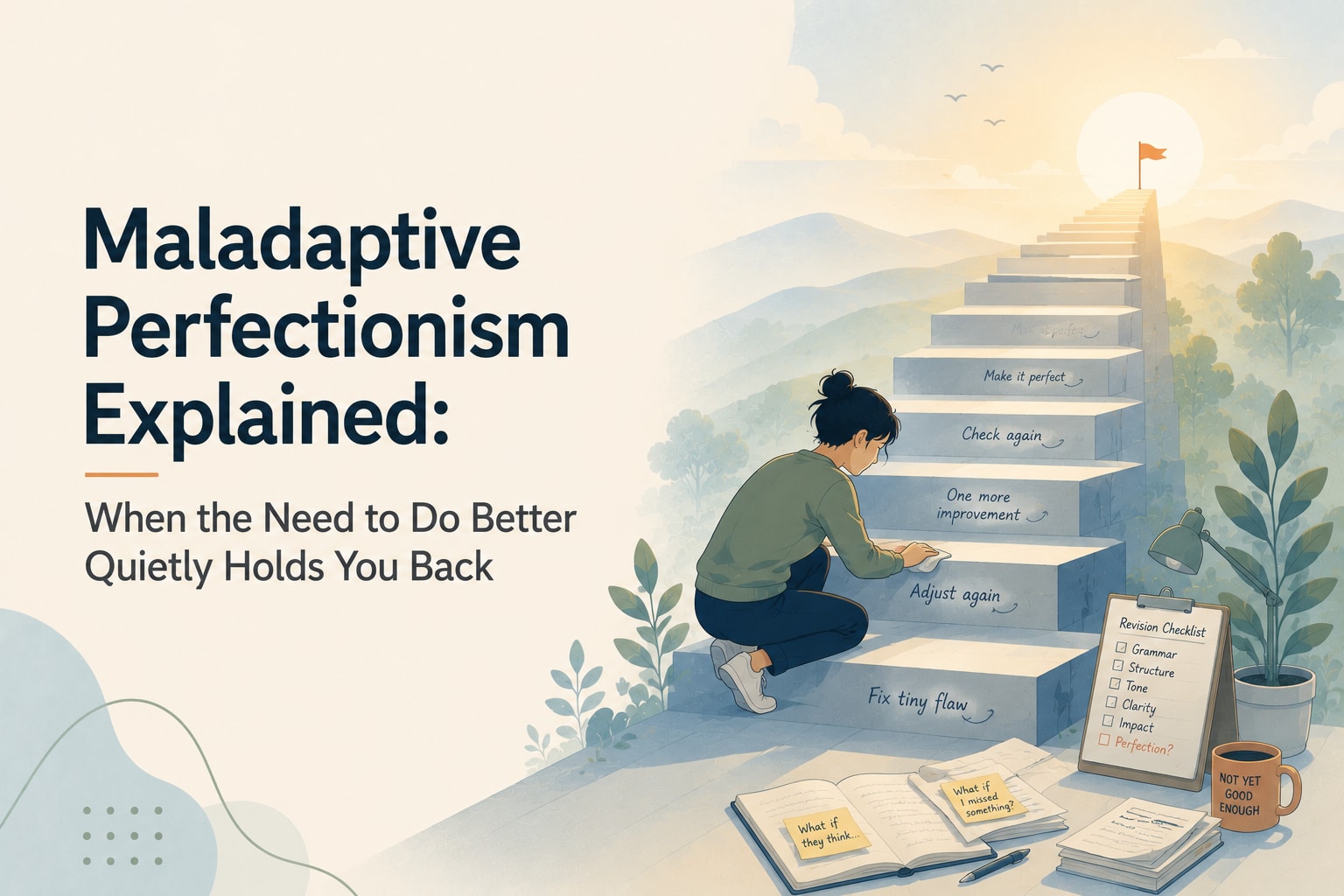
Maladaptive Perfectionism Explained
Maladaptive perfectionism explained begins with a feeling many people know well.
You finish a project.
Then you notice something that could be slightly better.
So you change it.
Then you notice something else.
Soon, what was finished no longer feels finished.
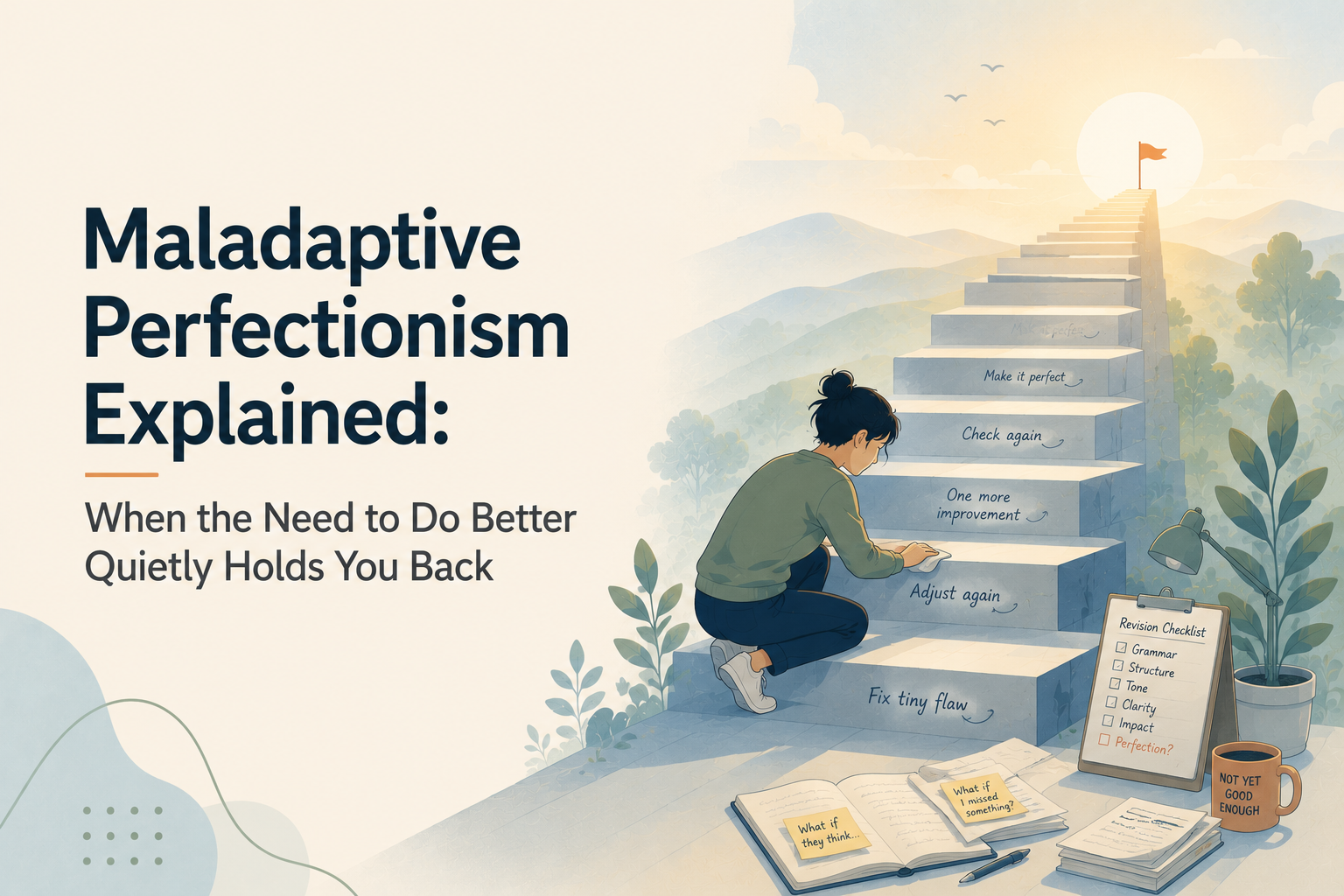
Instead of feeling satisfied, you feel responsible for making it even better.
At first, this seems like dedication.
You simply care about quality.
You want to do things well.
But if you look closely, something interesting appears.
The work itself is no longer the main concern.
The real goal becomes avoiding the uncomfortable feeling that comes with letting something be imperfect.
That is where the pattern begins.
The Behavior Most People Don't Notice
Maladaptive perfectionism is a pattern where the desire to do well quietly becomes a fear of doing anything imperfect.
The word maladaptive simply means that a strategy that once seemed helpful eventually starts working against you.
Wanting to improve your work is healthy.
Learning from mistakes is healthy.
Taking pride in quality is healthy.
Maladaptive perfectionism is different.
Instead of helping you create better work, it convinces you that nothing is ever ready.
The standard keeps moving.
You finish writing an article.
Then spend another hour changing words that readers would never notice.
You prepare for an interview.
Then convince yourself you need another week before applying.
You organize an idea until it becomes too intimidating to begin.
The behavior looks productive from the outside.
Inside, it feels surprisingly heavy.
This is why maladaptive perfectionism often overlaps with broader self-sabotage patterns.
The goal is still important.
The mind simply makes reaching it increasingly difficult.
Why the Brain Does This
The brain is constantly trying to protect you.
Sometimes from physical danger.
Often from emotional discomfort.
Criticism.
Embarrassment.
Failure.
Rejection.
These experiences leave emotional memories.
Over time, the mind quietly develops a strategy.
"If I make fewer mistakes, maybe I can avoid those feelings."
That sounds reasonable.
Until the brain begins treating perfection as the only acceptable level of safety.
Suddenly, every decision feels important.
Every sentence feels permanent.
Every choice feels like evidence of your ability.
Instead of asking,
"Is this useful?"
The brain starts asking,
"Is this impossible to criticize?"
That question never has a satisfying answer.
So the mind keeps searching.
Another edit.
Another revision.
Another possibility.
This is how overthinking loops quietly form.
Each improvement creates temporary relief.
But only temporary.
Soon another flaw appears.
The cycle begins again.
What started as careful thinking slowly becomes emotional protection.
Where This Pattern Shows Up in Daily Life
Maladaptive perfectionism rarely announces itself.
It blends into ordinary routines.
You rewrite a simple email several times.
You postpone launching your business because the website still needs small improvements.
You spend hours researching before buying something relatively inexpensive.
You avoid applying for opportunities because your résumé feels incomplete.
You delay posting your creative work because one sentence still bothers you.
You rehearse conversations until they feel emotionally exhausting.
You continue preparing long after preparation has stopped producing new insights.
Notice something interesting.
Most of these situations are not about ability.
They are about certainty.
The mind quietly believes that enough preparation will eliminate discomfort.
Reality rarely works that way.
Every meaningful decision contains uncertainty.
No amount of thinking completely removes it.
The longer perfectionism remains in charge, the easier it becomes to mistake endless refinement for genuine progress.
The Hidden Effect of This Pattern
The obvious cost of maladaptive perfectionism is time.
The hidden cost is trust.
Every time you second-guess a reasonable decision, you teach yourself that your judgment cannot be trusted.
Every time you reopen finished work, you reinforce the belief that completion is unsafe.
Over months or years, this changes how you experience almost everything.
Simple choices begin to feel significant.
Ordinary mistakes begin to feel deeply personal.
Success becomes strangely unsatisfying because your attention immediately moves toward what still needs fixing.
You might not notice it at first.
Others may even admire your dedication.
They see someone who works carefully.
They do not see how exhausting that carefulness has become.
Eventually, confidence starts depending on impossible conditions.
You tell yourself you will feel confident after one more improvement.
One more course.
One more revision.
One more perfect attempt.
But confidence rarely arrives that way.
Because the standard keeps changing.
The finish line quietly moves every time you approach it.
What This Reveals About Human Behavior
Maladaptive perfectionism reveals something surprisingly human.
People are not always trying to create better work.
Sometimes they are trying to protect themselves from emotional uncertainty.
That changes how we understand perfectionism.
It is not simply ambition.
It is often a form of emotional prediction.
The mind imagines future criticism and starts solving it before it exists.
The strange part is that this prediction slowly becomes more powerful than reality itself.
You may spend days preparing for reactions that never happen.
You may avoid sharing work that would have been appreciated.
You may keep improving something that was already good enough.
The mind believes certainty creates confidence.
Life teaches something different.
Confidence grows from repeated experience.
From completing things.
From discovering that mistakes are survivable.
From realizing you are capable of adapting after reality responds.
That is why action so often teaches lessons that thinking cannot.
Final Reflection
Maladaptive perfectionism explained is ultimately a story about protection.
The mind is not trying to make your life difficult.
It is trying to keep you emotionally safe.
The problem is that safety achieved through endless preparation is never complete.
There is always another possibility.
Another improvement.
Another imagined mistake.
The next time you find yourself making one more adjustment before calling something finished, pause for a moment.
Ask yourself:
Am I improving this because it genuinely needs it... or because finishing feels emotionally uncomfortable?
The answer is often quieter than you expect.
But it reveals the pattern.
Because healthy growth is not built on flawless performance.
It is built on the willingness to let imperfect work enter the real world, where experience—not endless preparation—becomes your greatest teacher.
Q: What is maladaptive perfectionism?
A: Maladaptive perfectionism is a pattern where striving for excellence becomes driven by the fear of mistakes, criticism, or failure. Instead of improving performance, it often leads to overthinking, delay, and chronic self-criticism.
Q: How is maladaptive perfectionism different from healthy perfectionism?
A: Healthy standards encourage learning and completion. Maladaptive perfectionism keeps raising the standard, making it difficult to feel satisfied or believe that your work is ever ready.
Q: Does maladaptive perfectionism cause procrastination?
A: Often, yes. When the fear of producing imperfect work becomes stronger than the desire to finish, people may delay starting, completing, or sharing their work.
Q: Is maladaptive perfectionism connected to overthinking?
A: Absolutely. It frequently creates overthinking loops because the mind keeps searching for certainty and hidden flaws instead of accepting that no amount of preparation can remove every possibility of imperfection.
