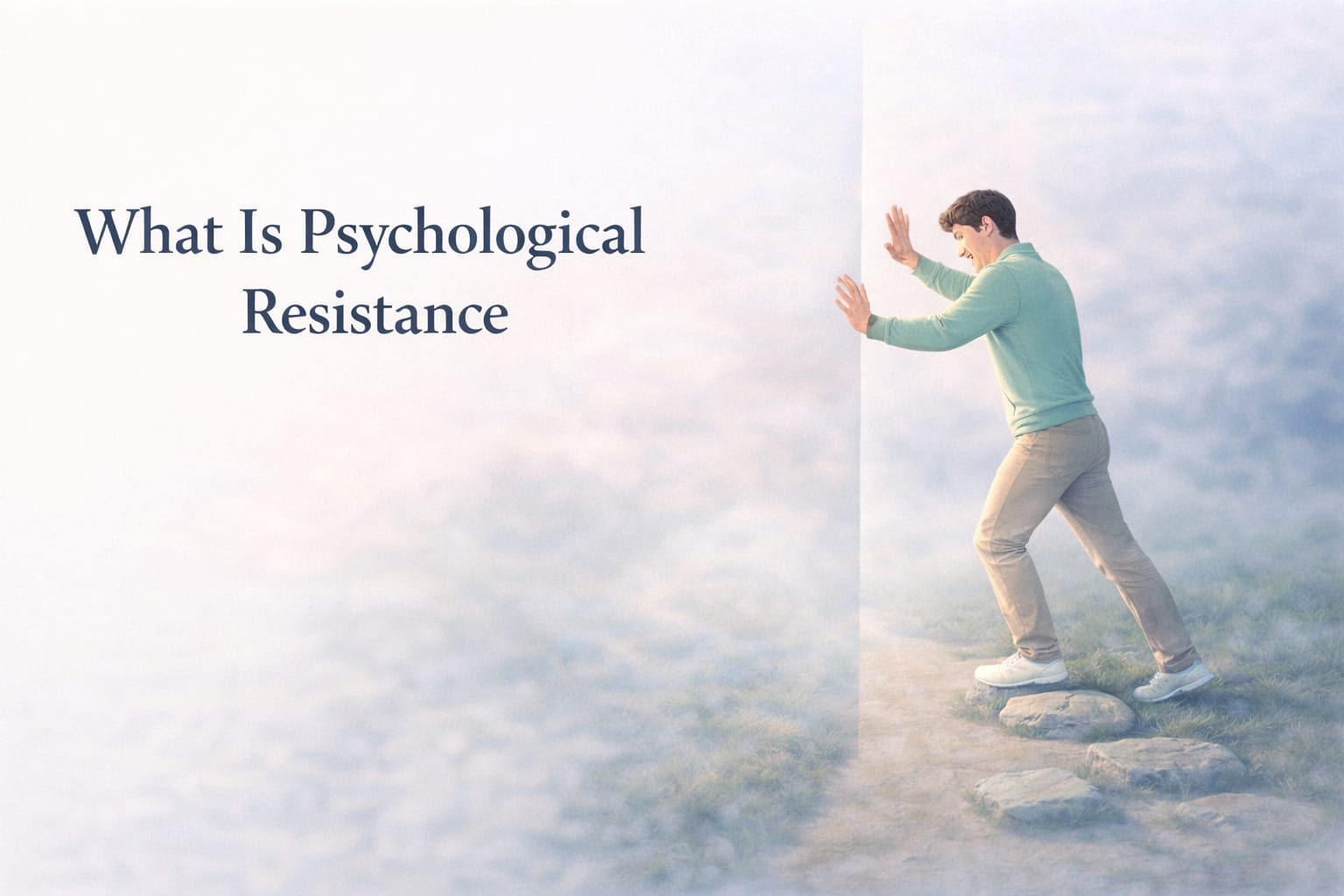
What Is Psychological Resistance
Most people have felt it…
but few recognize it.
It doesn’t look dramatic.
It doesn’t feel obvious.
It shows up as a pause.
A delay.
A quiet “not now.”
You plan to do something simple…
and suddenly feel a subtle pushback.
Not strong enough to stop you completely.
But enough to slow you down.
You might not notice it at first.
But if you look closely, something interesting appears.
The resistance is not in the task.
It is in your reaction to it.
And that’s where the pattern begins.
What this concept means
Psychological resistance is a mental response that makes action feel harder than it should be.
It is not always loud.
It does not announce itself.
It works quietly.
You think about doing something…
and feel a slight discomfort.
You hesitate.
You delay.
You look for reasons to postpone.
Even when the task is simple.
Even when you want to do it.
That’s what makes it confusing.
Because the resistance does not come from a lack of desire.
It comes from a subtle internal friction.
It creates a gap between intention and action.
You know what to do.
But something slows you down.
That “something” is psychological resistance.
Why the brain creates this pattern
The brain is designed to protect stability.
It prefers what is familiar.
What it understands.
What it can predict.
Any action that disrupts that familiarity triggers a response.
Not necessarily fear.
But caution.
Even small actions can create this effect.
Because change, no matter how small, introduces uncertainty.
The brain reacts by creating resistance.
Not to stop you completely.
But to slow the shift.
To give itself time to adjust.
It does this by making action feel slightly uncomfortable.
Slightly heavier.
Slightly less appealing.
That’s why psychological resistance feels so subtle.
It is not meant to block you.
It is meant to delay you.
How this pattern appears in daily life
Psychological resistance hides in ordinary behavior.
You see it when:
You open a task… then close it
You think about starting… but scroll instead
You delay something simple for no clear reason
You feel “off” right before beginning
You keep planning… but don’t act
It also appears in decisions.
You know what choice to make…
but hesitate anyway.
You revisit the same thought multiple times.
Not because it is unclear.
But because resistance keeps you in place.
You might notice something else.
Once you finally act…
the resistance fades.
The task feels easier than expected.
That contrast reveals the pattern.
The difficulty was not in the action.
It was in the resistance before it.
Why people often miss it
Psychological resistance is easy to overlook.
Because it disguises itself as logic.
“I’ll do it later.”
“I’m not in the right mood.”
“I need more time.”
These explanations feel reasonable.
So people trust them.
They don’t question the delay.
They accept it.
But if you observe closely, something interesting appears.
The same reasons show up again.
And again.
Across different situations.
Different tasks.
Different days.
That repetition is not coincidence.
It is a pattern.
But because the resistance feels small…
it goes unnoticed.
And because it goes unnoticed…
it continues.
Final reflection
Psychological resistance is not something most people try to understand.
They experience it…
but don’t name it.
It slows action.
It creates delay.
It turns simple tasks into heavier ones.
Not by changing the task…
but by changing how it feels.
You might not notice it at first.
But the moment you begin to see it,
something shifts.
The hesitation looks different.
The delay feels less convincing.
The pattern becomes visible.
And once a pattern becomes visible…
it no longer operates in the same way.
Not because it disappears.
But because it is no longer hidden.
FAQ
What is psychological resistance in simple terms?
It is a mental friction that makes starting or continuing an action feel harder than it actually is, leading to delay or avoidance.
Is psychological resistance the same as procrastination?
Not exactly. Resistance is the internal feeling that causes hesitation, while procrastination is the behavior that follows.
Why do I feel resistance even for small tasks?
Because the brain reacts to any form of change, even small ones, by creating slight discomfort to slow the transition.
How can I recognize psychological resistance?
Notice when you hesitate without a clear reason, especially right before starting something you already decided to do.
Does psychological resistance ever go away?
It is a natural mental pattern. It may not disappear completely, but recognizing it changes how strongly it affects your actions.
Related patterns
→ Why Starting Feels Harder Than Continuing
→ Why the Brain Resists Change
→ Why Progress Feels Uncomfortable
→ The Complete Guide to Self-Sabotage Patterns
