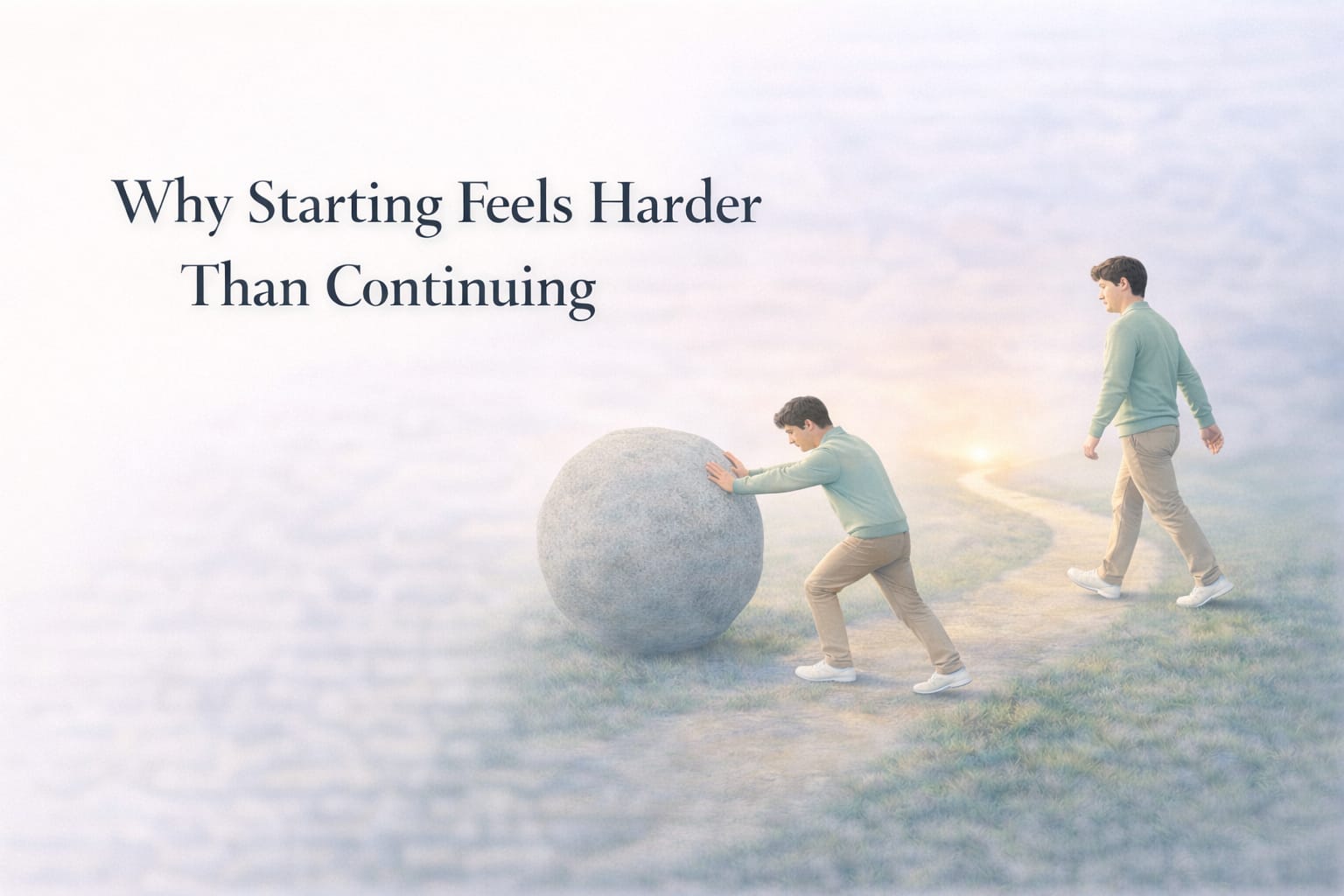
Why Starting Feels Harder Than Continuing
This is something most people experience…
but rarely stop to examine.
It shows up in small, ordinary moments.
You plan to begin something simple…
and feel an unexpected resistance.
But once you finally start…
it becomes easier to keep going.
The task didn’t change.
But the feeling did.
You might not notice it at first.
But if you look closely, something interesting appears.
The difficulty is not in the work itself.
It is in the moment before the work begins.
And that’s where the pattern starts.
What this concept means
This pattern describes a common experience:
The beginning of an action feels heavier than the action itself.
You think about starting…
and it feels difficult.
You imagine the effort…
and it feels larger than it actually is.
But once you take the first step…
the resistance fades.
The task becomes manageable.
Sometimes even easy.
So the problem is not continuation.
It is initiation.
The mind treats the starting point differently.
As if it carries more weight.
More uncertainty.
More effort.
And because of that, the beginning feels harder than the middle or the end.
Why the brain creates this pattern
The brain is designed to conserve energy.
It avoids unnecessary effort.
It prefers actions that are already in motion.
Because movement requires less decision-making than starting.
Starting something new requires a shift.
From rest to action.
From stillness to movement.
That shift demands energy.
Not just physical…
but mental.
The brain has to:
Decide what to do
Override comfort
Focus attention
Initiate action
All at once.
That moment of activation is where resistance appears.
Once the action begins, the brain relaxes.
Because the hardest part…
has already passed.
That’s why starting feels harder than continuing.
Not because the task is difficult.
But because the brain resists the transition into action.
How this pattern appears in daily life
You can see this pattern almost everywhere.
It appears when:
You delay starting a simple task
You keep thinking about doing something but don’t begin
You wait for the “right moment” to act
You open something… then close it without starting
You tell yourself you’ll begin later
The task itself is often not the issue.
It might be small.
Quick.
Even easy.
But the starting point feels heavy.
You might notice something else.
Once you finally begin…
you often continue longer than expected.
What felt difficult suddenly feels natural.
That shift is the pattern revealing itself.
Why people often miss it
Most people don’t recognize this pattern.
Because it doesn’t feel like a pattern.
It feels like a valid reason.
“I’m not ready.”
“I’ll do it later.”
“This isn’t the right time.”
These thoughts feel logical.
But they are often responses to resistance.
Not reflections of reality.
The mind creates a small barrier at the beginning.
And then explains it away.
So instead of seeing the pattern…
people trust the explanation.
They assume the task is the problem.
Or their energy.
Or their timing.
But if you observe closely, something interesting appears.
The same resistance shows up again.
And again.
Always at the start.
That consistency is the clue.
Final reflection
Why starting feels harder than continuing is not about discipline.
It is about how the mind handles transitions.
The brain resists the moment where action begins.
Because that moment requires energy, focus, and change.
But once movement starts…
the resistance fades.
And the task becomes easier to carry forward.
You might not notice it at first.
But the difficulty is not in doing.
It is in beginning.
And once you see that clearly…
something shifts.
The next time resistance appears,
it no longer feels like a mystery.
It starts to look like a pattern.
FAQ
Why is it so hard to start simple tasks?
Because starting requires mental activation. The brain resists this shift from rest to action, even if the task itself is easy.
Why does it get easier after I begin?
Once action starts, the brain no longer needs to initiate movement. It simply continues what is already in progress.
Is this the same as procrastination?
It is closely related. This pattern often explains why procrastination happens at the beginning of tasks.
How can I recognize this pattern?
Notice if resistance appears before starting but disappears after you begin. That difference is a key sign.
Does everyone experience this?
Yes. It is a natural part of how the brain conserves energy and manages effort.
Related patterns
→ Why the Brain Resists Change
→ Why Progress Feels Uncomfortable
→ Overthinking Loops: Why Your Mind Won’t Let Decisions Go
→ The Complete Guide to Self-Sabotage Patterns
