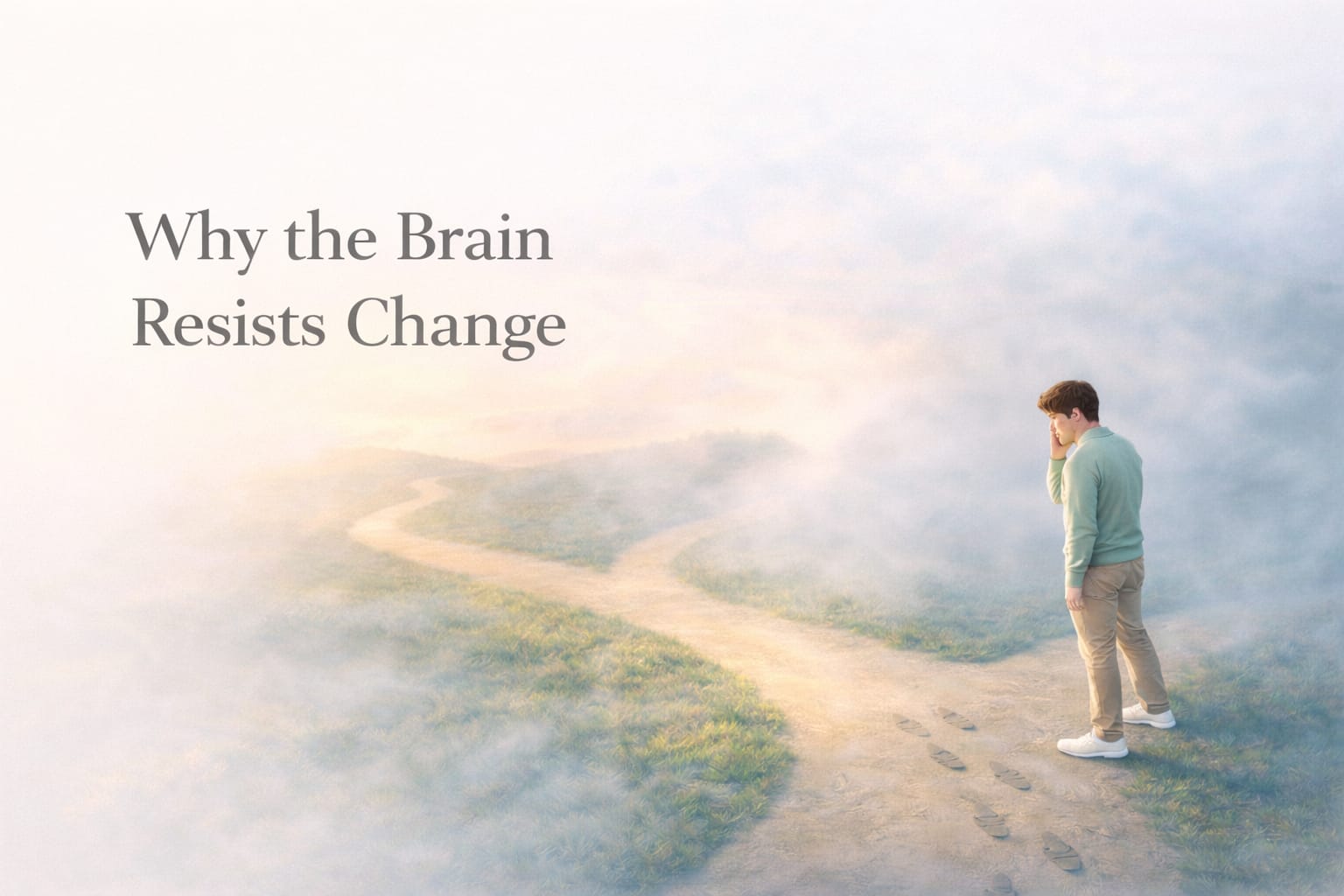
Why the Brain Resists Change
Why the brain resists change is not always obvious.
It rarely feels like resistance.
It feels like hesitation.
Delay.
A quiet pull back into what is familiar.
You might not notice it at first.
But if you look closely, something interesting appears.
The mind is not always trying to improve your life.
Sometimes, it is trying to protect what already exists.
And that’s where the pattern begins.
Before you go further
If this feels familiar, you may be noticing more than one pattern.
→ Download: The Self-Sabotage Pattern Recognition Guide
Identify the 7 hidden behavioral loops that quietly shape your decisions, delay progress, and keep you stuck in familiar cycles.
The behavior most people don’t notice
The brain does something subtle when faced with change.
It slows you down.
Not dramatically.
Just enough.
You open a new opportunity… and suddenly feel tired.
You think about starting something… and remember something else you should do first.
You decide to change a habit… and feel an unexpected discomfort.
It doesn’t feel like fear.
It feels like logic.
Like timing is wrong.
Like maybe later would be better.
But if you observe closely, the pattern repeats.
Not once.
Not twice.
But consistently.
The moment something new appears, something inside quietly resists it.
Why the mind creates this pattern
The brain is designed for efficiency.
Not transformation.
Familiar patterns require less energy.
Less thinking.
Less uncertainty.
Change, on the other hand, demands attention.
It introduces unknown outcomes.
And the brain treats the unknown as a potential risk.
Even when the change is positive.
Even when it leads to growth.
The mind does not evaluate change based on long-term benefit.
It evaluates based on immediate stability.
So it asks one silent question:
“Is this safe to disrupt what already works?”
If the answer is unclear, resistance begins.
Not loudly.
But subtly.
That’s why the brain resists change.
Not because it wants to hold you back.
But because it wants to keep things predictable.
Where this shows up in everyday life
This pattern hides in ordinary moments.
You see it when someone plans to start something new… tomorrow.
When a decision is postponed without a clear reason.
When small actions feel heavier than they should.
It appears in:
Starting a new routine
Changing environments
Making important decisions
Leaving familiar situations
Even positive change can trigger resistance.
A better opportunity.
A new direction.
A fresh start.
And still, the mind hesitates.
Because familiarity feels safer than possibility.
You might not notice it at first.
But the delay is not random.
It follows a pattern.
The hidden effect
Over time, this resistance shapes outcomes.
Not dramatically.
But quietly.
Small delays become missed opportunities.
Hesitation becomes inaction.
Inaction becomes a pattern.
And eventually, it starts to look like identity.
“I’m just someone who takes time.”
“I’m not ready yet.”
“This isn’t the right moment.”
But if you look closely, something interesting appears.
It is not about readiness.
It is about resistance.
The brain creates a loop:
Discomfort → Delay → Relief → Reinforcement
You avoid the discomfort of change.
You feel temporary relief.
And the brain learns:
“This works. Do it again.”
That’s where the loop strengthens.
And that’s where the pattern continues.
Final reflection
The brain resists change in ways that are easy to miss.
It does not block you.
It slows you.
It redirects you.
It makes staying the same feel reasonable.
Even when something better is possible.
But once you see the pattern, it becomes harder to ignore.
You begin to notice the small delays.
The subtle hesitation.
The quiet pull back into what is familiar.
And that awareness changes something.
Not instantly.
But gradually.
Because the moment you see the pattern…
It no longer runs completely unnoticed.
FAQ
Why does the brain resist change even when it’s good?
The brain prioritizes safety and predictability over improvement. Even positive change introduces uncertainty, which the mind interprets as potential risk.
Is resisting change a form of self-sabotage?
It can be. When resistance repeatedly delays beneficial actions, it becomes a pattern that limits progress without obvious intention.
Why does change feel uncomfortable?
Change requires mental effort and breaks familiar patterns. This creates discomfort because the brain prefers routines that require less energy.
How can I tell if I’m resisting change?
Look for repeated delays, hesitation without clear reasons, and choosing familiar options even when better alternatives are available.
Does everyone experience this pattern?
Yes. It is a natural part of how the brain works, though it shows up differently depending on the situation and individual habits.
Related patterns
If you noticed this pattern, you may also recognize:
→ Overthinking Loops: Why Your Mind Won’t Let Decisions Go
→ Why Too Many Choices Create Anxiety
→ The Complete Guide to Self-Sabotage Patterns
→ Why Smart People Experience Imposter Syndrome
