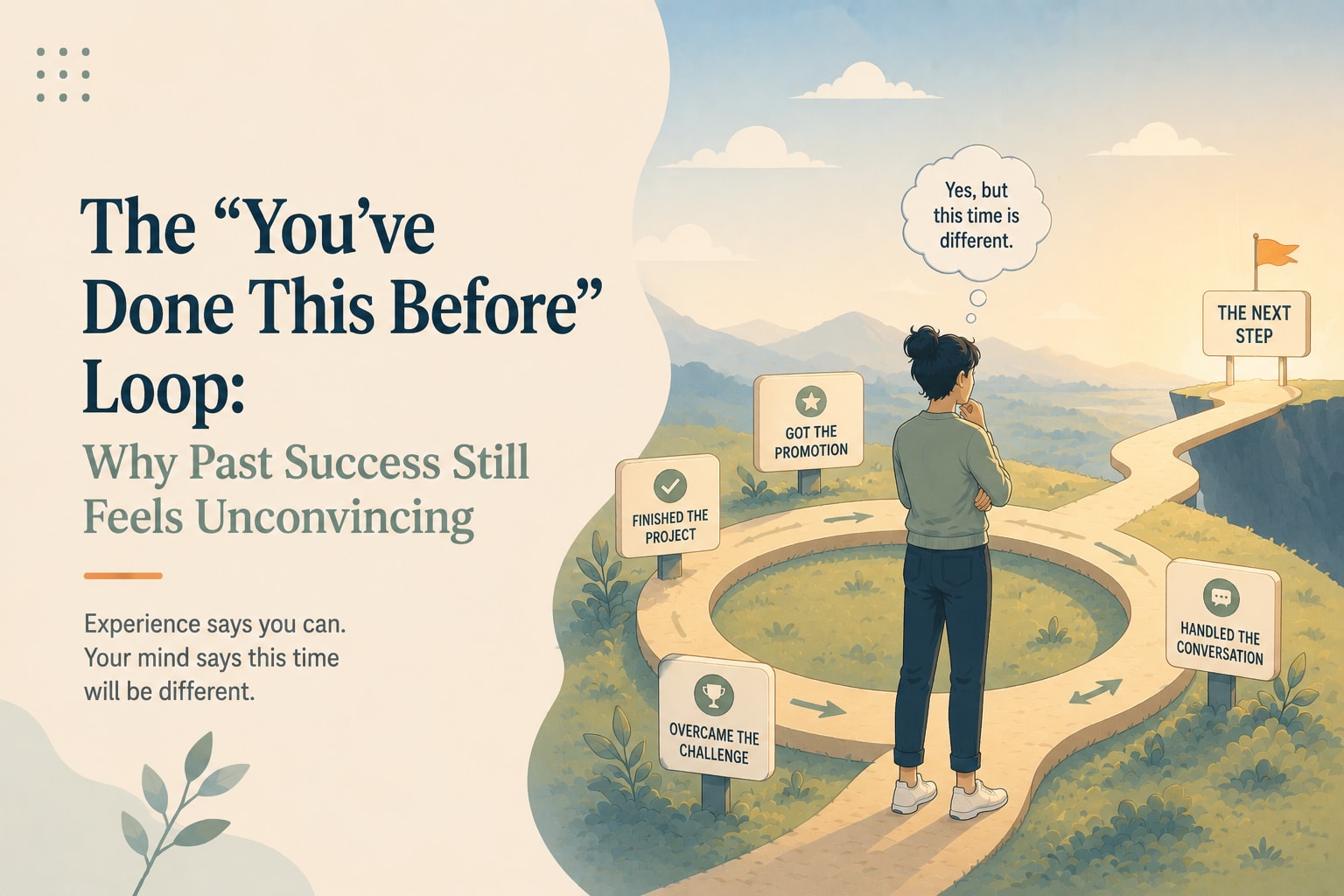
The “You’ve Done This Before” Loop: Why Past Success Still Feels Unconvincing
The You’ve Done This Before Loop begins when a familiar challenge returns, but your previous success does not feel emotionally available.
You have handled something like this before.
You have evidence.
You remember completing the project, surviving the conversation, making the decision, or finding your way through the uncertainty.
Someone may even remind you:
"You’ve done this before."
For a moment, the reminder makes sense.
Then your mind quietly adds:
"Yes, but this time is different."
The past achievement remains true.
It simply stops feeling relevant.
That is what makes this loop difficult to recognise.
You are not forgetting your history.
You are repeatedly creating reasons your history should not count.
What the “You’ve Done This Before” Loop Describes
This framework describes the gap between remembered competence and felt competence.
You can know that you have succeeded before while still feeling as though the next attempt will reveal something different.
Past experience says:
"I have handled this."
The present feeling says:
"That does not prove I can handle this version."
The mind then begins separating the current situation from every previous success.
The audience is larger.
The responsibility is greater.
The timing is worse.
The expectations are higher.
The earlier success involved luck.
The conditions were easier.
Some differences may be real.
But if you look closely, the sequence repeats even when the new situation is only slightly different.
Past success is accepted as history.
It is not accepted as evidence.
This is one of the quieter self-sabotage patterns, because the person may appear careful and realistic while repeatedly weakening the meaning of their own experience.
The Stages of the Loop
The loop usually moves through a predictable sequence.
Stage 1: A familiar demand appears
You are asked to speak, decide, publish, lead, apply, perform, or complete something you have faced before.
The details may differ, but the underlying demand is recognisable.
You have already developed some ability in this area.
Stage 2: Uncertainty rises
The new situation contains something you cannot fully predict.
You feel exposed.
The task matters.
Your attention shifts from what you know to what might go wrong.
This is often where overthinking loops begin.
Stage 3: Past evidence is remembered
You remind yourself that you have managed similar situations.
Someone else may point it out.
For a brief moment, the memory creates perspective.
You can see that the present fear is not the whole story.
Stage 4: The mind creates an exception
Almost immediately, the previous success is disqualified.
"That situation was easier."
"I had more help then."
"They expected less from me."
"I only succeeded because everything happened to go well."
The achievement remains real, but its meaning is reduced.
Stage 5: The current challenge becomes untested again
Once the past has been excluded, the present feels like a first attempt.
You no longer experience yourself as someone building on previous ability.
You feel like someone about to discover whether any ability existed at all.
That shift makes the stakes feel much larger.
Stage 6: Extra protection appears
You overprepare.
Delay.
Seek reassurance.
Revise repeatedly.
Avoid committing.
Lower expectations before anyone else can.
These behaviours reduce discomfort temporarily.
They also reinforce the idea that past experience was not enough.
Stage 7: Success happens without changing the belief
You complete the task.
The outcome may be good.
Relief appears.
Then the success is explained away like the others.
The next challenge arrives.
The loop begins again.
Why the Mind Repeats This Loop
Past success is fixed.
The present is uncertain.
The brain often gives more attention to what is unresolved than to what has already been proven.
This creates an imbalance.
Your previous achievements feel familiar and emotionally quiet.
The current risk feels immediate.
Because the uncertainty produces stronger emotion, it begins to seem more informative.
You might not notice it at first.
But the mind often treats emotional intensity as evidence.
A calm memory of success struggles to compete with a present feeling of inadequacy.
This connects with the Evidence vs Feeling Model, where emotion quietly outweighs facts without directly disproving them.
The loop is also reinforced by identity.
If you still see yourself as inexperienced, uncertain, or less capable than others believe, each success creates tension.
The achievement suggests one identity.
Your existing self-image suggests another.
Instead of updating the self-image, the mind treats the success as an exception.
This is why the pattern can overlap with Imposter Syndrome Explained.
You continue accumulating evidence of competence while finding new reasons not to internalise it.
Where This Pattern Appears in Daily Life
The loop often appears before visible moments.
A professional has delivered several successful presentations but feels unqualified before each new one.
A creator has published useful work before but treats every new article as the piece that may finally reveal their limitations.
A manager has solved difficult problems but assumes the next challenge requires a level of ability they do not possess.
A person has set boundaries successfully before, yet every new boundary feels like an unfamiliar social risk.
A student has passed previous examinations but believes the next one will expose how little they really understand.
The pattern also appears during recovery from setbacks.
You may have moved through disappointment before.
You may know that difficult emotions eventually changed.
But when another setback arrives, previous resilience feels strangely irrelevant.
The mind says:
"That was different."
Sometimes it was.
But the conclusion often goes further.
It turns difference into proof that nothing from the past can help you understand the present.
The framework becomes especially visible in prolonged creative or professional work.
In The Project That Never Launched, a person may have completed strong work before, yet each new project becomes another test of whether they are truly capable of finishing.
Experience exists.
The emotional sense of experience does not.
What Keeps the Loop Going
The loop survives because each round ends with relief rather than integration.
You finish the task.
The pressure drops.
You move on.
But the achievement is not allowed to change your expectation of yourself.
Instead, the mind focuses on what almost went wrong.
The hours of preparation.
The mistakes that were nearly visible.
The help you needed.
The parts that could have been better.
This creates a distorted record.
The success is remembered.
The competence behind it is not.
Perfectionism strengthens the loop by allowing only effortless or flawless performance to count as proof of ability.
If you were anxious, then you were not truly confident.
If you needed preparation, then you were not naturally capable.
If you made corrections, then the success was not clean enough.
The standard makes competence almost impossible to recognise.
Self-doubt adds another layer.
As explained in Self-Doubt vs Low Confidence, you may not only question the task.
You may question your ability to handle it.
Each new challenge becomes a fresh evaluation of the self.
Past success does not settle the question because the mind believes the real test has not happened yet.
The next task is always the one that will reveal the truth.
Final Reflection
The “You’ve Done This Before” Loop is not a lack of evidence.
It is a repeated failure to let evidence accumulate.
You complete something difficult.
The result becomes part of your history.
But it does not become part of how you understand yourself.
The next challenge arrives.
Uncertainty returns.
The mind disqualifies the past.
You feel inexperienced again.
But if you look closely, the sequence repeats.
The situation changes.
The explanation changes.
The conclusion remains the same:
"This time, what I have already done may not count."
That is the loop.
Past success is acknowledged but never allowed to create present trust.
The mind keeps waiting for one final achievement that will make competence feel undeniable.
Yet each achievement is processed through the same pattern.
Perhaps the most revealing part is not that you feel uncertain before doing something difficult.
Uncertainty is normal.
It is that your mind keeps treating every new uncertainty as though it erases everything you have already learned.
Related Patterns
If this loop feels familiar, it often connects to other patterns.
