Self-Doubt vs Low Confidence: What Is the Difference?
Self-doubt vs low confidence can seem like two ways of describing the same internal experience.
Both can make you hesitate.
Both can make you question yourself.
Both can appear before an important conversation, decision, opportunity, or performance.
But if you look closely, something interesting appears.
Self-doubt often attaches itself to a specific moment.
Low confidence is more likely to shape how you see your ability across many moments.
You might doubt whether you chose the right career without believing you are incapable of working.
You might feel confident in your profession but doubt whether you are ready for a particular promotion.
You might also experience something broader.
Instead of questioning one decision, you quietly expect yourself to struggle in most situations where your ability becomes visible.
That is where the difference begins.
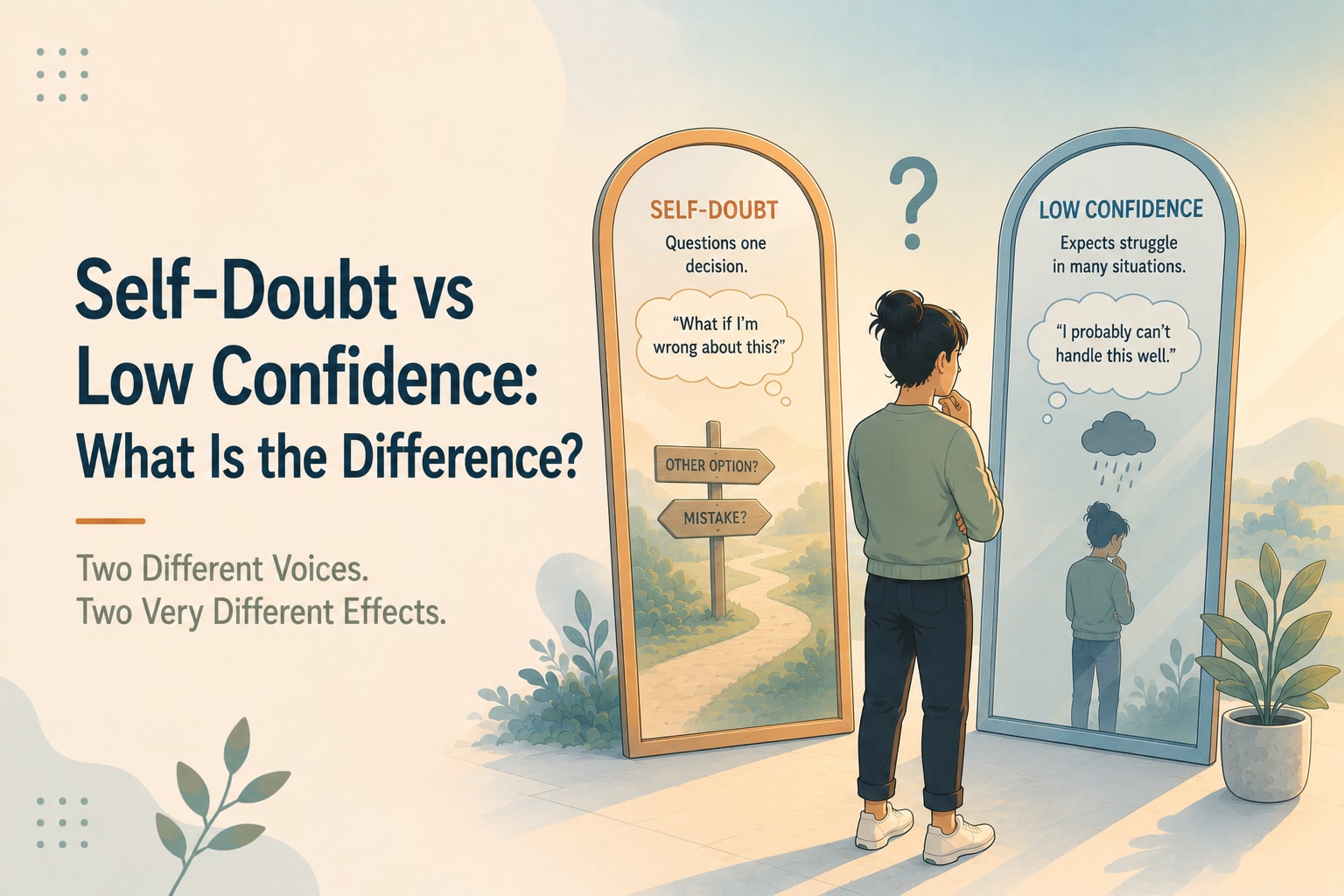
Self-doubt asks:
"What if I am wrong about this?"
Low confidence says:
"I probably cannot handle this well."
The first questions a judgment.
The second lowers your expectation of yourself.
They often overlap, but they do not always come from the same place or create the same behaviour.
Both can become part of wider self-sabotage patterns, particularly when uncertainty develops into recurring overthinking loops, reassurance-seeking, avoidance, and fear of being exposed.
The Behavior Most People Don’t Notice
The difference between self-doubt and low confidence often becomes visible in what happens after the uncertain moment passes.
Self-doubt can be temporary.
You question whether you understood the situation correctly.
You wonder whether another option would have been better.
You review what you said.
Once new information appears or the situation ends, the doubt may settle.
Low confidence tends to travel with you.
It appears in different situations even when the details change.
You may expect to speak badly in meetings, struggle with new responsibilities, make poor decisions, or disappoint people before anything has happened.
The assumption is not only that the current situation is difficult.
It is that you are likely to be inadequate within it.
That distinction matters.
A person with self-doubt may still act.
They may feel uncertain while believing they can adjust if something goes wrong.
A person with low confidence may interpret uncertainty as evidence that action should be avoided.
You might not notice it at first.
Both people may say:
"I’m not sure."
But underneath the sentence, they may mean different things.
One means:
"I need more information."
The other means:
"I do not trust myself to deal with the outcome."
Why the Brain Does This
Self-doubt often begins with uncertainty.
The brain notices incomplete information and starts checking for possible mistakes.
This is not always harmful.
A small amount of doubt can help you reconsider assumptions, prepare more carefully, or recognise a risk you missed.
The problem begins when the mind cannot stop checking.
Instead of using doubt to improve the decision, it begins using thought to search for complete certainty.
That is when self-doubt can develop into the kind of mental repetition described in Why Doubt Grows the More You Think.
Low confidence usually involves something broader.
The brain is not only assessing the situation.
It is predicting your ability to function within it.
Past criticism, repeated embarrassment, harsh comparison, or limited experience can quietly shape this expectation.
If earlier mistakes were treated as proof of incompetence, the mind may begin expecting future difficulty before any evidence appears.
A new task then feels threatening not only because it is unfamiliar, but because it seems likely to confirm an existing belief.
"This will probably show that I am not good enough."
That expectation changes attention.
You notice signs of struggle more quickly.
You discount signs of competence.
A mistake feels meaningful.
A success feels temporary or accidental.
The mind begins gathering evidence unevenly.
Over time, the conclusion feels obvious, even though the way the evidence is being interpreted has already been shaped by low confidence.
Where This Pattern Shows Up in Daily Life
Self-doubt and low confidence can appear in the same situation while producing different internal reactions.
At work
Someone with self-doubt may finish a report and wonder whether one section is clear enough.
Someone with low confidence may assume the entire report is probably poor because they do not see themselves as a strong writer.
In relationships
Self-doubt may sound like:
"Did I misunderstand what they meant?"
Low confidence may sound like:
"Why would someone like that seriously choose me?"
One questions an interaction.
The other questions personal worth within the relationship.
During decision-making
A person experiencing self-doubt may compare two options repeatedly.
A person with low confidence may believe that whichever option they choose, they will probably manage it badly.
When receiving an opportunity
Self-doubt asks whether the timing is right.
Low confidence questions whether the opportunity should have been offered at all.
That is why some people feel less capable immediately after being promoted, recognised, or invited into a larger role.
The opportunity increases visibility.
Visibility increases self-monitoring.
Existing uncertainty becomes connected to identity.
This pattern appears in Why Confidence Drops When It Matters and Why You Feel Less Capable Than You Are.
The external situation becomes more important, and the internal assessment becomes less generous.
The Hidden Effect of This Pattern
Self-doubt can delay a decision.
Low confidence can quietly reduce the size of your life.
That may sound dramatic, but the process is usually subtle.
You stop volunteering ideas.
You choose responsibilities that feel safely below your ability.
You remain silent until someone else expresses the same thought.
You prepare excessively because ordinary preparation never feels convincing enough.
You ask for reassurance before and after decisions.
You may even avoid opportunities you once wanted because accepting them would require you to become visible.
The hidden effect is not only missed action.
It is missing evidence.
Confidence grows partly through experience.
You attempt something.
You observe what happens.
You adjust.
You discover that mistakes can be corrected and unfamiliar situations can become manageable.
When low confidence prevents participation, that evidence never develops.
The person continues feeling unprepared because they have fewer experiences of acting while uncertain.
Self-doubt can create a similar loop when it becomes repetitive.
You question the decision.
You delay action.
The lack of action prevents new information.
The remaining uncertainty seems to justify more doubt.
This is why The Action Reduces Fear Loop is useful.
Thinking can evaluate possibilities.
Action reveals what actually happens.
What This Reveals About Human Behavior
The mind often confuses feelings with measurements.
Feeling uncertain begins to look like proof that the decision is unsafe.
Feeling nervous begins to look like proof that you are unprepared.
Feeling less confident begins to look like proof that your ability has disappeared.
But internal feelings do not always describe external capacity accurately.
Sometimes they describe pressure.
Sometimes they describe unfamiliarity.
Sometimes they describe how closely you are monitoring yourself.
The deeper difference between self-doubt and low confidence is where the question is directed.
Self-doubt turns toward the choice:
"Can I trust this decision?"
Low confidence turns toward the self:
"Can I trust myself?"
That is why low confidence can be more persistent.
A decision can be completed.
A situation can end.
But a negative expectation about yourself can follow you into the next experience.
The patterns also reinforce one another.
Repeated self-doubt can weaken confidence.
Low confidence can make every new decision easier to doubt.
A person questions themselves, seeks reassurance, acts less independently, and gathers less evidence of personal capability.
The reduced evidence then appears to confirm the original belief.
But if you look closely, the belief was not merely observing behaviour.
It was influencing the behaviour being observed.
Final Reflection
Self-doubt and low confidence both create hesitation, but they are not identical.
Self-doubt often questions what you think.
Low confidence questions what you can do.
One may appear around a particular choice.
The other may shape your expectations across many situations.
You can doubt a decision and still trust your ability to respond.
You can also make a clear decision while quietly believing you are not capable of carrying it out.
That difference explains why reassurance sometimes helps and sometimes does not.
Information may settle a specific doubt.
It cannot automatically change a wider belief about personal ability.
The pattern is often quiet.
A difficult moment appears.
Uncertainty rises.
The mind decides whether the uncertainty belongs to the situation or to the self.
If it belongs to the situation, you search for clarity.
If it belongs to the self, you begin searching for evidence that you are capable enough to continue.
Sometimes the clearest question is not:
"Why am I unsure?"
It is:
"Am I questioning this situation, or have I started questioning myself through it?"
The answer reveals whether you are dealing with a passing doubt or a broader expectation that has quietly followed you into the room.
Q: Is self-doubt the same as low confidence?
A: No. Self-doubt often involves questioning a specific decision, interpretation, or action. Low confidence is a broader expectation that you may not perform well or handle situations effectively.
Q: Can a confident person still experience self-doubt?
A: Yes. A person can generally trust their abilities while feeling uncertain about a particular choice, unfamiliar task, or important decision.
Q: Can repeated self-doubt cause low confidence?
A: It can. Continually reopening decisions and distrusting your judgment may gradually weaken confidence, especially when it leads to avoidance and repeated reassurance-seeking.
Q: Why do I feel confident in some areas but not others?
A: Confidence is often specific to context. Familiarity and repeated experience can create confidence in one area, while uncertainty, past criticism, or limited exposure can reduce it elsewhere.
