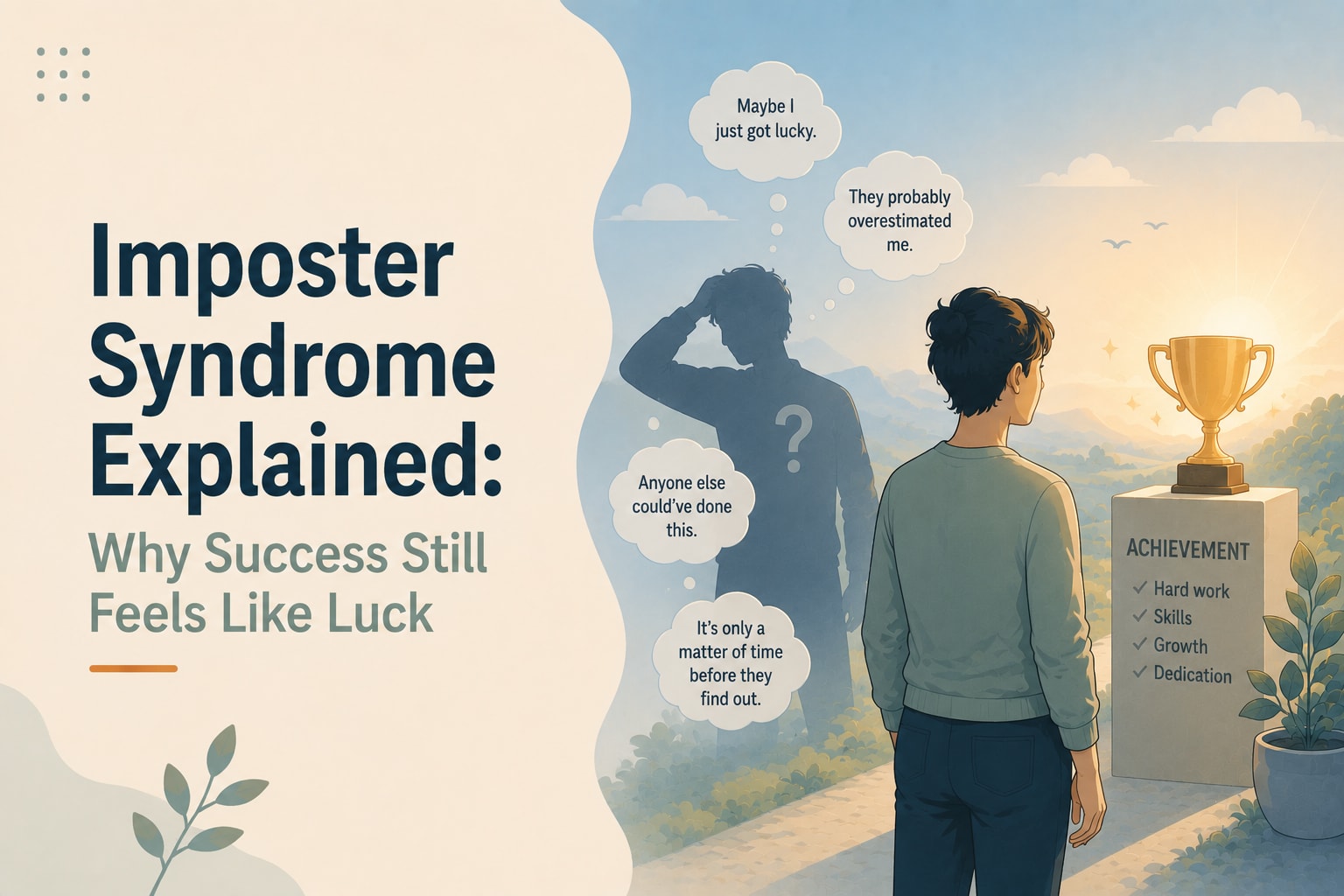
Imposter Syndrome Explained: Why Success Still Feels Like Luck
Imposter syndrome explained begins with a feeling that is surprisingly difficult to describe.
Someone congratulates you.
You smile.
You thank them.
But somewhere in the background, another thought quietly appears.
"If they knew how uncertain I felt, they probably wouldn't be saying this."
Your achievements are real.
The promotion happened.
The project succeeded.
The qualification was earned.
The opportunity arrived because someone believed you could handle it.
Yet success feels strangely disconnected from your identity.
Instead of thinking, "I earned this," your mind begins searching for another explanation.
Maybe it was timing.
Maybe expectations were low.
Maybe people simply overestimated you.
Maybe next time they will realise you are not as capable as they think.
You might not notice it at first.
It can sound like humility.
It can even look responsible.
But if you look closely, something interesting appears.
The mind is not simply questioning one achievement.
It is quietly refusing to let success become evidence about who you are.
That is why imposter syndrome often appears alongside broader self-sabotage patterns, especially when overthinking loops, perfectionism, and self-doubt begin shaping the way success is interpreted.
The Behavior Most People Don’t Notice
Many people imagine imposter syndrome as feeling like a fraud.
The quieter version is easier to miss.
It is constantly explaining away your competence.
Every success receives an alternative explanation.
You worked hard.
The mind says you were lucky.
You solved a difficult problem.
The mind says anyone else would have done the same.
You earned recognition.
The mind says expectations must have been unusually low.
Notice the pattern.
Mistakes become personal.
Success becomes accidental.
The mind uses two completely different standards.
When something goes wrong, you assume it reflects your ability.
When something goes well, you assume it reflects external circumstances.
Over time, this creates a strange imbalance.
Evidence of competence keeps arriving.
Very little of it is allowed to stay.
Each achievement is mentally placed outside your identity.
Instead of becoming proof that you are capable, it becomes another exception that must be explained.
That is where the pattern begins.
Why the Brain Does This
The mind naturally tries to create a stable story about who you are.
If that story includes the belief that you are not capable enough, new evidence creates tension.
Success no longer fits the existing identity.
The brain has two options.
It can update the identity.
Or it can explain away the evidence.
For many people, the second option feels psychologically easier.
The achievement becomes luck.
The praise becomes politeness.
The opportunity becomes coincidence.
Nothing about your core belief needs to change.
Past experiences often shape this process.
Repeated criticism.
High expectations.
Constant comparison.
Growing up believing mistakes mattered more than progress.
Over time, the mind may become more familiar with proving inadequacy than recognising competence.
Success then feels unfamiliar.
And unfamiliar experiences are often questioned before they are accepted.
Perfectionism strengthens the pattern.
If success only counts when every detail is flawless, very few achievements ever qualify.
Even excellent work feels incomplete because the mind immediately notices what could have been better.
Instead of celebrating what happened, attention shifts toward what remained imperfect.
The achievement quietly disappears behind the next standard.
Where This Pattern Shows Up in Daily Life
Imposter syndrome rarely appears only at work.
It quietly follows people into many different parts of life.
Someone receives a promotion and immediately worries they will disappoint everyone.
A university graduate assumes the degree only reflects easy marking or fortunate circumstances.
A business owner believes clients simply have not realised there are better people available.
A writer publishes an article but spends more time thinking about the sentences they dislike than the ideas readers found valuable.
Someone enters a healthy relationship but quietly wonders whether their partner will eventually discover they are less interesting, intelligent, or capable than they first appeared.
The pattern even appears during conversations.
Someone compliments you.
You immediately explain why the compliment is exaggerated.
You mention the help you received.
You point out what still needs improvement.
You change the subject.
Receiving recognition becomes uncomfortable because it conflicts with the story the mind already believes.
That is why many people experiencing imposter syndrome also relate to Why You Feel Less Capable Than You Are.
Their actual ability and their internal assessment rarely seem to match.
The Hidden Effect of This Pattern
The obvious cost is anxiety.
The quieter cost is hesitation.
If success feels undeserved, future opportunities begin carrying additional pressure.
The next project must prove you belong.
The next conversation must confirm that the previous success was not accidental.
The next achievement must erase the remaining doubt.
Of course, it never does.
Each success receives the same explanation as the last.
Luck.
Timing.
Good circumstances.
Low expectations.
The person keeps achieving without ever allowing achievement to change self-perception.
This influences behaviour in subtle ways.
You overprepare.
You apologise before presenting ideas.
You avoid visible opportunities.
You hesitate before applying for roles you already qualify for.
You work longer than necessary because ordinary preparation never feels sufficient.
Sometimes you reject opportunities before someone else has the chance to reject you.
Not because you lack ability.
Because being exposed feels more frightening than remaining unseen.
The person begins protecting themselves from an identity they already assume is true.
What This Reveals About Human Behavior
Imposter syndrome reveals something interesting about the human mind.
People do not simply respond to evidence.
They interpret evidence through existing beliefs.
If you already believe you are capable, one success strengthens that belief.
If you already believe you are inadequate, the same success often receives another explanation.
The evidence stays the same.
The interpretation changes.
This explains why external achievement does not automatically create internal confidence.
Confidence is not built only by collecting success.
It also depends on allowing success to become part of your identity.
That is much harder than it sounds.
Especially if your mind has spent years explaining competence away.
This pattern also explains why reassurance often has limited effects.
Someone tells you that you deserve your success.
You feel relieved.
Then another achievement arrives.
The doubt quietly returns.
The issue was never a lack of compliments.
It was the story your mind keeps telling about what those compliments mean.
This connects closely with Why You Trust Others More Than Yourself.
External validation feels convincing for a moment because your own interpretation still refuses to accept the evidence.
The mind keeps searching for proof that it belongs.
While quietly ignoring the proof it already has.
Final Reflection
Imposter syndrome is often misunderstood as believing you have no ability.
Many people experiencing it are highly capable.
Their struggle lies elsewhere.
They find it difficult to let success become evidence.
Every achievement is treated as temporary.
Every compliment becomes negotiable.
Every opportunity feels like something that still needs to be earned.
The pattern is subtle.
Success happens.
Recognition follows.
The mind searches for another explanation.
The achievement becomes disconnected from identity.
The next opportunity feels just as uncertain as the previous one.
Nothing changes externally.
Very little changes internally.
You might not notice it at first.
The problem is not always that you underestimate your ability.
Sometimes you simply refuse to let your own evidence count.
The mind keeps asking for proof while quietly dismissing every piece of proof it receives.
Perhaps that is the most interesting part of imposter syndrome.
It is not always the absence of confidence.
Sometimes it is the inability to recognise confidence already supported by experience.
Q: What is imposter syndrome in simple terms?
A: Imposter syndrome is the feeling that your success is not truly deserved, even when there is clear evidence that you have earned it through your ability and effort.
Q: Is imposter syndrome the same as low confidence?
A: Not exactly. Low confidence is a broader expectation of struggling in many situations. Imposter syndrome specifically involves doubting the legitimacy of your achievements and fearing that others will eventually discover you are less capable than they believe.
Q: Why do successful people still experience imposter syndrome?
A: Success does not automatically change deeply held beliefs about identity. Many people explain away achievements as luck, timing, or external circumstances instead of allowing them to reshape how they see themselves.
Q: Can overthinking make imposter syndrome worse?
A: Yes. Repeatedly analysing mistakes while dismissing successes strengthens self-doubt. Over time, the mind becomes more skilled at finding reasons you do not deserve success than recognising the evidence that you do.
