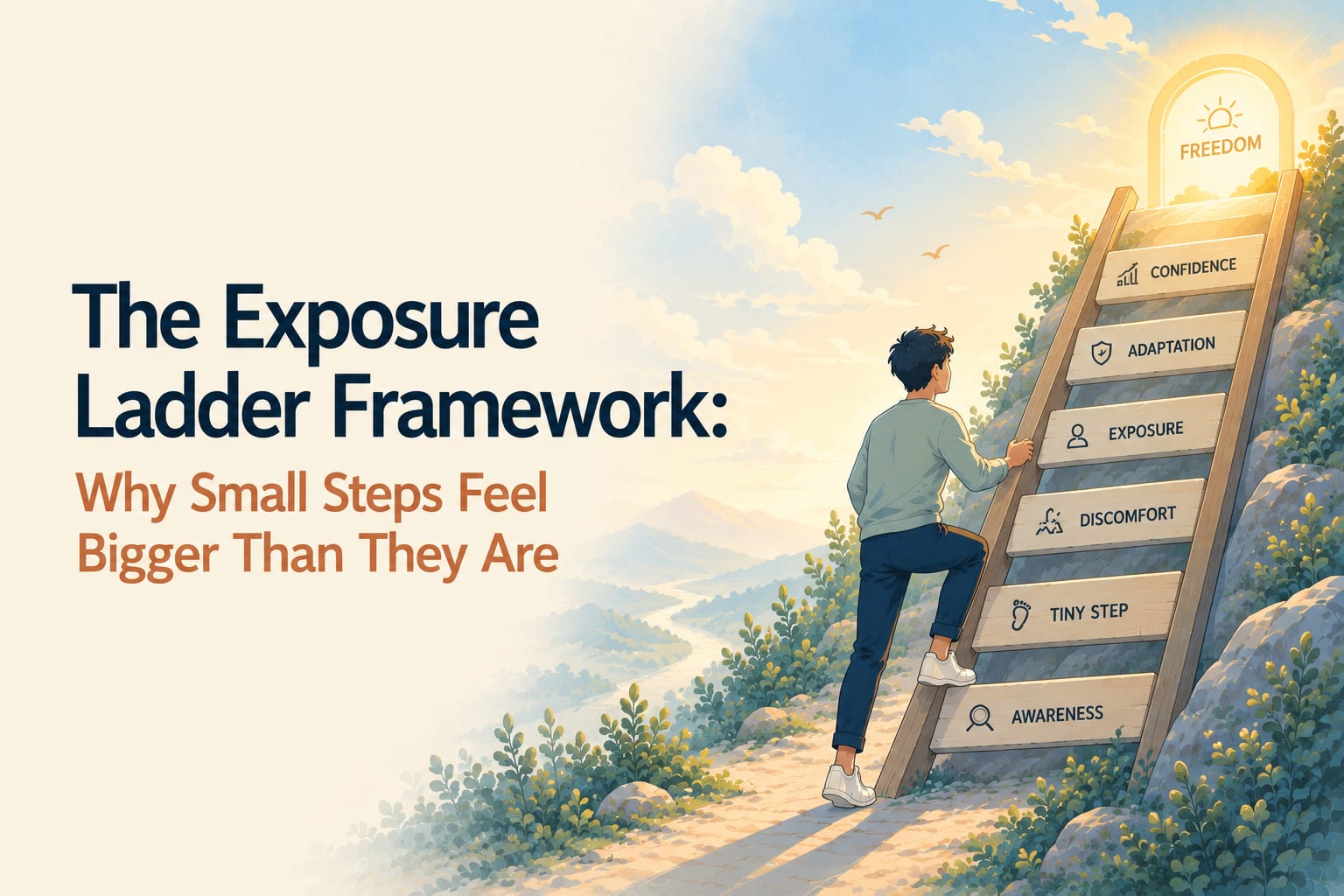
The Exposure Ladder Framework begins with a quiet observation.
Most people don't wait because they're incapable.
They wait because the first step feels too big.
So they don't move.
They tell themselves they'll start when it feels easier.
But if you look closely, something interesting appears.
It rarely feels easier first.
It usually feels easier after you've taken one small step.
The mind treats unfamiliar situations like steep cliffs.
It rarely notices the small steps in between.
Everything becomes one enormous leap.
Start the business.
Have the conversation.
Speak in public.
Apply for the opportunity.
The brain sees the final step.
It ignores the first one.
That's where overthinking loops quietly begin.
The Exposure Ladder Framework changes the picture.
Instead of asking,
"Can I do the whole thing?"
It asks,
"What's the smallest version I can do today?"
Not the perfect version.
Not the finished version.
Just the first rung of the ladder.
Something interesting happens when you climb that first rung.
The situation changes less than you expected.
But you change more than you expected.
Your brain gathers evidence.
"Maybe this isn't as dangerous as I imagined."
One small experience quietly replaces one large assumption.
That's how confidence is built.
Not through thinking.
Through exposure.
This is why so many self-sabotage patterns survive.
The mind believes confidence must come first.
The ladder quietly proves the opposite.
Every small action becomes proof that uncertainty can be survived.
And once the first rung feels familiar, the second no longer looks impossible.
The goal isn't to force yourself into overwhelming situations.
The goal is to make today's action slightly larger than yesterday's.
Small enough to begin.
Large enough to teach your brain something new.
That's how fear slowly loses its authority.
Not all at once.
One rung at a time.
The next time something feels intimidating, don't ask whether you're ready.
Ask yourself,
"What's the first rung?"
You might be surprised by how much smaller it is than the story in your head.
If you look deeper, this framework connects to something much larger.
Many of the fears that shape your life don't disappear before action.
They become smaller because of it.
Related Patterns
If this framework feels familiar, it often connects to other hidden behaviors.
