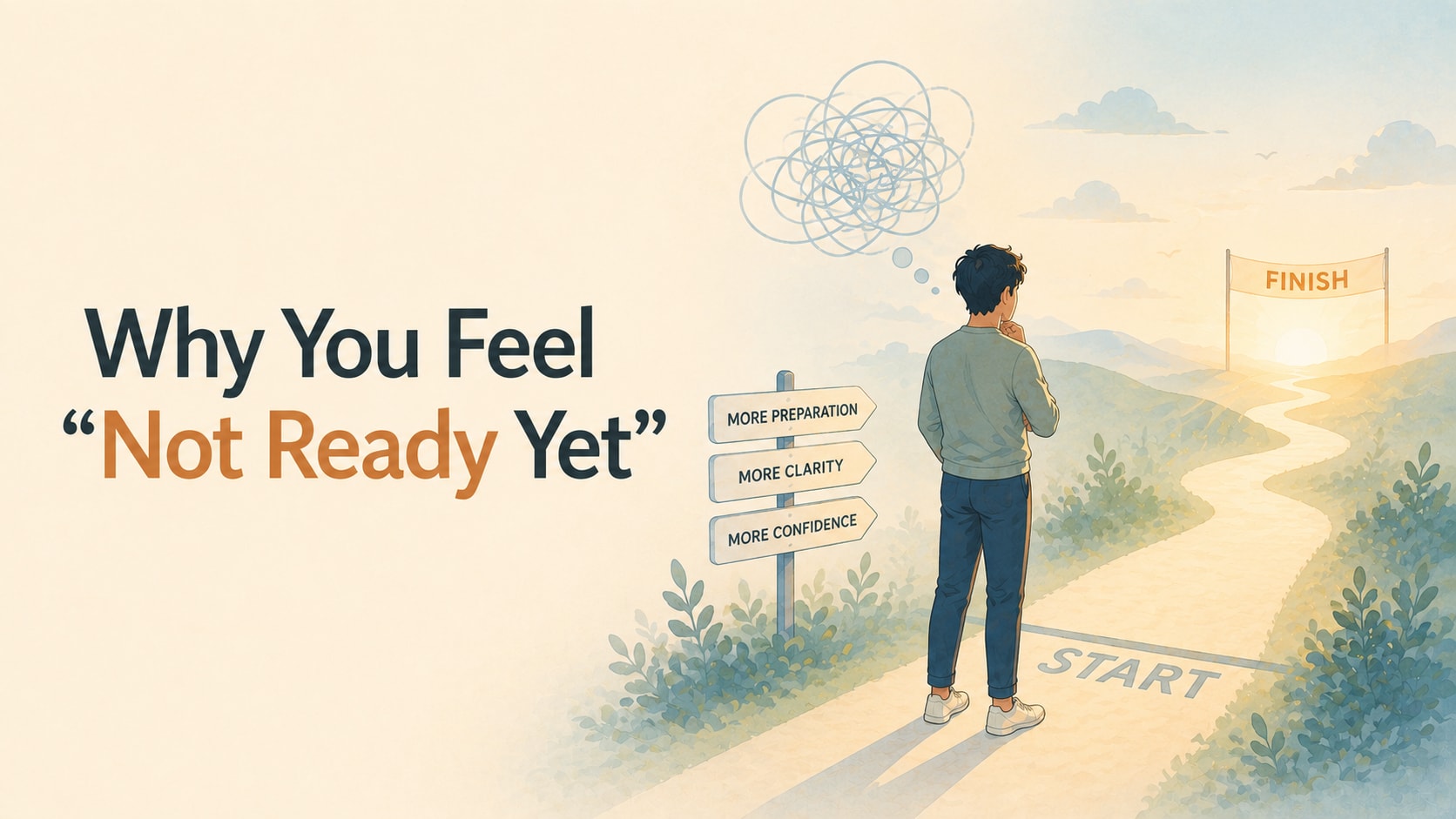
Why You Feel “Not Ready Yet”
This is one of the most common psychological patterns people mistake for wisdom.
You tell yourself you'll begin once you know a little more.
Once you're more confident.
Once you've prepared enough.
Once the timing feels right.
It sounds responsible.
It even sounds intelligent.
But if you look closely, something interesting appears.
The feeling of being "not ready" rarely disappears on its own.
Instead, it quietly moves further away.
Every time you reach one level of preparation, your mind invents another.
Without realizing it, you've stopped waiting for information.
You're waiting for certainty.
And certainty has a habit of staying just out of reach.
Free Guide: If this pattern feels familiar, download The Self-Sabotage Pattern Recognition Guide and learn the seven hidden mental loops that quietly keep intelligent people stuck before they begin.
What this behavior actually is
Feeling "not ready yet" is a psychological pattern where your brain postpones action until it believes the risk has become emotionally acceptable.
Notice the difference.
The delay isn't caused by a lack of ability.
It's caused by a lack of perceived safety.
That distinction changes everything.
Most people assume readiness comes before action.
The brain often works in the opposite direction.
Action creates experience.
Experience creates confidence.
Confidence creates the feeling of readiness.
But when the order gets reversed, waiting becomes endless.
This is why the pattern frequently appears inside larger self-sabotage patterns.
Not because you're trying to fail.
Because you're trying to avoid uncertainty.
Those aren't the same thing.
Why the brain does this
The brain was never designed to optimize opportunity.
It was designed to reduce danger.
Long before modern life, hesitation often kept people alive.
Unknown environments meant possible threats.
Uncertain decisions carried real consequences.
Today, the same protective system still exists.
Only the dangers have changed.
Instead of avoiding predators, your brain avoids:
- embarrassment
- rejection
- criticism
- failure
- uncertainty
- losing status
- looking inexperienced
The mind quietly translates these emotional risks into one sentence:
"I'm just not ready yet."
That sentence feels logical.
But underneath it is something else.
A desire to eliminate uncertainty before taking action.
The problem is that uncertainty is part of almost every meaningful decision.
The brain keeps waiting for a condition that life rarely provides.
This is why people become trapped inside overthinking loops.
Thinking feels safer than acting.
Preparing feels safer than trying.
Waiting feels safer than discovering what happens next.
Where it appears in everyday life
This pattern rarely announces itself.
It hides inside ordinary moments.
You don't apply for the job yet.
You don't launch the business yet.
You don't publish your work yet.
You don't ask the question yet.
You don't have the difficult conversation yet.
Instead, you prepare.
You research.
You organize.
You improve.
You learn another skill.
You buy another course.
You tell yourself you're getting closer.
Sometimes you are.
But sometimes preparation quietly becomes a substitute for movement.
You might not notice it at first.
Because preparation looks productive.
From the outside, you're busy.
Inside, nothing has actually changed.
The opportunity is still waiting.
So are you.
The hidden cost
Waiting feels harmless.
After all, you're only delaying.
Not giving up.
But delays accumulate.
The opportunity changes.
The circumstances change.
Your confidence changes.
The longer you wait, the larger the action begins to feel.
What once seemed manageable slowly becomes intimidating.
Then something even quieter happens.
Your identity begins adapting to the waiting.
Instead of seeing yourself as someone who acts, you begin seeing yourself as someone who prepares.
The mind starts protecting that identity.
Eventually, not starting feels more familiar than beginning.
This is why hesitation often becomes self-reinforcing.
The less evidence you have that you can handle uncertainty, the more uncertainty seems dangerous.
That's where the cycle feeds itself.
Not dramatically.
Quietly.
Repeatedly.
The pattern most people miss
Most people think they're waiting for readiness.
They're actually waiting for emotional certainty.
Those sound similar.
They're completely different.
Readiness is practical.
Certainty is emotional.
You can absolutely have enough knowledge to begin while still feeling uncertain.
In fact, that's how most meaningful progress begins.
The interesting part is this:
People who eventually feel confident usually didn't wait for confidence.
They accumulated it.
One action at a time.
One uncomfortable conversation.
One imperfect attempt.
One uncertain decision.
The confidence arrived afterward.
Not beforehand.
That's the pattern most people miss.
The feeling they're waiting for is often created by the action they're avoiding.
Final reflection
You might not notice it at first.
Feeling "not ready yet" seems like a temporary state.
Something that will eventually disappear.
But if you look closely, something interesting appears.
The feeling isn't measuring your ability.
It's measuring your comfort.
Those are very different things.
Comfort asks for certainty.
Growth rarely offers it.
The next time your mind tells you you're "not ready yet," pause for a moment.
Ask a quieter question.
"Am I missing information... or am I waiting for uncertainty to disappear?"
The answer won't always be comfortable.
But it will often be honest.
And honesty is usually where movement begins. :contentReference[oaicite:0]{index=0}
Q: Why do I always feel like I'm not ready yet?
A: Your brain naturally tries to reduce uncertainty before action. That protective instinct can make normal challenges feel like signs that you need more preparation, even when you're already capable.
Q: Is feeling "not ready yet" a form of self-sabotage?
A: It can become one. When waiting repeatedly replaces action, the pattern quietly reinforces hesitation and keeps opportunities out of reach.
Q: Is this connected to overthinking?
A: Yes. Many people who feel "not ready yet" become trapped in overthinking loops because thinking feels safer than acting under uncertainty.
Q: How do I know if I genuinely need more preparation?
A: Ask whether new preparation is giving you new information or simply helping you avoid discomfort. If you're repeating the same preparation without moving forward, the pattern may already be active.
Related Patterns
If this pattern feels familiar, it usually connects to other hidden behaviors.
