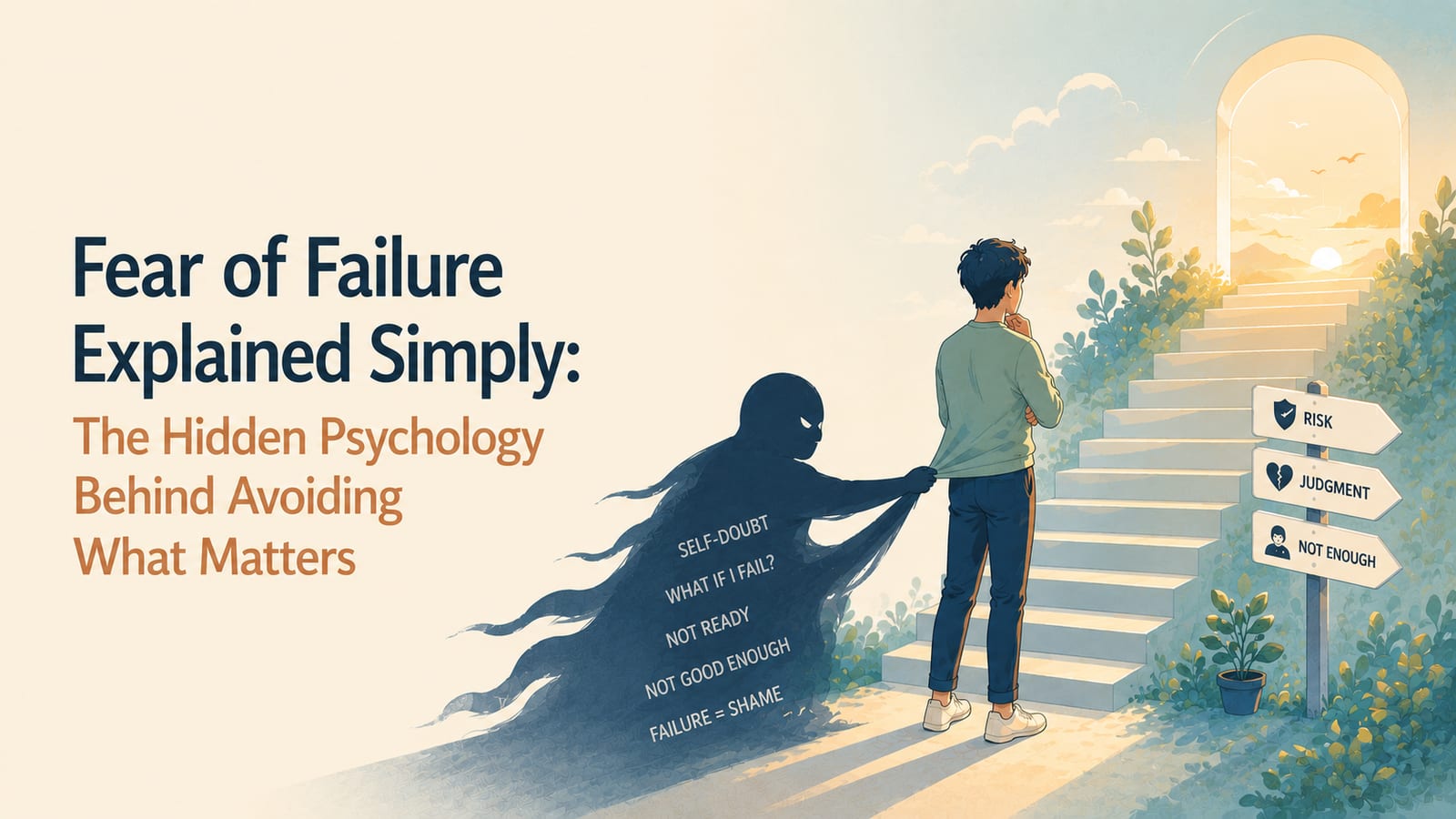
Fear of Failure Explained Simply
It simply starts with a realization that surprises many people.
Most people don't avoid failure.
They avoid the possibility of failing.
That sounds like a small difference.
It isn't.
You might postpone sending the email.
Delay applying for the job.
Keep researching instead of launching.
Tell yourself you'll start next week.
From the outside, it looks like procrastination.
But if you look closely, something interesting appears.
The task isn't always the problem.
What your mind imagines could happen afterward often is.
That's where the pattern begins.
What fear of failure actually means
Fear of failure is a psychological pattern where the mind treats possible failure as something that must be avoided rather than experienced.
It isn't simply being afraid of making mistakes.
Everyone dislikes mistakes.
Fear of failure becomes different when the possibility of failure starts changing your behavior before anything has even happened.
You stop yourself before life has a chance to.
You hesitate.
You prepare endlessly.
You wait for confidence.
You look for certainty.
Without realizing it, your decisions begin revolving around avoiding discomfort instead of pursuing what matters.
This is why fear of failure often appears inside larger self-sabotage patterns.
Not because you're trying to lose.
Because you're trying to avoid emotional risk.
The behavior most people don't notice
Fear of failure is rarely obvious.
Very few people wake up and think,
"I'm avoiding this because I'm afraid."
Instead, fear changes its appearance.
It sounds reasonable.
"I need more experience."
"I should prepare a little longer."
"Maybe next month."
"I'm waiting for the right opportunity."
Each explanation feels logical.
And sometimes those reasons are genuinely true.
But if the same explanation keeps returning every time an opportunity appears, something deeper may be happening.
The brain has found a socially acceptable way to delay action.
You might not notice it at first.
Because preparation feels responsible.
Waiting feels patient.
Thinking feels productive.
But underneath all three, fear can quietly remain untouched.
Why the brain does this
The brain is built to reduce uncertainty.
It constantly asks one question:
"Is this safe?"
Failure threatens more than results.
It can threaten identity.
Reputation.
Belonging.
Self-worth.
The brain doesn't always separate a failed project from a failed person.
Instead, it treats both as emotionally connected.
That's why small decisions sometimes feel surprisingly heavy.
A simple email becomes stressful.
A conversation becomes exhausting.
A new opportunity becomes overwhelming.
To avoid those feelings, the brain encourages safer behaviors.
It keeps you thinking.
Planning.
Preparing.
Comparing.
This is one reason fear of failure often overlaps with overthinking loops.
Thinking creates the feeling of control.
Even when nothing actually changes.
Where this pattern appears in everyday life
Fear of failure doesn't only appear during major life decisions.
It hides inside ordinary moments.
You don't apply because someone else might be better.
You don't publish because it isn't perfect.
You don't ask because they might say no.
You don't start because you're afraid you won't finish.
You don't speak because you might sound inexperienced.
Each situation seems unrelated.
But they're connected by the same invisible question.
"What if this goes badly?"
The brain answers by encouraging delay.
Not because delay solves the problem.
Because delay postpones the emotional risk.
For a while, that feels like relief.
The hidden effect of this pattern
Avoiding failure also means avoiding evidence.
Evidence that you can recover.
Evidence that mistakes aren't permanent.
Evidence that you are more capable than you believed.
Without those experiences, fear quietly grows.
Not because life became more dangerous.
Because your brain has fewer reasons to believe you'll be okay.
Eventually, hesitation becomes familiar.
Preparation becomes comfortable.
Action becomes unusual.
That's why fear of failure often feels stronger over time.
It isn't necessarily increasing.
It's simply being challenged less often.
The less often uncertainty is experienced, the more threatening uncertainty appears.
What this reveals about human behavior
Fear of failure reveals something fascinating about the mind.
Human beings don't simply avoid pain.
We often avoid imagined pain.
The prediction becomes more powerful than reality.
The story becomes more convincing than the experience.
You might not notice it at first.
But if you look closely, something interesting appears.
Many people aren't being stopped by failure.
They're being stopped by a future their mind has already invented.
The event hasn't happened.
The emotion already has.
That's why the pattern feels so real.
The brain reacts to imagined outcomes almost as seriously as actual ones.
Once you recognize that, hesitation begins to look different.
It isn't weakness.
It's protection.
Sometimes useful.
Sometimes outdated.
Final reflection
Fear of failure isn't proof that you're incapable.
It's proof that your mind cares about what could happen.
The problem begins when protection becomes permission to wait forever.
You might not notice it at first.
Because waiting feels sensible.
Preparing feels wise.
Thinking feels productive.
But if you look closely, something becomes clear.
Life rarely asks whether you feel completely ready.
It simply keeps presenting opportunities.
The question isn't whether fear disappears.
It's whether fear quietly becomes the person making your decisions.
Recognizing that pattern is often the first step toward interrupting it.
Q: What is fear of failure in psychology?
A: Fear of failure is a psychological pattern where anticipated failure becomes emotionally threatening enough to delay or prevent action.
Q: Why does fear of failure cause procrastination?
A: Procrastination temporarily reduces the anxiety associated with possible failure, making delay feel emotionally safer than starting.
Q: Is fear of failure related to overthinking?
A: Yes. Many people respond to fear of failure by entering overthinking loops, believing more analysis will eliminate uncertainty.
Q: Can fear of failure become self-sabotage?
A: Yes. When fear repeatedly influences decisions, it often develops into larger self-sabotage patterns that quietly limit growth.
Related Patterns
If this pattern feels familiar, it often connects to other behaviors.
