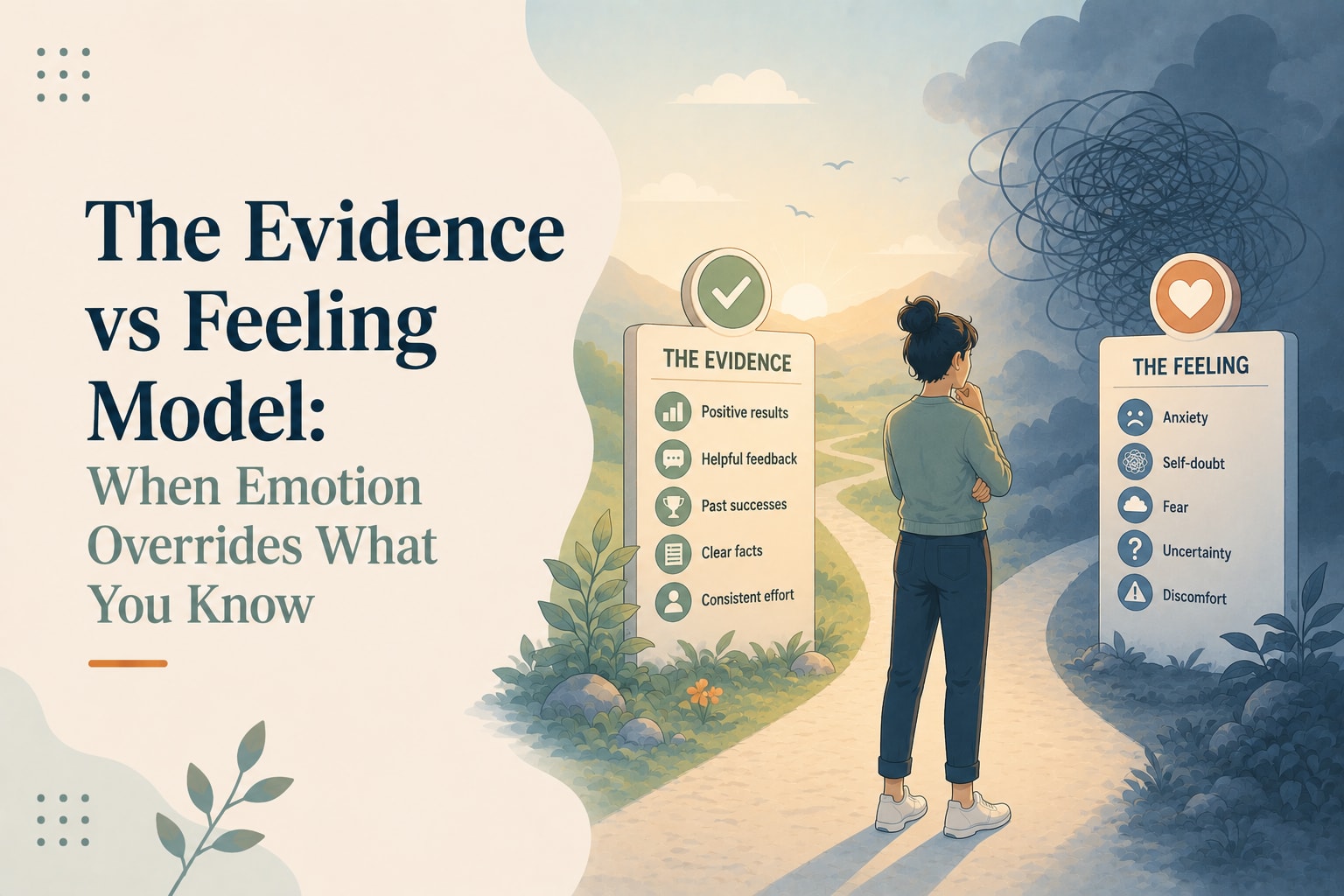
The Evidence vs Feeling Model: When Emotion Overrides What You Know
The Evidence vs Feeling Model describes what happens when the facts point in one direction, but your emotions make another explanation feel more believable.
You know the presentation went reasonably well.
But you feel embarrassed, so your mind decides it must have been a failure.
You have received positive feedback.
But you still feel unqualified, so the praise begins to look mistaken.
Someone tells you they are not upset.
But you feel uneasy, so you keep searching for evidence that something is wrong.
You might not notice it at first.
The feeling does not present itself as one possible response to the situation.
It presents itself as information about the situation.
That is where the loop begins.
The evidence remains visible.
The emotion becomes more convincing.
Then the mind reorganizes the evidence until it matches the feeling.
What the Evidence vs Feeling Model Describes
The framework begins with a simple conflict.
Evidence says one thing.
Feeling says another.
In theory, the difference should be easy to recognise.
In practice, emotions often feel more immediate than facts.
Evidence may be quiet.
It may exist in completed work, supportive messages, previous results, observable behaviour, or direct explanations.
A feeling arrives with physical force.
Tension appears in the body.
The mind becomes alert.
An uncomfortable possibility starts repeating.
Because the emotion feels urgent, it receives more attention.
The person may still know the facts.
They simply stop feeling persuaded by them.
This is closely connected to emotional reasoning and cognitive distortions, where a feeling becomes evidence for the conclusion that created it.
You feel incapable, so you assume you are incapable.
You feel rejected, so you assume rejection has happened.
You feel uncertain, so you assume the decision must be wrong.
The model helps separate three things that usually become blended together:
What happened.
What you felt.
What the feeling made the event mean.
The Stages of the Evidence vs Feeling Loop
The loop usually moves through a recognisable sequence.
Stage 1: An event creates uncertainty
Something happens that does not provide complete emotional clarity.
You submit a project.
Make a decision.
Enter a new role.
Send an important message.
Receive a brief response.
The event may be positive, negative, or neutral.
What matters is that some uncertainty remains.
Stage 2: A strong feeling appears
You feel anxious, exposed, guilty, embarrassed, or inadequate.
The emotion may be connected to the current situation.
It may also be shaped by an older fear.
At this stage, the feeling is simply present.
It has not yet become a conclusion.
Stage 3: The feeling is treated as evidence
The mind begins reasoning from the emotional state.
"I feel nervous, so something must be wrong."
"I feel unprepared, so I must not be ready."
"I feel guilty, so I probably acted unfairly."
The feeling stops being a reaction.
It becomes proof.
Stage 4: Contradictory evidence is weakened
Facts that do not match the feeling become less convincing.
Praise is dismissed as politeness.
Past success becomes luck.
Clear reassurance begins to sound incomplete.
The mind may not deny the evidence directly.
It simply creates reasons it should not count.
Stage 5: Attention searches for emotional confirmation
You begin noticing details that support the feeling.
One awkward sentence becomes more important than the entire conversation.
One criticism outweighs several compliments.
One moment of uncertainty becomes proof that the whole decision was careless.
But if you look closely, the sequence repeats.
The mind is no longer examining all available evidence.
It is searching for evidence that makes the feeling understandable.
Stage 6: Behaviour follows the emotional conclusion
You withdraw.
Delay.
Recheck.
Ask for reassurance.
Edit the work again.
Avoid the opportunity.
Reopen the decision.
The behaviour then prevents new experiences that might challenge the original conclusion.
This is one of the ways self-sabotage patterns quietly reinforce themselves.
Why the Mind Repeats This Loop
Feelings are designed to influence attention.
Fear makes possible threats easier to notice.
Embarrassment makes social mistakes feel important.
Guilt pushes attention toward possible harm.
These reactions can be useful.
The problem begins when emotional intensity is confused with factual accuracy.
The mind assumes:
"If I feel this strongly, there must be a strong reason."
Sometimes there is.
Sometimes the emotion reflects a familiar expectation rather than the current evidence.
A person who has been criticised repeatedly may feel exposed whenever their work becomes visible.
Someone who expects rejection may experience uncertainty as an early sign of abandonment.
A person with low confidence may feel incapable whenever a task becomes important.
The feeling is real.
The conclusion may still be incomplete.
The loop repeats because accepting the feeling as evidence creates a temporary sense of explanation.
Uncertainty is uncomfortable.
A negative conclusion can feel strangely stabilising because it gives the discomfort a clear meaning.
"I feel anxious because I am going to fail."
The explanation may be painful, but it feels definite.
That certainty can be more emotionally appealing than admitting:
"I feel anxious, and I do not yet know what will happen."
Where This Pattern Appears in Daily Life
The Evidence vs Feeling Model appears in situations that seem unrelated.
At work
You are invited into a larger role.
The invitation is evidence that someone trusts your ability.
You feel intimidated.
The feeling becomes proof that you are not ready.
This can overlap with Imposter Syndrome Explained, where visible achievements are repeatedly outweighed by an internal sense of fraudulence.
In relationships
Someone explains that they are busy.
Their recent behaviour supports the explanation.
You still feel rejected.
The mind begins searching their messages for a hidden change in tone.
The feeling becomes more persuasive than the direct information.
After making a decision
You considered the options carefully and chose.
Relief appears briefly.
Then doubt arrives.
Because the choice no longer feels comfortable, the mind assumes it may no longer be correct.
This is the same sequence described in The Decision → Doubt Pattern.
During creative work
The project is complete.
Other people respond well.
You feel dissatisfied with one part.
That dissatisfaction expands until the entire project seems unworthy of publication.
This is where emotional reasoning can hide inside perfectionism.
Inside a stalled project
A person may have evidence that their idea is useful, their plan is workable, and the first version is sufficient to test.
But because launching feels exposing, the discomfort is interpreted as evidence that the project is not ready.
The lived sequence can be seen more clearly in The Project That Never Launched, where repeated refinement protects the person from the emotional risk of completion.
What Keeps the Loop Going
The loop is reinforced by whatever provides immediate emotional relief.
Avoiding the presentation reduces anxiety.
Rechecking the message reduces uncertainty.
Asking for reassurance briefly settles doubt.
Editing the project delays exposure.
Reopening the decision creates the feeling that nothing irreversible has happened.
Each response feels useful because the discomfort decreases.
But the relief teaches the mind something unintended.
It suggests that the feeling was dangerous and required action.
The next emotional reaction then becomes harder to tolerate.
This is why the framework often overlaps with overthinking loops.
Thinking begins as an attempt to examine evidence.
It gradually becomes an attempt to make the feeling disappear.
The person reviews the facts repeatedly, but each review is controlled by the same emotional conclusion.
No amount of evidence feels sufficient because the standard is no longer factual clarity.
The standard is emotional certainty.
Fear of failure keeps the loop moving by making discomfort feel predictive.
Perfectionism reinforces it by treating dissatisfaction as proof that more work is required.
Self-doubt strengthens it by making personal judgment seem less reliable than the feeling itself.
The pattern survives because the person believes they are responding to evidence.
They are often responding to the emotional meaning placed on it.
Final Reflection
The Evidence vs Feeling Model does not suggest that emotions are false.
Feelings often reveal that something matters.
They can point toward fear, pressure, memory, uncertainty, or an unmet need.
But they do not always describe the external situation with the same accuracy.
That distinction is easy to lose.
The evidence says the work was accepted.
The feeling says it was not good enough.
The evidence says the person has not rejected you.
The feeling says rejection is approaching.
The evidence says you have handled similar situations before.
The feeling says this time will expose you.
Both exist at once.
The loop begins when the feeling is allowed to rewrite what the evidence means.
Perhaps the most revealing question is not:
"Why do I feel this way?"
It is:
"What conclusion has this feeling asked me to accept?"
That is where the sequence becomes visible.
Not because the emotion disappears.
Because you can finally see the moment when a feeling stopped being an experience and started becoming proof.
Related Patterns
If this loop feels familiar, it often connects to other patterns.
