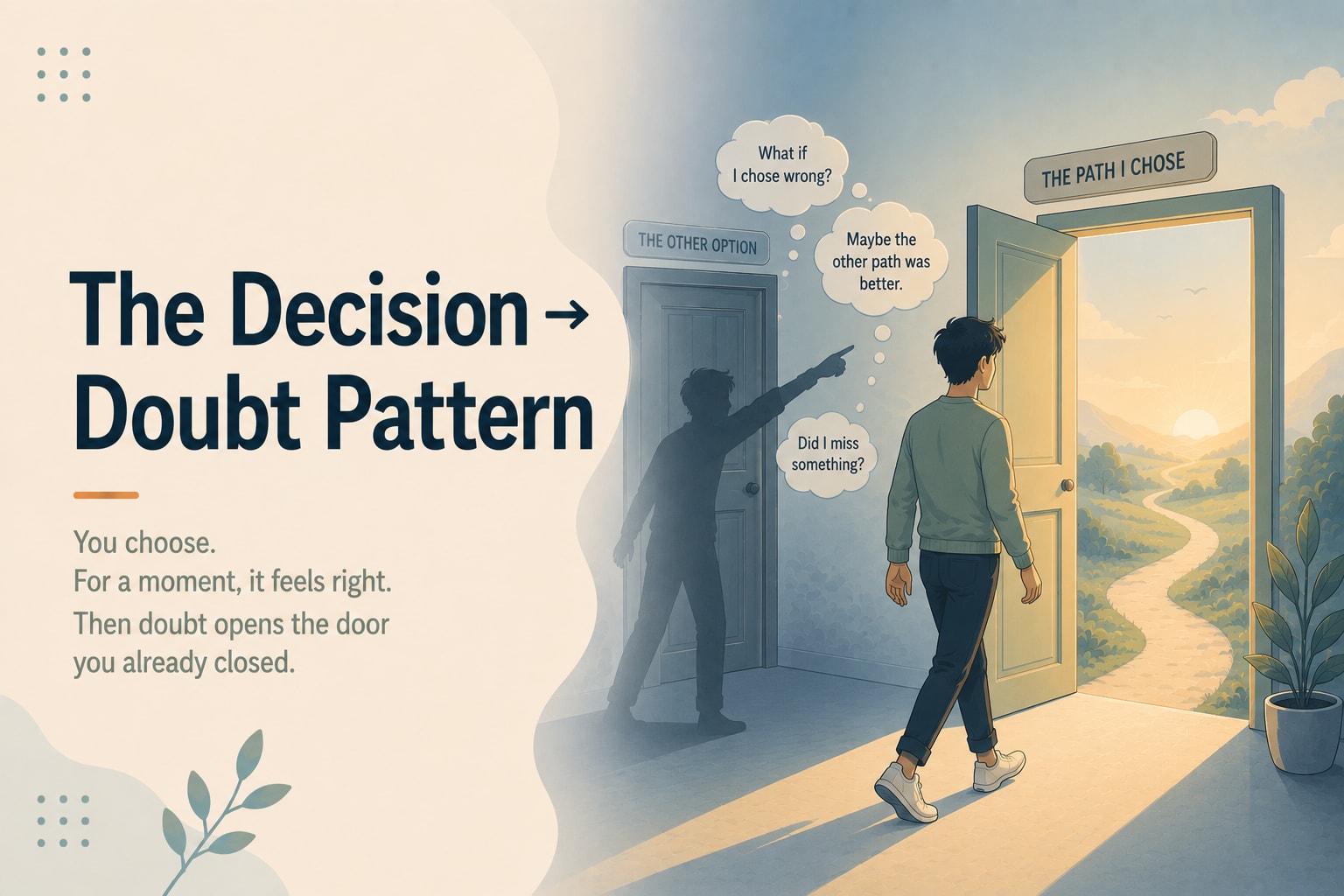
The Decision → Doubt Pattern
The Decision → Doubt Pattern often begins after the decision has already been made.
Not before.
After.
You finally choose.
You send the message.
Accept the offer.
Say no.
Book the ticket.
Set the boundary.
For a brief moment, everything feels settled.
Then something shifts.
"Maybe I chose too quickly."
"What if the other option was better?"
"Did I misunderstand something?"
Nothing new has happened.
The decision has not changed.
Only your relationship with it has.
You might not notice it at first.
You think you're reviewing the decision.
But if you look closely, something interesting appears.
You're no longer looking for information.
You're looking for certainty.
And certainty is a difficult thing to find after the moment has already passed.
The mind quietly begins reopening a door it already closed.
It imagines conversations that never happened.
It compares futures that never existed.
It creates invisible alternatives that always seem calmer than the path you actually chose.
That's where the pattern begins.
The decision stops being something you made.
It becomes something you must repeatedly defend.
The strange part is that doubt often arrives because you finally committed.
As long as every option remained open, there was nothing to lose.
Once one path becomes real, every path you didn't choose becomes imaginary.
Imaginary paths have a remarkable advantage.
Nothing ever goes wrong inside them.
Your real decision now competes with a perfect version of a life that never had to face reality.
That comparison is impossible to win.
This is how self-sabotage patterns quietly appear.
Not by making terrible decisions.
But by refusing to let any decision stay finished.
The more the mind revisits the choice, the more details it discovers.
Each detail feels important.
Each question feels necessary.
Soon you're no longer deciding.
You're trapped inside one of the familiar overthinking loops that quietly convince you that more thinking will eventually remove uncertainty.
It rarely does.
If anything, the opposite happens.
The longer you stare at the decision, the less familiar it becomes.
Even choices that once felt obvious begin to feel fragile.
Sometimes this pattern is connected to self-doubt cycles.
The decision itself is not the real target.
Your own judgment is.
Every question quietly asks the same thing.
"Can I really trust myself?"
That question is rarely answered by another hour of thinking.
Because the mind isn't searching for facts anymore.
It's searching for reassurance that uncertainty cannot exist alongside a good decision.
But every meaningful decision contains uncertainty.
That isn't a flaw in your thinking.
It's part of choosing.
Perhaps the most surprising part of this pattern is that doubt often feels like responsibility.
You tell yourself you're being careful.
Thoughtful.
Wise.
Sometimes you are.
Other times, the thinking has quietly stopped protecting the decision and started protecting you from the discomfort of not knowing what would have happened otherwise.
Those are very different things.
The first helps you choose.
The second keeps you emotionally attached to decisions that can no longer be changed.
If you look deeper, this pattern connects to something much larger.
It is rarely just about one decision.
It is often about how much you trust yourself after making one.
Related Patterns
- The Complete Guide to Self-Sabotage Patterns
- Why You Second-Guess Your Choices
- Why Doubt Grows the More You Think
