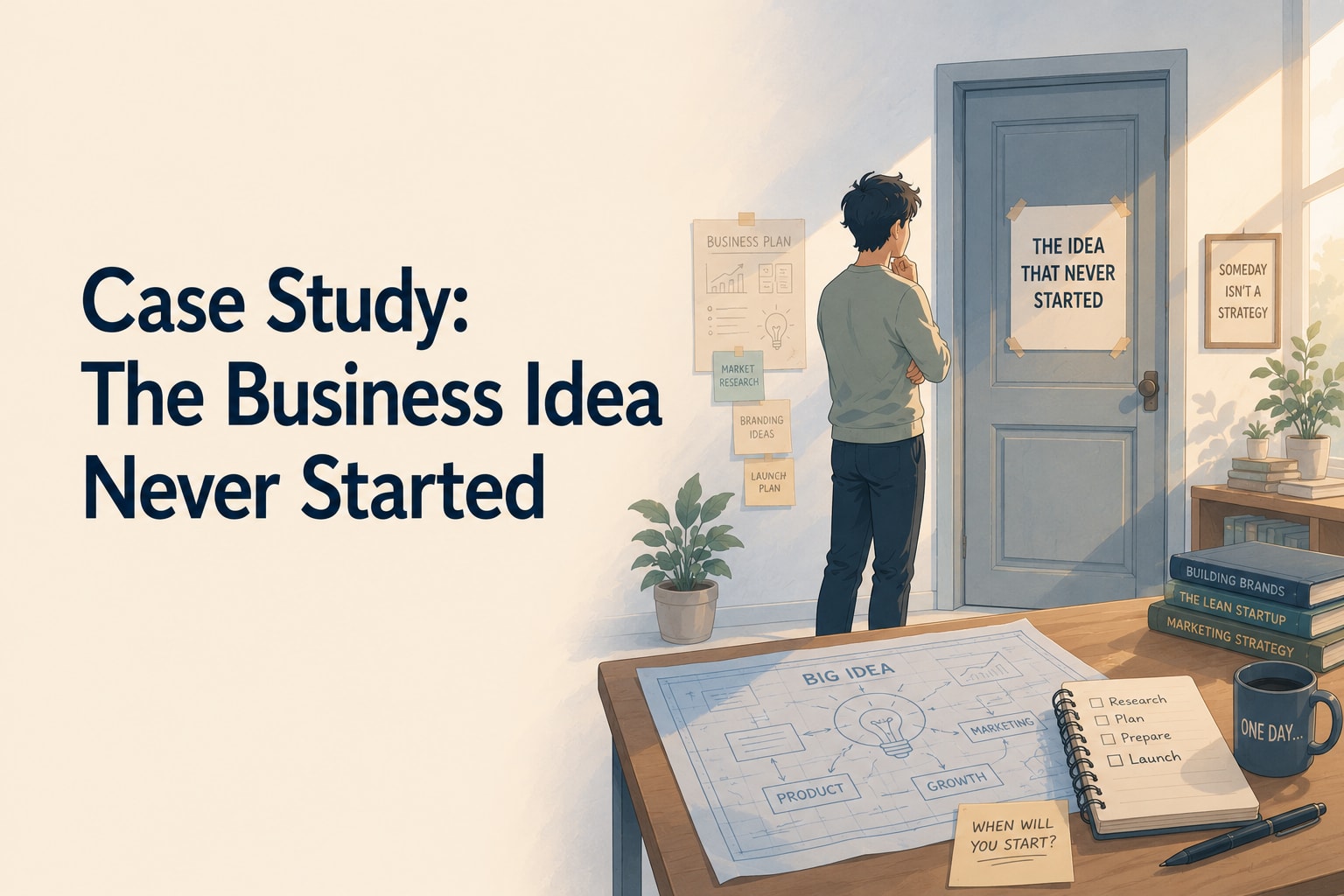
The case study "The Business Idea Never Started" is surprisingly common.
It rarely begins with a lack of ambition.
It usually begins with a good idea.
The idea feels exciting.
It feels realistic.
The person genuinely intends to build it.
Months later, nothing has been launched.
The interesting question isn't why the business failed.
It's why it never reached the starting line.
The situation
The person notices a gap in the market.
They begin researching competitors.
They buy books.
Watch videos.
Take courses.
Create folders.
Design logos.
Write business plans.
Collect advice.
Everything appears productive.
Whenever someone asks how the project is going, the answer sounds encouraging.
"I'm still preparing."
Weeks become months.
Months become a year.
The idea still exists.
Only inside notebooks and documents.
Nothing has been tested.
No customer has ever seen it.
No version has ever been released.
The business hasn't failed.
It has remained permanently unfinished.
The pattern that appeared
The behavior followed a predictable sequence.
First, preparation created momentum.
Research felt like progress.
Planning felt responsible.
Learning created the feeling that the project was moving forward.
Then preparation quietly replaced action.
Every new question created another reason to wait.
More market research.
More branding.
More refinement.
More certainty.
Each decision delayed the next one.
Without realizing it, preparation had become the project.
The launch became something that would happen later.
Then later became another later.
This is how many self-sabotage patterns quietly unfold.
Not through dramatic mistakes.
Through repeated postponement that always feels reasonable.
Why the mind reacted this way
From the outside, the behavior looked disciplined.
Psychologically, something different was happening.
Launching the business would have created uncertainty.
Customers might ignore it.
Someone might criticize it.
Sales might be disappointing.
The brain recognized those possibilities long before they happened.
It responded by delaying exposure.
Preparation reduced anxiety.
Action increased uncertainty.
Given those two choices, the mind naturally preferred preparation.
This is one reason Overthinking Loops become so persistent.
Thinking feels productive.
It also feels safe.
Eventually, the brain starts confusing preparation with progress.
The business appears active.
In reality, it has never entered the real world.
Where this pattern connects
The business idea is only one example.
The same behavioral loop appears elsewhere.
Someone keeps rewriting a résumé instead of applying.
A writer edits the first chapter for months without publishing.
A creator watches tutorials instead of making videos.
A professional waits until they feel "experienced enough" before offering their services.
The situation changes.
The psychological system remains remarkably similar.
The pattern often overlaps with:
- Fear of failure
- Perfectionism patterns
- Self-doubt cycles
- Procrastination behavior
Each reinforces the others.
Fear encourages preparation.
Preparation delays action.
Delay reduces confidence.
Reduced confidence strengthens fear.
The loop quietly feeds itself.
This is why recognizing the pattern matters more than criticizing the behavior.
Once the loop becomes visible, it becomes interruptible.
One practical way to interrupt it is through the Exposure Ladder Framework, which breaks intimidating actions into small, repeatable steps.
Instead of preparing for one giant launch, the focus shifts to taking one visible action at a time.
What this case reveals about human behavior
This case study isn't really about entrepreneurship.
It's about how the human mind responds to meaningful uncertainty.
The more important something feels...
The more carefully the brain tries to protect it.
Ironically, that protection often prevents the very outcome it hoped to preserve.
You might not notice it at first.
Because preparation looks almost identical to progress.
The difference only becomes visible over time.
Progress creates evidence.
Preparation creates intention.
Both feel productive.
Only one changes reality.
That's what makes this pattern so difficult to recognize while it's happening.
The person doesn't believe they're avoiding the goal.
They believe they're getting closer to it.
Final reflection
Most unfinished projects don't begin with laziness.
They begin with care.
The business mattered.
That's why it was protected.
The protection simply lasted too long.
Eventually, the safest version of the business became the one that never existed outside the imagination.
That's the quiet paradox.
Sometimes the greatest threat to an important idea isn't failure.
It's endless preparation.
Once you recognize that pattern, you begin asking a different question.
Not,
"Am I ready to launch?"
But,
"What evidence am I still waiting for that only action can give me?"
That single question often reveals the difference between preparation and postponement.
Related Patterns
This pattern often appears alongside others.
- Overthinking Loops
- Fear of Failure Explained Simply (coming soon)
- Why You Prepare More Than You Execute (coming soon)
- The Exposure Ladder Framework (coming soon)
- The Complete Guide to Self-Sabotage Patterns
