import Image from "next/image";
export const metadata = { title: "Case Study: Delaying an Important Conversation", description: "Delaying an important conversation reveals how avoidance, overthinking, and fear quietly turn a manageable discussion into a heavier problem.", };
export const slug = "case-study-delaying-important-conversation";
export const tags = [ "delaying an important conversation", "conversation avoidance", "emotional avoidance", "overthinking loops", "self sabotage patterns", "fear of conflict", "procrastination psychology", "human behavior psychology" ];
Case Study: Delaying an Important Conversation
Delaying an important conversation rarely begins with a decision to avoid it completely.
The person usually intends to speak.
They know the issue needs attention.
They may even plan what they want to say.
Yet the conversation keeps moving to another day.
Nothing dramatic prevents it.
The delay is built from small decisions that feel reasonable in the moment.
That is what makes the pattern easy to miss.
The situation
A person notices that a working relationship has become unclear.
Responsibilities are being handled unevenly.
Small misunderstandings are becoming more frequent.
The issue is manageable, but it needs to be discussed.
The person decides to raise it during the next meeting.
The meeting arrives.
Other topics take priority.
They decide the timing is not ideal.
Later, they draft a message requesting a conversation.
They read it several times.
The wording feels too direct, so they soften it.
Then it feels too vague.
The message remains unsent.
A few days later, another misunderstanding occurs.
The person again decides that a conversation is necessary.
They begin planning what to say.
No conversation happens.
The pattern that appeared
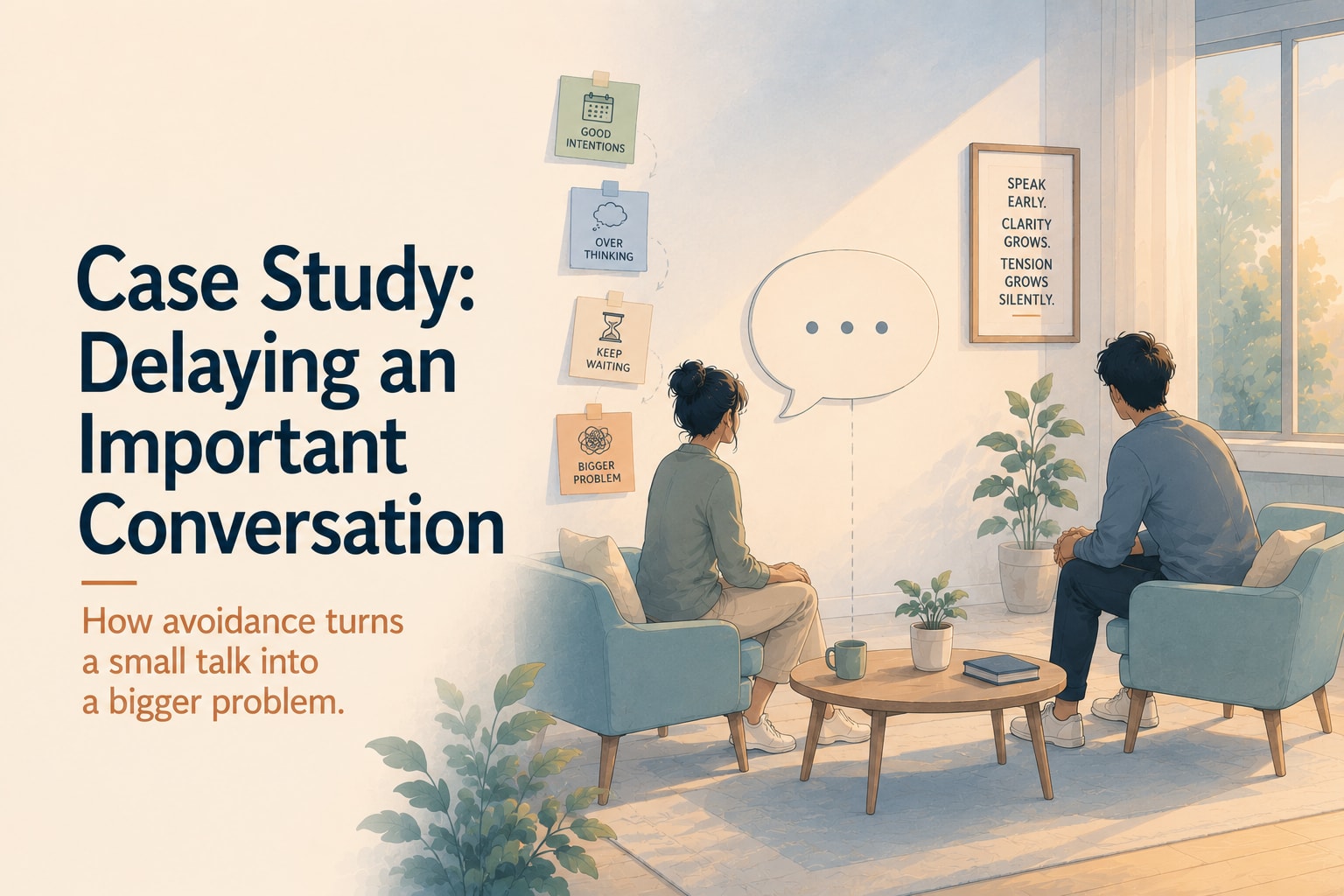
The delay followed a predictable structure.
Recognition
The person understood that the issue required direct communication.
There was no lack of awareness.
Preparation
They reviewed previous interactions, imagined possible responses, and organized their thoughts.
Reconsideration
Each possible opening created another concern.
Would the conversation sound confrontational?
Would the other person become defensive?
Was the issue serious enough to mention?
Temporary postponement
The person chose to wait for a better moment.
Short-term relief
Once the conversation was postponed, the immediate pressure decreased.
Renewed tension
Because the issue remained unresolved, another incident brought the concern back.
The loop restarted.
This is how overthinking loops often operate in real situations.
The thinking appears to prepare the person for action.
In practice, it repeatedly moves action further away.
Why the mind reacted this way
The conversation carried uncertainty.
The person could control their words.
They could not control the response.
The other person might disagree.
They might feel criticized.
The relationship could become temporarily uncomfortable.
The brain treated those possibilities as risks.
It responded by searching for a version of the conversation with no emotional friction.
A perfectly timed moment.
Perfectly neutral language.
A predictable reaction.
That version did not exist.
So preparation continued.
The mind was not only trying to communicate clearly.
It was trying to remove uncertainty before communication began.
This is where ordinary caution becomes emotional avoidance.
The person avoids the conversation because they are trying to avoid the feelings that might appear inside it.
The delay therefore provides immediate relief.
That relief quietly rewards the behavior.
The next postponement becomes easier.
Where this pattern connects
Delaying an important conversation rarely exists as an isolated habit.
It often connects to several wider patterns.
Fear of conflict
The person assumes disagreement will damage the relationship rather than clarify it.
Self-doubt cycles
They repeatedly question whether their concern is valid enough to mention.
Perfectionism patterns
The conversation must be handled in exactly the right way before it can begin.
Procrastination behavior
The discussion is moved into the future, where it temporarily feels easier to manage.
Together, these patterns become part of a broader system of self-sabotage patterns.
The person is not intentionally making the relationship more difficult.
They are trying to preserve stability.
But preserving short-term comfort allows the underlying problem to grow.
There are practical ways to interrupt this pattern once it becomes visible.
The Exposure Ladder Framework reduces the pressure by breaking one intimidating conversation into smaller acts of exposure.
The first step may be writing the central issue in one sentence.
The next may be asking for ten minutes to talk.
The goal is not to rehearse every possible response.
It is to make the conversation small enough to begin.
What this case reveals about human behavior
This case shows how avoidance can look like careful preparation.
The person did not ignore the issue.
They thought about it often.
They reviewed it.
They planned around it.
Their mind remained active.
From the inside, this activity felt responsible.
From the outside, the result was the same as doing nothing.
The conversation remained unfinished.
This distinction matters.
Mental activity can create the feeling that a problem is being handled even when no external action has occurred.
The person feels close to resolution because the topic is constantly present in their thoughts.
But thought does not create shared understanding.
Only the conversation can do that.
You might not notice it at first.
But if you look closely, something interesting appears.
The delay is rarely caused by not knowing what to say.
It is caused by not knowing what will happen after it is said.
Final reflection
The important conversation eventually becomes harder.
Not because the original issue changed dramatically.
Because the delay added more weight to it.
More examples accumulated.
More assumptions formed.
More meaning was attached to the discussion.
What could have been a short clarification began to feel like a major confrontation.
This is how the pattern expands.
Avoidance reduces discomfort now.
Then quietly increases it later.
Once the structure becomes visible, the question changes.
Instead of asking:
"How can I make this conversation completely safe?"
A more useful question appears:
"What is the smallest honest version of this conversation I can have now?"
That question does not remove uncertainty.
It simply stops uncertainty from making every decision.
Related Patterns
This pattern often appears alongside others.
- Overthinking Loops
- Emotional Avoidance Definition
- Fear of Conflict Patterns (coming soon)
- The Exposure Ladder Framework
- The Complete Guide to Self-Sabotage Patterns
