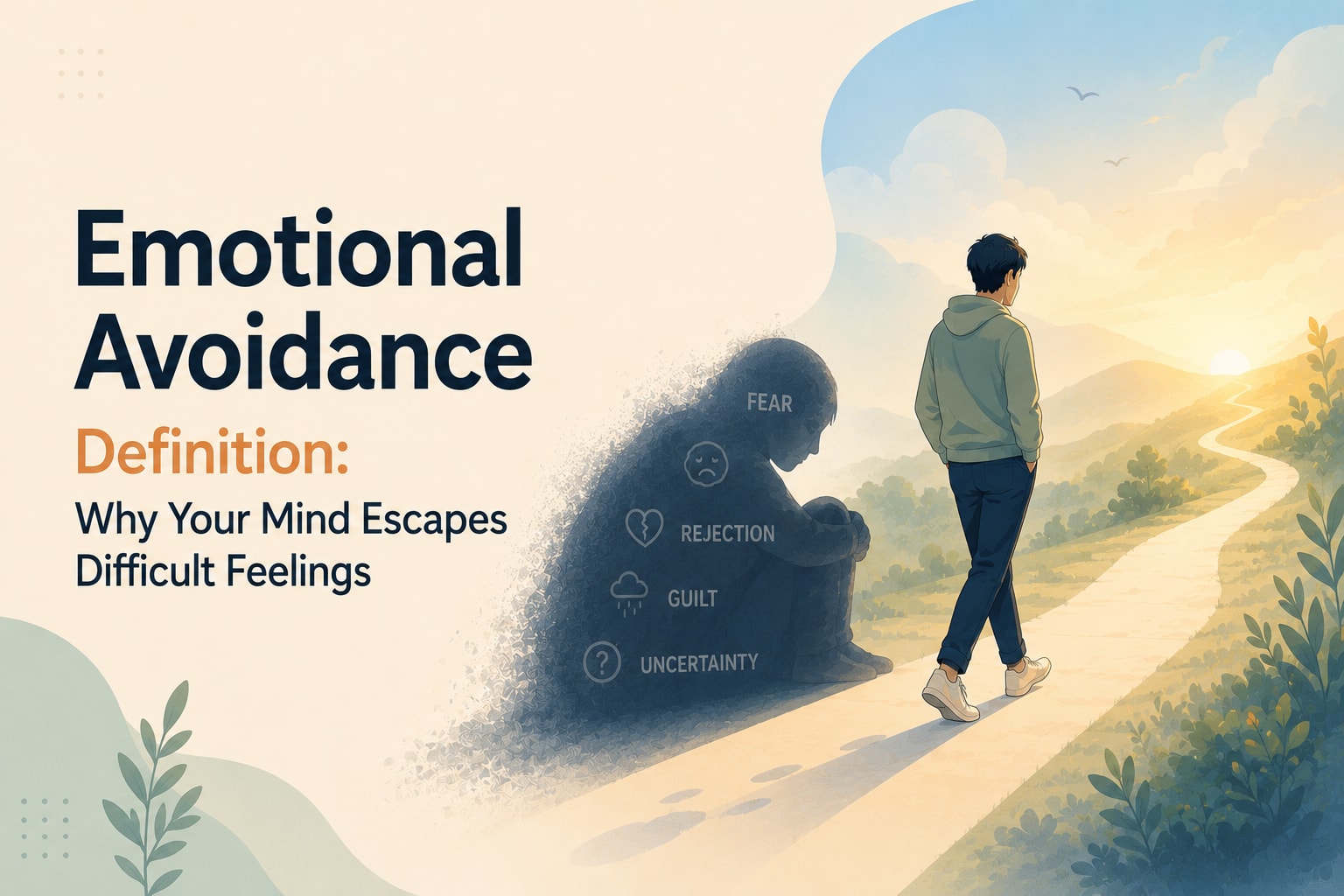
Emotional Avoidance Definition
Emotional avoidance definition begins with something almost everyone has experienced.
You tell yourself you're just tired.
Or busy.
Or waiting for the right time.
But the conversation never happens.
The decision stays unfinished.
The feeling remains untouched.
You might not notice it at first.
Because emotional avoidance rarely looks dramatic.
It often looks like ordinary life.
But if you look closely, something interesting appears.
The situation isn't what you're avoiding.
It's the emotion attached to it.
That's where the pattern begins.
What emotional avoidance actually means
Emotional avoidance is a psychological pattern where a person unconsciously avoids situations, thoughts, conversations, or decisions because they might trigger uncomfortable emotions.
Those emotions might include:
- embarrassment
- disappointment
- shame
- rejection
- guilt
- grief
- vulnerability
- uncertainty
Notice what is actually being avoided.
Not the task.
Not the opportunity.
Not the conversation.
The feeling.
The mind quietly learns that avoiding the situation also delays experiencing the emotion.
For a moment, that works.
Relief appears.
But so does repetition.
Over time, emotional avoidance often becomes part of larger self-sabotage patterns.
Not because you're trying to make life harder.
Because your brain is trying to make uncomfortable emotions disappear.
The behavior most people don't notice
Emotional avoidance rarely announces itself.
It disguises itself as ordinary behavior.
You stay busy instead of sitting with difficult thoughts.
You keep working instead of grieving.
You scroll your phone instead of having the conversation.
You plan instead of deciding.
You research instead of beginning.
You convince yourself you'll deal with it tomorrow.
Each decision seems harmless.
Sometimes even productive.
But something subtle is happening.
The emotion never actually leaves.
It simply waits.
That's why emotional avoidance can continue for weeks, months, or even years without being recognized.
The behavior changes.
The emotional pattern stays the same.
Why the mind does this
The brain naturally moves toward comfort and away from discomfort.
That isn't weakness.
It's survival.
Emotions like shame, rejection, fear, or uncertainty activate systems designed to protect you.
One way the brain reduces emotional discomfort is by avoiding whatever seems to cause it.
The relief feels immediate.
If you don't have the conversation...
You don't feel awkward.
If you don't apply...
You can't be rejected.
If you don't begin...
You can't fail.
For a while, avoidance seems effective.
The uncomfortable feeling becomes quieter.
But the brain learns something important.
"Avoiding works."
So it repeats the strategy.
This is why emotional avoidance often overlaps with overthinking loops.
Thinking feels emotionally safer than acting.
Analyzing feels safer than experiencing.
Without realizing it, the mind starts choosing certainty over growth.
Where this pattern appears in everyday life
Emotional avoidance hides inside ordinary moments.
You don't answer an important message because you're worried about the conversation.
You avoid checking your finances because you're afraid of what you'll find.
You stay in an unhappy situation because change feels uncertain.
You don't tell someone how you feel because rejection seems unbearable.
You postpone making a decision because choosing creates anxiety.
You avoid asking for help because vulnerability feels uncomfortable.
None of these behaviors are really about the action itself.
They're about avoiding the emotional experience attached to it.
That's why two people can face the same situation and respond completely differently.
The situation stays the same.
The emotional meaning changes everything.
The hidden effect of this pattern
Emotional avoidance doesn't remove emotions.
It postpones them.
Sometimes it even strengthens them.
The difficult conversation grows larger in your mind.
The decision feels heavier.
The opportunity becomes more intimidating.
Meanwhile, confidence quietly decreases.
Not because you became less capable.
Because you stopped collecting evidence that you could handle discomfort.
That's the hidden cost.
Avoidance protects you from temporary emotional pain.
But it also protects you from discovering your emotional resilience.
Over time, the mind starts believing discomfort is something that must always be escaped.
That's how emotional avoidance quietly feeds procrastination, perfectionism, fear of failure, and self-doubt.
One hidden loop begins creating many others.
What this reveals about human behavior
Emotional avoidance reveals something surprisingly human.
People rarely avoid reality.
They avoid how reality might make them feel.
You might not notice it at first.
But if you look closely, something interesting appears.
Many of the decisions we call "logical" are quietly emotional.
We think we're delaying because we need more time.
Sometimes we're delaying because we don't want to experience uncertainty.
We think we're waiting for better circumstances.
Sometimes we're waiting for uncomfortable emotions to disappear.
The emotions become invisible.
The behaviors become visible.
That's why the pattern is so easy to miss.
Once you begin recognizing the emotional layer beneath your actions, many confusing behaviors suddenly make sense.
Final reflection
Emotional avoidance isn't proof that something is wrong with you.
It's proof that your mind wants to protect you.
The problem begins when protection quietly becomes a habit.
Because emotions have an interesting quality.
They don't disappear simply because they're ignored.
They usually wait.
The next time you notice yourself delaying something important, pause for a moment.
Ask yourself a different question.
"Am I avoiding this situation... or am I avoiding the feeling I expect it to create?"
Sometimes the answer won't change the situation.
But it will reveal the pattern.
And once the pattern becomes visible, it becomes much harder for it to quietly control your decisions.
Q: What is emotional avoidance in psychology?
A: Emotional avoidance is a psychological pattern where people avoid situations, thoughts, or decisions because they don't want to experience difficult emotions such as fear, shame, guilt, or uncertainty.
Q: Why does emotional avoidance happen?
A: The brain naturally tries to reduce emotional discomfort. Avoiding situations often provides immediate relief, which teaches the brain to repeat the behavior.
Q: Is emotional avoidance related to overthinking or self-doubt?
A: Yes. Emotional avoidance often leads to overthinking loops, self-doubt cycles, procrastination, and fear of failure because thinking feels emotionally safer than acting.
Q: Can emotional avoidance become self-sabotage?
A: Yes. When avoiding uncomfortable emotions repeatedly delays important actions, it gradually becomes one of the most common self-sabotage patterns.
Related Patterns
If this pattern feels familiar, it often connects to other hidden behaviors.
