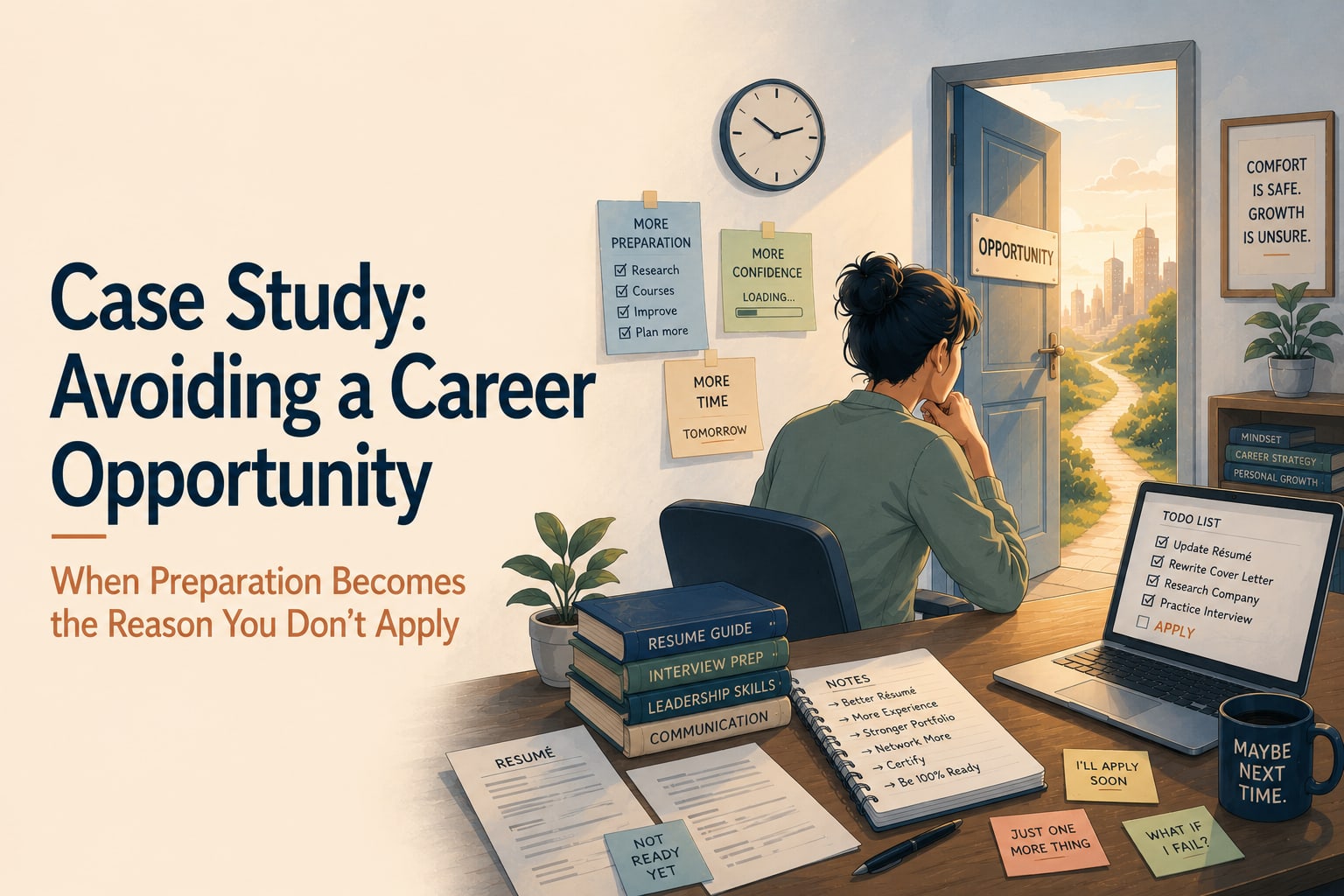
Case Study: Avoiding a Career Opportunity
A promotion becomes available.
A recruiter reaches out.
A job posting perfectly matches someone's experience.
Nothing prevents them from applying.
Yet the application is never submitted.
The opportunity eventually closes.
From the outside, it looks like hesitation.
From a behavioral perspective, something much more structured has taken place.
The situation
The person notices the opportunity immediately.
They save the job description.
They compare their experience with every listed requirement.
They update their résumé.
They rewrite their cover letter.
They ask friends for advice.
They promise themselves they will apply after making a few improvements.
A few days later, they revise the résumé again.
They research the company.
They look at employee profiles online.
They watch interview tips.
Everything suggests movement.
Nothing reaches the hiring manager.
Eventually, the application deadline passes.
The opportunity disappears without a decision ever being made.
The pattern that appeared
The behavior followed a familiar sequence.
First, the opportunity created possibility.
The role represented growth, recognition, or a different future.
Next, the mind searched for certainty.
Instead of asking whether the opportunity was worth pursuing, attention shifted toward personal readiness.
Questions multiplied.
"Am I experienced enough?"
"What if someone better applies?"
"Should I gain one more certification first?"
Each question created another reason to delay.
Preparation slowly replaced participation.
The application was postponed not once, but repeatedly.
Each delay felt logical.
Viewed individually, every decision seemed responsible.
Viewed together, they formed a pattern.
This is how self-sabotage patterns often develop.
Not through obvious avoidance.
Through small, reasonable decisions that quietly move action further away.
Why the mind reacted this way
The brain was not simply evaluating a job.
It was evaluating uncertainty.
Submitting an application would have created outcomes beyond personal control.
The employer might reject it.
The interview might expose weaknesses.
The new role might require unfamiliar responsibilities.
To reduce that uncertainty, the mind looked for something it could control.
Preparation.
Preparation temporarily lowered anxiety.
It created the feeling of progress without requiring exposure.
This is one reason Overthinking Loops become so persistent.
Thinking feels safer than testing.
Planning feels safer than participating.
The longer preparation continues, the more the opportunity becomes psychologically significant.
Ironically, that increased importance makes taking action even more difficult.
Where this pattern connects
Although this case centers on a career opportunity, the same structure appears in many parts of life.
Someone delays launching a business until everything is perfect.
A creator postpones publishing because the work could be better.
A student waits before applying for a scholarship.
Someone avoids introducing themselves to people they admire.
Different situations.
The same behavioral system.
This pattern frequently overlaps with:
- Fear of failure
- Perfectionism patterns
- Self-doubt cycles
- Procrastination behavior
- Identity and self-worth concerns
Each pattern reinforces the next.
Fear encourages preparation.
Preparation delays action.
Delay reduces confidence.
Reduced confidence strengthens future hesitation.
The loop becomes self-sustaining.
One way to interrupt it is through the Exposure Ladder Framework.
Instead of preparing indefinitely, the focus shifts toward the smallest visible action.
Updating the résumé.
Submitting one application.
Sending one message.
The goal becomes gathering evidence rather than eliminating uncertainty.
What this case reveals about human behavior
This case is not really about careers.
It is about how people respond when a decision carries personal meaning.
The more significant an opportunity feels, the more the mind tries to protect against possible disappointment.
Protection often disguises itself as responsibility.
More research.
More editing.
More preparation.
From the inside, these behaviors feel productive.
From the outside, they produce the same outcome as avoidance.
The opportunity remains untouched.
You might not notice it at first.
Because the person appears busy.
The hidden difference is that preparation creates readiness, while action creates evidence.
Only one changes reality.
That distinction often remains invisible until the opportunity has already passed.
Final reflection
Most career opportunities are not lost because people lack ability.
Many are lost because uncertainty quietly becomes the deciding factor.
The application is postponed.
The interview is delayed.
The opportunity closes on its own.
Nothing dramatic happens.
That is precisely what makes the pattern difficult to recognize.
Avoidance rarely announces itself.
It often arrives disguised as preparation.
Once that disguise becomes visible, the question changes.
Instead of asking,
"Am I finally ready?"
The more useful question becomes,
"What action would give me information that preparation never can?"
That small shift is often where the pattern begins to break.
Related Patterns
This pattern often appears alongside others.
