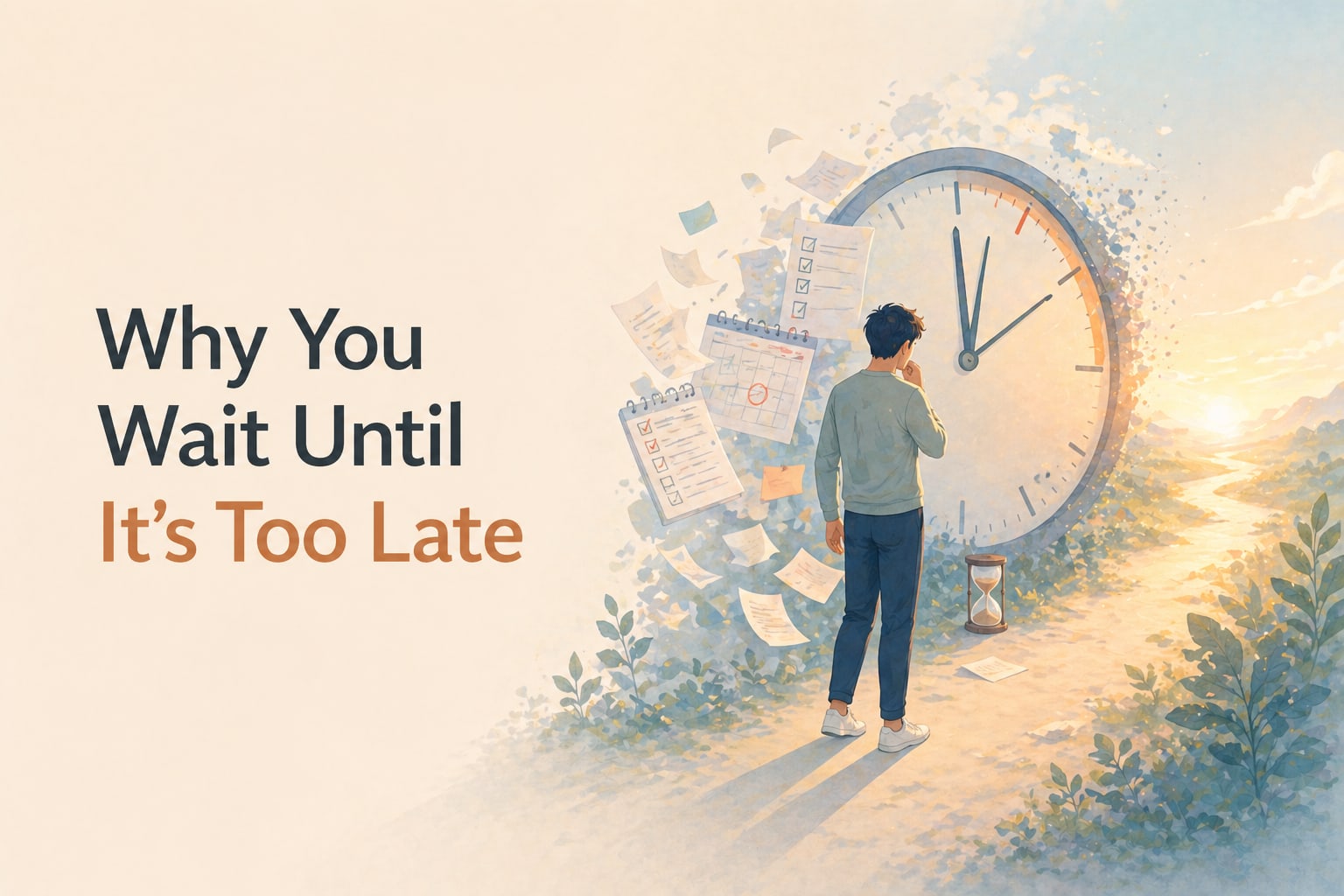
Why You Wait Until It’s Too Late
It often doesn’t feel intentional.
You know the task is there.
You are aware of the deadline.
You even think about it repeatedly.
But you don’t act.
Not yet.
You tell yourself there’s still time.
You’ll start later.
You’ll do it properly when the moment feels right.
But the moment keeps moving.
Until suddenly…
There isn’t enough time left.
You might not notice it at first.
But if you look closely, something interesting appears.
You don’t act early.
You act when pressure forces you to.
That’s where the pattern begins.
What this actually means
Waiting until it’s too late is not just poor timing.
It is a behavioral pattern where action is delayed until urgency removes the option to avoid it.
Instead of choosing when to act, the person lets pressure decide.
The deadline becomes the trigger.
Not intention.
Not discipline.
This often sits inside larger self-sabotage patterns.
Because the delay creates unnecessary difficulty.
And that difficulty becomes part of the cycle.
The behavior most people don’t notice
The delay does not feel like avoidance.
It feels like postponement.
You acknowledge the task.
You think about starting.
But you choose not to act yet.
Then you shift your attention.
You do something else.
Something easier.
Something immediate.
The task remains in the background.
Always present.
But not urgent enough.
Yet.
This is where procrastination patterns quietly take hold.
The mind is not ignoring the task.
It is managing when the discomfort becomes unavoidable.
Why the mind does this
The mind tries to reduce discomfort.
Starting early creates a different type of discomfort.
Uncertainty.
Effort.
Responsibility.
So instead of facing it early, the mind delays it.
But delay has a side effect.
It increases pressure over time.
Eventually, the pressure becomes stronger than the avoidance.
And that’s when action happens.
Not because it’s easier.
But because there is no alternative left.
This connects to overthinking loops.
Because while you are delaying, you are still thinking about the task.
You are aware of it.
You are tracking time.
You are mentally preparing.
But you are not acting.
It also connects to fear of failure.
Because starting early creates space for evaluation.
Mistakes.
Judgment.
But starting late compresses everything.
There is less time to reflect.
Less time to question.
You just act.
In a way, waiting becomes a strategy.
It removes the space where doubt can grow.
Where this pattern appears in daily life
You see this pattern in predictable situations.
You wait until the night before to start an assignment.
You rush through it.
You submit just before the deadline.
You delay preparing for an important meeting.
You review things quickly at the last moment.
You rely on urgency to focus.
You avoid starting a personal project.
Until one day, you feel behind.
And try to catch up all at once.
You delay responding to something important.
Until it becomes awkward.
Or too late to respond naturally.
In each case, the timeline was known.
But action was postponed.
Until pressure forced movement.
The hidden effect of this pattern
At first, this pattern can seem effective.
You get things done.
You meet deadlines.
You manage under pressure.
But something else is happening quietly.
The quality of your work becomes tied to urgency.
Not clarity.
Not intention.
And over time, this creates instability.
Because pressure is unpredictable.
Sometimes it pushes you.
Sometimes it overwhelms you.
This also feeds into self-doubt cycles.
Because you begin to notice the pattern.
You see that you only act under pressure.
You start questioning your discipline.
Your consistency.
Your control.
Not realizing that the pattern itself created that dynamic.
What this reveals about human behavior
This pattern reveals something important.
People don’t always act when they should.
They act when they have to.
Because “should” still leaves room for avoidance.
But “have to” removes that option.
So the mind waits.
Not passively.
But strategically.
It delays until action becomes unavoidable.
This reduces internal resistance.
But increases external pressure.
And over time, this shifts how you experience tasks.
You stop seeing them as things to do.
And start seeing them as things to survive.
There are simple ways to interrupt this pattern once it’s recognized.
Not by forcing discipline.
But by acting before pressure builds.
Even small early actions change the timeline.
They reduce the need for urgency.
And return control to you.
Final reflection
Waiting until it’s too late rarely feels like a decision.
It feels like something that just happens.
But if you observe it closely…
It follows a pattern.
Awareness without action.
Time without movement.
Pressure without control.
Until finally—
Action without choice.
And sometimes, the real shift is not learning how to handle pressure better.
It’s learning how to move before pressure becomes the only reason you do.
Q: Why do I wait until it’s too late to act?
A: Because delaying reduces immediate discomfort, and pressure later forces action when avoidance is no longer possible.
Q: Is this procrastination or a different pattern?
A: It is a form of procrastination, but specifically driven by waiting for urgency to override hesitation.
Q: How is this connected to overthinking?
A: You continue thinking about the task while delaying it, which increases pressure without producing action.
Q: How can I stop this pattern?
A: By taking small actions earlier, before pressure builds, so the task doesn’t rely on urgency to get done.
Related Patterns
If this pattern feels familiar, it often connects to other behaviors:
