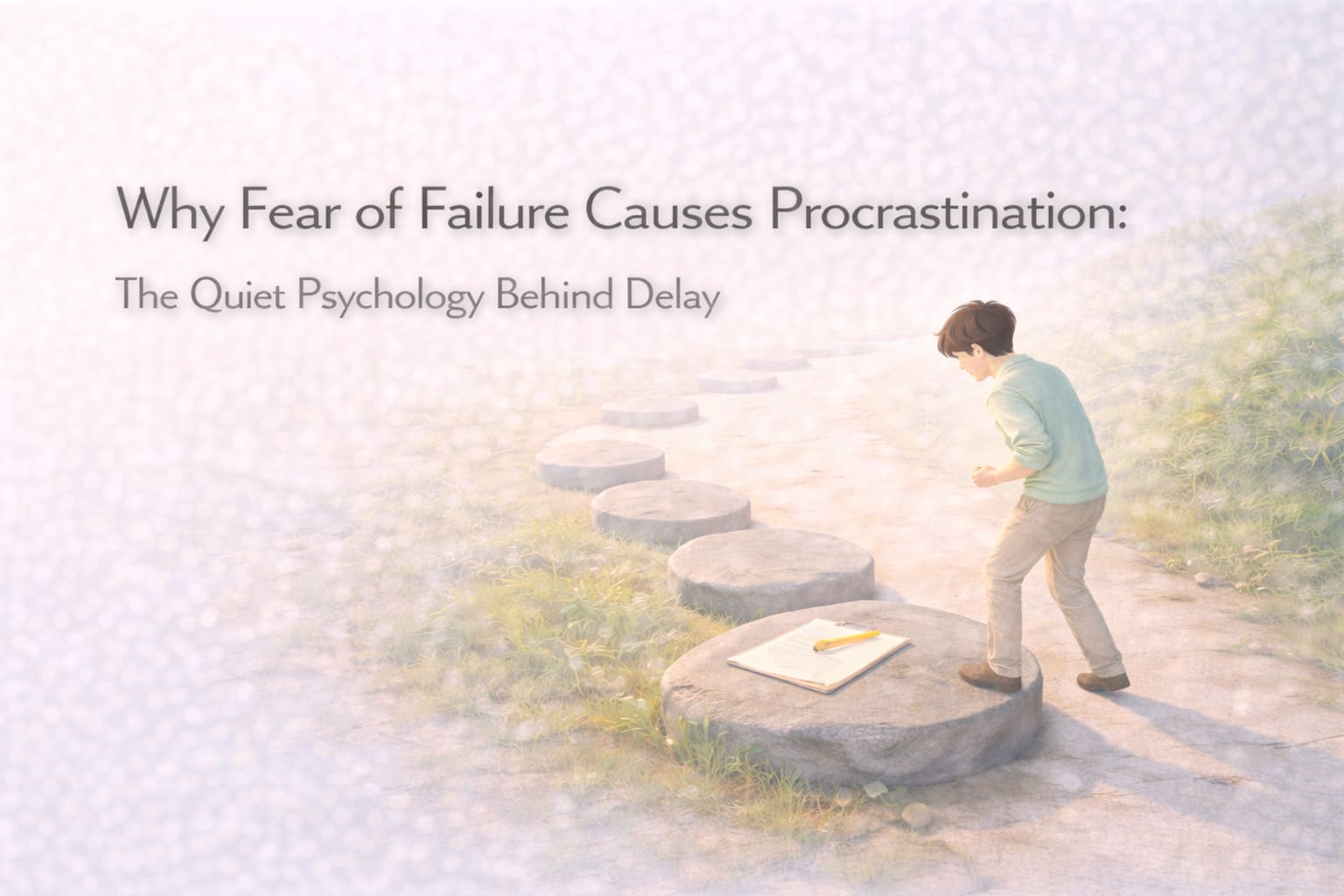
Why Fear of Failure Causes Procrastination
Why fear of failure causes procrastination becomes easier to understand when you notice a small moment many people experience.
You know something needs to be done.
A task.
A decision.
A project you’ve been thinking about for days.
You tell yourself you’ll start soon.
But instead, you wait.
You check something else.
You organize something small.
You think about the task again without beginning it.
At first, it seems like simple delay.
But if you look closely, something interesting appears.
Sometimes procrastination is not about laziness.
It’s about fear of failure quietly slowing action.
What This Behavior Actually Is
Why fear of failure causes procrastination often comes down to how the brain interprets risk.
When a task feels important, the mind begins imagining possible outcomes.
Success is one possibility.
But failure becomes another.
Once the brain imagines failure, something subtle happens.
Action begins to feel heavier.
If you start and fail, the result becomes visible.
But if you delay starting, the outcome remains uncertain.
In that sense, procrastination becomes a protective strategy.
The mind delays action to protect identity.
If the task is never attempted, failure cannot be confirmed.
Over time, this pattern can quietly connect with deeper self-sabotage behaviors.
If you want to understand the broader framework behind these patterns, the full guide explains it here:
The Complete Guide to Self-Sabotage Patterns
Why the Brain Does This
The brain is strongly motivated to avoid negative emotional experiences.
Failure can trigger embarrassment, disappointment, or self-doubt.
To prevent these feelings, the mind sometimes chooses delay instead of action.
Several psychological mechanisms reinforce this pattern.
Identity protection
People often connect performance with self-worth.
If a task fails, the brain interprets it as a threat to identity.
Uncertainty discomfort
The mind prefers predictable outcomes.
Starting something uncertain creates tension.
Short-term emotional relief
Procrastination provides immediate relief.
The moment you postpone the task, the pressure temporarily fades.
Overthinking substitution
Sometimes procrastination does not look like avoidance.
It looks like thinking.
You analyze the task repeatedly instead of starting it.
If this feels familiar, it often connects with patterns described here:
Thinking feels safer than acting.
But thinking alone rarely moves progress forward.
The Hidden Cost
Fear of failure may seem protective in the moment.
But the long-term cost slowly becomes visible.
Tasks grow heavier with time.
Deadlines create stress.
Confidence decreases when important actions remain unfinished.
Several subtle effects often appear.
Delayed progress
Opportunities depend on action.
Procrastination slows movement.
Mental pressure increases
Unfinished tasks remain active in the mind.
Confidence weakens
Repeated delay can reduce trust in your own follow-through.
Momentum disappears
Progress often comes from small consistent steps.
Fear interrupts that rhythm.
This is how procrastination linked to fear of failure becomes a form of self-sabotage.
Not through failure.
Through hesitation.
A Small Shift That Changes the Pattern
Breaking the pattern of procrastination caused by fear of failure often begins with awareness.
Once you recognize the pattern, small changes can interrupt it.
Separate action from outcome
Starting a task does not determine the final result.
It simply begins the process.
Reduce the size of the first step
Large tasks create pressure.
Small actions reduce resistance.
Even five minutes of effort can break procrastination.
Recognize imagined failure
Much of the fear exists in the mind’s prediction.
Reality often looks different once action begins.
Over time, the brain begins learning something important.
Action reduces fear faster than avoidance.
Final Reflection
Fear of failure is deeply human.
The mind wants to protect you from disappointment.
It wants to avoid mistakes.
It wants to prevent embarrassment.
Because of this, the brain sometimes slows action before the task even begins.
You might not notice it at first.
The delay feels reasonable.
The hesitation feels temporary.
But if you watch closely, patterns begin to appear.
Moments where fear quietly replaces movement.
Moments where progress waits.
And once you begin recognizing those moments, something subtle changes.
The next time hesitation appears, you see it more clearly.
Not as a signal to stop.
But as a familiar pattern the mind has learned to follow.
Q: Why does fear of failure cause procrastination?
A: Fear of failure causes procrastination because the brain tries to avoid the emotional discomfort associated with making mistakes or being judged.
Q: Is procrastination always caused by laziness?
A: No. In many cases procrastination is connected to fear, uncertainty, or overthinking rather than lack of motivation.
Q: How is fear of failure connected to overthinking?
A: When people fear failure, they often analyze tasks repeatedly instead of starting them, creating overthinking loops that delay action.
Q: How can someone overcome procrastination caused by fear of failure?
A: Recognizing the pattern, taking smaller actions, and separating effort from outcome can gradually reduce procrastination.
