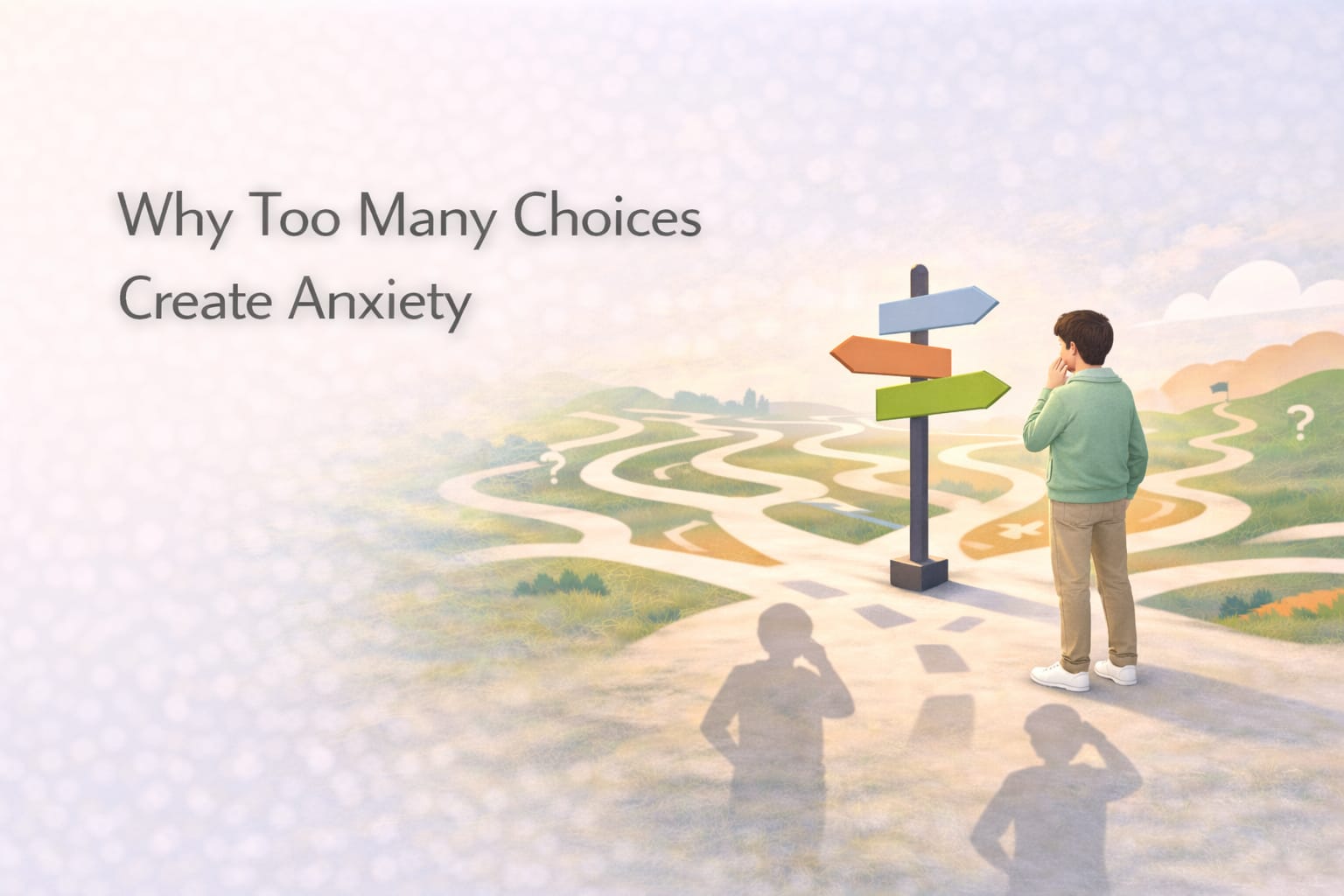
Why Too Many Choices Create Anxiety
Why too many choices create anxiety is something most people have experienced without realizing the psychology behind it.
You open a menu with dozens of options.
Or you try to choose between several opportunities.
At first, it seems like freedom.
More options should make life easier.
But something strange begins to happen.
The mind slows down.
You compare one option with another.
Then another.
Then another.
You might not notice it immediately.
But if you look closely, something interesting begins to appear.
The problem is no longer choosing.
The problem becomes choosing correctly.
And that’s where the anxiety begins.
What This Behavior Actually Is
Psychologists sometimes call this pattern choice overload.
It happens when the number of available options becomes so large that the brain struggles to evaluate them effectively.
At first, more options seem beneficial.
More possibilities.
More flexibility.
More potential outcomes.
But the brain must process each option.
It asks quiet questions like:
What if this isn’t the best choice?
What if another option would have been better?
What if I regret this later?
Instead of making the decision easier, additional choices create more mental comparisons.
The brain begins analyzing possibilities repeatedly.
Over time, this analysis can fall into the patterns described in overthinking loops.
The mind circles the decision again and again, searching for certainty.
But certainty rarely appears when too many possibilities exist.
Why Too Many Choices Create Anxiety
The reason too many choices create anxiety is connected to how the brain handles responsibility.
Every choice closes other doors.
When you pick one option, all the others disappear.
The mind becomes aware of that loss.
So it tries to prevent mistakes.
It analyzes.
Compares.
Rechecks.
But when many options exist, the number of possible comparisons becomes enormous.
The brain begins imagining different outcomes for each choice.
What if this path fails?
What if the other option would have worked better?
The more possibilities the mind sees, the more uncertainty it experiences.
Ironically, what looks like freedom from the outside can feel like pressure inside the mind.
The brain now believes it must find the perfect choice among many alternatives.
And when perfection becomes the standard, hesitation appears.
This is where decision overload can quietly connect to deeper patterns explored in self-sabotage patterns.
The mind becomes so concerned about making the wrong choice that it delays making any choice at all.
The Hidden Cost
At first, too many choices simply feel tiring.
But the hidden cost often appears in subtle ways.
Decisions take longer.
Energy is spent evaluating possibilities.
Small choices begin to feel heavier than they should.
Over time, something interesting happens.
The brain begins avoiding decisions altogether.
When faced with too many options, people may delay choosing.
They may ask others to decide.
Or they may return later hoping the choice will somehow become clearer.
But often, nothing changes.
The options remain the same.
And the mind remains stuck in analysis.
This hesitation slows progress.
Not because the person lacks intelligence.
But because the brain is trying to prevent regret.
Ironically, the attempt to make the perfect choice can prevent forward movement entirely.
A Small Shift That Changes the Pattern
The anxiety created by too many choices rarely disappears through effort alone.
But small adjustments in how decisions are approached can change the experience.
Limit the number of options
When possible, reduce choices to a smaller group.
The brain handles a few options far more comfortably than dozens.
Accept that no decision guarantees perfection
Every path contains unknowns.
Waiting for certainty often means waiting forever.
Recognize the thinking loop
If the mind keeps comparing the same options repeatedly, the decision may already be clear enough.
These shifts don’t remove uncertainty.
But they change how the brain relates to it.
And often, once the first step is taken, clarity appears through experience rather than analysis.
Final Reflection
When people ask why too many choices create anxiety, the answer is rarely about weakness.
It’s about how the mind handles possibility.
The human brain evolved to make decisions in environments with limited options.
A few paths.
A few tools.
A few outcomes.
Modern life presents something very different.
Dozens of possibilities.
Hundreds of options.
Endless variations.
So the brain tries to keep up.
It compares.
Calculates.
Predicts.
But if you watch the pattern carefully, something interesting appears.
The mind isn’t actually searching for the perfect option.
It is searching for reassurance that the choice won’t lead to regret.
And reassurance is something the future rarely provides.
Q: Why do too many choices make people anxious?
A: Too many choices increase the number of comparisons the brain must evaluate. This creates mental overload and uncertainty, which can lead to anxiety and hesitation.
Q: What is choice overload in psychology?
A: Choice overload is a psychological phenomenon where having too many options makes decision-making more difficult and stressful rather than easier.
Q: Can too many choices lead to overthinking?
A: Yes. When many options exist, the brain repeatedly compares possible outcomes, which can create overthinking loops around the decision.
Q: How can someone reduce anxiety when making decisions?
A: Limiting options, setting simple decision criteria, and accepting uncertainty can help reduce the mental pressure created by too many choices.
