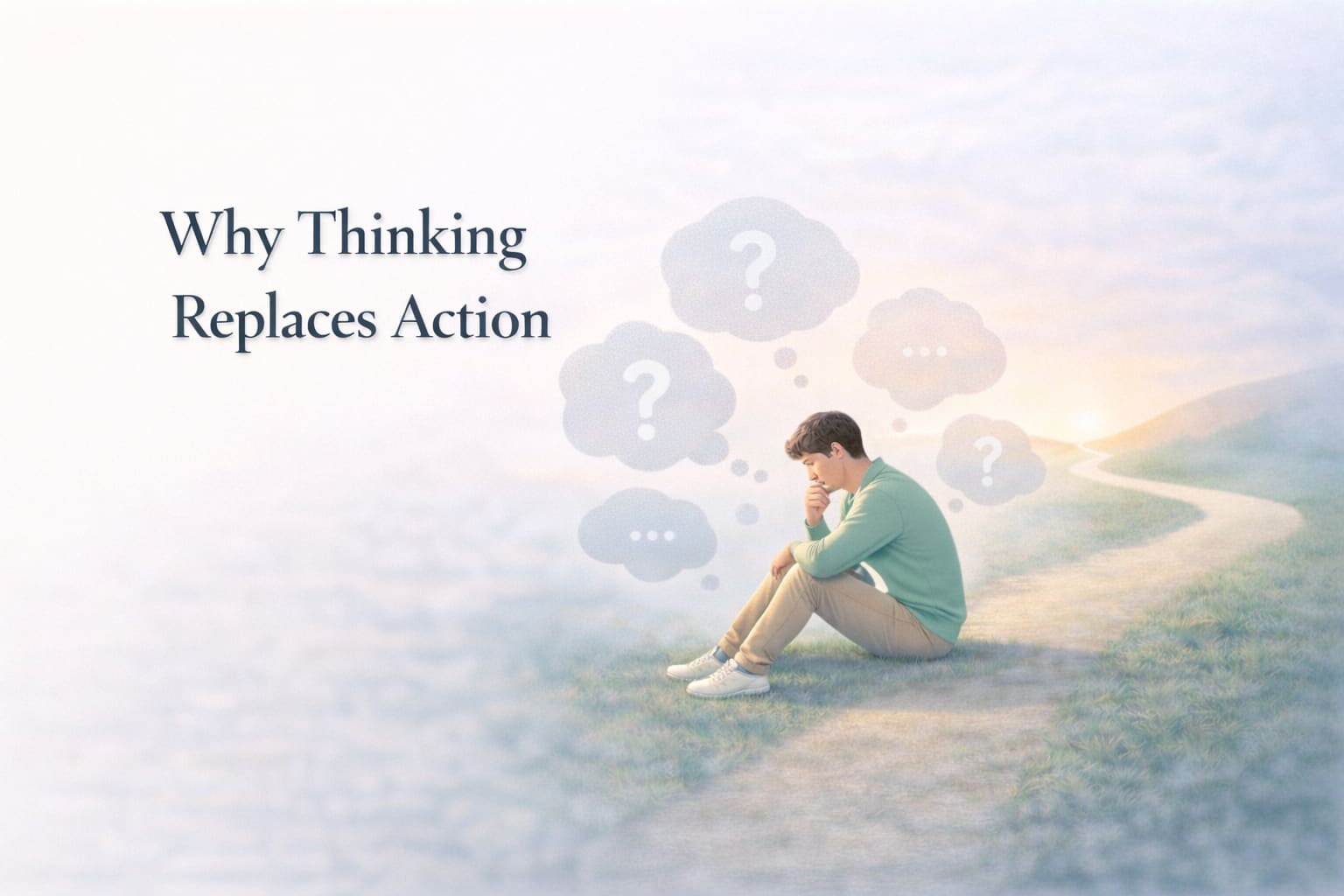
Why Thinking Replaces Action
This is not always obvious.
It doesn’t feel like avoidance.
It feels like preparation.
You sit with an idea…
and begin to think it through.
You consider options.
You imagine outcomes.
You refine your approach.
And without noticing…
time passes.
Action stays where it was.
You might not notice it at first.
But if you look closely, something interesting appears.
The thinking feels like movement.
But nothing is actually moving.
And that’s where the pattern begins.
Before you go further
If this feels familiar, you may be noticing more than one pattern.
→ Download: The Self-Sabotage Pattern Recognition Guide
Identify the 7 hidden behavioral loops that quietly shape your decisions, delay progress, and keep you stuck in familiar cycles.
The behavior most people don’t notice
Thinking is often mistaken for progress.
It feels active.
Engaged.
Productive.
You are doing something with the problem.
You are not ignoring it.
So it feels like you are moving forward.
But there is a subtle shift that happens.
The thinking begins to extend.
You revisit the same ideas.
You reframe the same possibilities.
You continue exploring without arriving.
And slowly, thinking takes the place of action.
Not intentionally.
But gradually.
The mind stays busy.
While the external world stays unchanged.
That’s what makes the pattern easy to miss.
Because it feels like effort.
Why the mind creates this pattern
The mind uses thinking as a form of control.
When you think, you stay in a safe space.
Nothing is at risk.
Nothing is exposed.
No real consequences occur.
Action, on the other hand, introduces uncertainty.
It creates outcomes.
Some of which cannot be reversed.
So the brain leans toward thinking.
Because thinking feels safe.
It creates the sense of progress…
without the risk of movement.
That’s why thinking replaces action.
Not because you don’t want to act.
But because thinking allows you to delay the moment where action becomes real.
Where this shows up in everyday life
This pattern appears in quiet, everyday moments.
You see it when:
You plan something repeatedly but don’t start
You think about sending a message but keep editing it mentally
You consider different paths without choosing one
You replay ideas instead of testing them
You prepare endlessly without taking the first step
It also shows up in self-reflection.
You analyze your habits.
Your decisions.
Your patterns.
But the insights do not always turn into action.
They remain as thoughts.
You might notice something else.
The more you think…
the more there is to think about.
And the moment of action keeps shifting further away.
The hidden effect
Over time, this pattern shapes outcomes.
Not in obvious ways.
But in quiet delays.
Opportunities are postponed.
Decisions remain open.
Progress slows.
Not because you are inactive…
but because your activity is internal.
The mind creates a loop:
Think → Expand → Refine → Delay → Repeat
Each cycle feels meaningful.
But it rarely leads to movement.
And slowly, thinking becomes the default response.
Instead of acting…
you think more.
Instead of deciding…
you reflect again.
You might not notice it at first.
But the pattern repeats across different areas.
Different situations.
Different moments.
Final reflection
Thinking is useful.
Until it replaces action.
Why thinking replaces action is not about thinking itself.
It is about where thinking stops.
And action begins.
The mind prefers to stay in thought.
Because thought feels controlled.
Safe.
Reversible.
But if you look closely, something interesting appears.
The longer thinking continues…
the further action moves away.
And once you see that pattern,
the shift becomes clearer.
Not in theory.
But in real moments.
When thinking begins to extend…
and action quietly waits.
FAQ
Why does thinking replace action?
Because thinking feels safe and controlled, while action introduces uncertainty. The brain prefers to stay in thought to avoid risk.
Is thinking always a problem?
No. Thinking is useful for clarity. It becomes a problem when it delays or replaces action entirely.
How can I tell if I’m stuck in thinking?
If you keep reflecting without taking steps forward, and decisions remain unacted upon, thinking may be replacing action.
Is this related to overthinking?
Yes. It is a form of overthinking where mental activity replaces real-world movement.
Why does it feel like progress even when nothing happens?
Because thinking requires effort, and effort feels like movement—even when no external action occurs.
Related patterns
→ Overthinking Loops: Why Your Mind Won’t Let Decisions Go
→ Why Analysis Creates Delay
→ Overanalysis Patterns (Overanalysis Psychology)
→ The Complete Guide to Self-Sabotage Patterns
