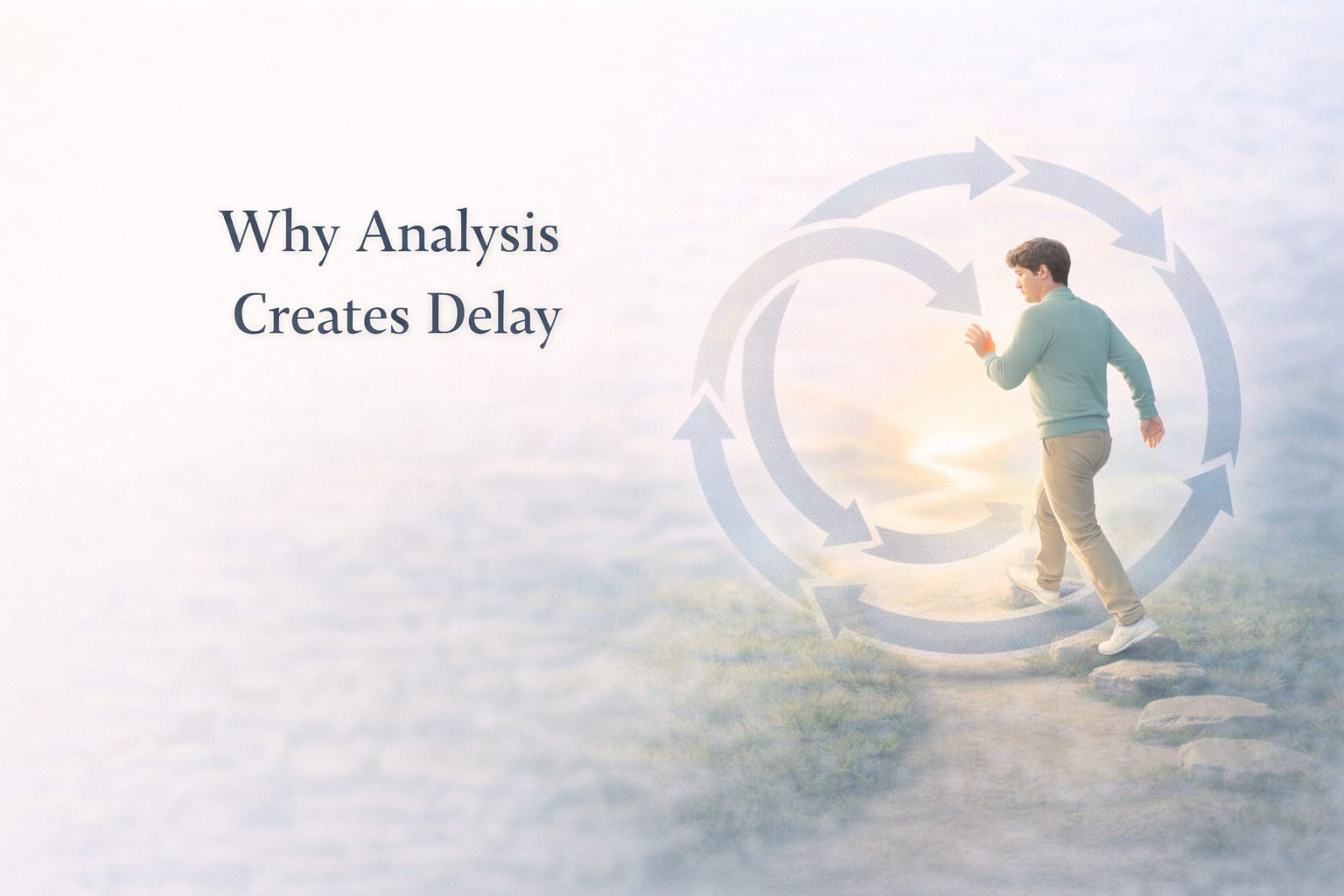
Why Analysis Creates Delay
This is not always obvious.
It rarely feels like delay.
It feels like thinking.
Careful thinking.
Necessary thinking.
You pause to consider something…
then continue thinking about it longer than expected.
You try to be sure…
but the moment of action keeps moving further away.
You might not notice it at first.
But if you look closely, something interesting appears.
The thinking is not bringing you closer to action.
It is keeping you in place.
And that’s where the pattern begins.
Before you go further
If this feels familiar, you may be noticing more than one pattern.
→ Download: The Self-Sabotage Pattern Recognition Guide
Identify the 7 hidden behavioral loops that quietly shape your decisions, delay progress, and keep you stuck in familiar cycles.
The behavior most people don’t notice
Analysis feels productive.
It feels like progress.
You are thinking.
Evaluating.
Considering possibilities.
But there is a subtle shift that happens.
At first, analysis moves you forward.
It helps you understand.
It helps you decide.
But at a certain point, something changes.
The thinking starts to repeat.
You revisit the same options.
You re-evaluate the same outcomes.
You search for clarity that doesn’t arrive.
And without noticing, action is postponed.
Not intentionally.
But gradually.
The delay does not feel like avoidance.
It feels like preparation.
That’s what makes it easy to miss.
Why the mind creates this pattern
The mind is trying to protect you from making a wrong decision.
It prefers certainty.
It wants to reduce risk.
So it uses analysis as a tool.
The more you think, the safer it feels.
Or at least, that is the assumption.
But certainty is rarely complete.
There is always another angle.
Another outcome.
Another possibility to consider.
So the thinking continues.
The brain believes it is getting closer to clarity.
But often, it is moving in circles.
That’s why analysis creates delay.
Not because thinking is wrong.
But because the mind keeps extending it.
Trying to reach a point that does not fully exist.
Where this shows up in everyday life
This pattern appears in simple decisions.
And in important ones.
You see it when:
You keep researching before starting
You rethink a decision multiple times
You delay sending a message
You wait for the “right moment” to act
You hesitate even after deciding
It also shows up in planning.
You refine plans endlessly.
You adjust details repeatedly.
You prepare more than necessary.
But the action never quite begins.
You might notice something else.
The more you analyze…
the more uncertain things feel.
That is the signal.
The thinking is no longer helping.
It is expanding the delay.
The hidden effect
Over time, this pattern changes how you act.
Not dramatically.
But consistently.
Decisions take longer.
Opportunities become less clear.
Confidence starts to weaken.
Because you keep questioning what you already understood.
The mind creates a loop:
Analyze → Expand → Doubt → Delay → Repeat
Each cycle feels like progress.
But it rarely leads to movement.
And slowly, delay becomes normal.
Not because you are avoiding action on purpose.
But because analysis fills the space where action should happen.
You might not notice it at first.
But the delay is not random.
It follows the same structure each time.
Final reflection
Analysis is useful.
Until it becomes a loop.
Why analysis creates delay is not about thinking too much.
It is about thinking without closure.
The moment where thinking should lead to action…
is extended.
Then extended again.
And eventually, replaced.
But if you look closely, something interesting appears.
The delay is not caused by lack of clarity.
It is caused by continued thinking.
And once you see that pattern…
it becomes easier to recognize.
Not after the fact.
But in the moment it begins.
FAQ
Why does analysis lead to delay?
Because the mind keeps searching for certainty. When that certainty is not reached, thinking continues and action is postponed.
Is analysis always a bad thing?
No. Analysis is useful at first. It becomes a problem when it repeats without leading to a decision.
How can I tell if I’m stuck in analysis?
If your thinking keeps repeating and does not bring you closer to action, you are likely in an analysis loop.
Is this the same as overthinking?
It is closely related. Analysis-based delay is a specific form of overthinking focused on decisions.
Why do I feel less certain the more I think?
Because each new thought introduces more possibilities, which increases uncertainty instead of reducing it.
Related patterns
→ Overthinking Loops: Why Your Mind Won’t Let Decisions Go
→ Overanalysis Patterns (Overanalysis Psychology)
→ What Is Psychological Resistance
→ The Complete Guide to Self-Sabotage Patterns
