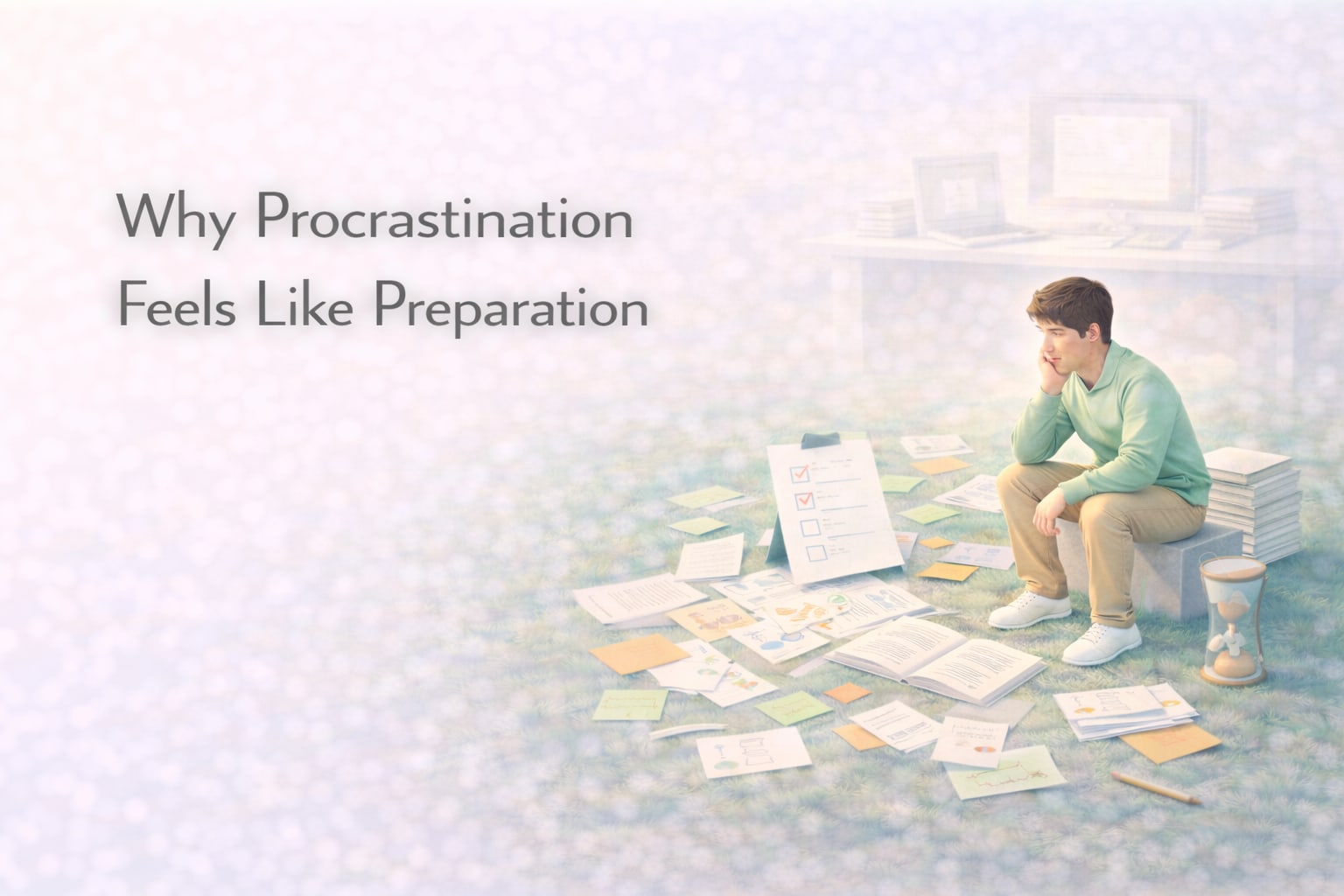
Why Procrastination Feels Like Preparation
Why procrastination feels productive is something many people recognize once they start paying attention to their own habits.
You sit down to work on something important.
Instead of beginning the task itself, you organize ideas.
You research a little more.
You plan the structure.
Maybe you refine the outline again.
It feels responsible.
It feels thoughtful.
But if you pause and look closely, something interesting appears.
The preparation keeps going.
The real work never begins.
And that is where the pattern quietly starts.
What This Behavior Actually Is
When people search for why procrastination feels productive, they are often describing a subtle mental substitution.
The brain replaces action with preparation.
Planning feels useful.
Research feels intelligent.
Organizing feels responsible.
All of these activities resemble progress.
But they often exist just outside the real task.
You might notice this pattern:
You research the project but never start building it.
You outline the article but never write it.
You gather information but never publish anything.
The mind stays busy.
But the outcome remains the same.
This is why procrastination rarely feels like doing nothing.
It feels like getting ready.
And that “getting ready” can slowly turn into the repetitive thinking described in
overthinking loops.
The mind prepares long after preparation is necessary.
Why Procrastination Feels Productive
Understanding why procrastination feels productive requires looking at how the brain handles pressure.
Important tasks create psychological tension.
They carry expectations.
Deadlines.
The possibility of mistakes.
The brain senses this pressure and looks for a way to reduce it.
Preparation becomes the perfect compromise.
It allows you to stay close to the task without confronting the difficult part.
Starting.
Because once you start, the work becomes real.
The outcome might not be perfect.
You might discover mistakes.
The brain quietly tries to avoid that uncertainty.
So it delays the moment of action.
It suggests one more step first.
A little more research.
Another round of planning.
And over time this delay can quietly become one of the patterns explored in
self-sabotage patterns.
Not because the person lacks motivation.
But because the mind is trying to avoid discomfort.
The Hidden Cost
Preparation feels safe.
It feels responsible.
But when preparation replaces action, something subtle begins to happen.
Projects remain unfinished.
Ideas stay theoretical.
Days pass without visible progress.
The person may even feel busy.
They think about the project constantly.
They gather more information.
They refine their plans.
But the real task never moves forward.
Eventually the brain begins associating thinking about the task with progress.
Which makes the delay harder to notice.
Because from the inside, it feels like effort.
But effort without movement slowly turns into frustration.
The person wonders why nothing seems to change, even though they are thinking about the task all the time.
A Small Shift That Changes the Pattern
Breaking the cycle where procrastination feels productive rarely requires extreme discipline.
The shift often begins with noticing the difference between preparation and action.
Set limits on preparation
Preparation is useful, but it rarely needs to continue indefinitely.
A simple boundary can prevent endless planning.
Start before clarity feels perfect
Many tasks become clearer once action begins.
Waiting for perfect understanding often delays the work itself.
Focus on visible progress
Measure progress by completed steps rather than time spent thinking about the task.
Even small actions can shift the momentum.
Once the brain sees movement, the pressure around the task often decreases.
Final Reflection
Once you understand why procrastination feels productive, the pattern becomes easier to notice.
You sit down to begin something important.
The mind suggests one more step first.
More research.
More planning.
More preparation.
At first it sounds reasonable.
But if you observe carefully, something interesting appears.
The preparation is not always about improving the work.
Sometimes it is about delaying the moment when the work becomes real.
And once you notice that difference, the pattern starts to lose its power.
Because preparation and progress are not always the same thing.
Q: Why does procrastination sometimes feel productive?
A: Procrastination often includes activities like planning, researching, or organizing. These actions feel useful, which makes the delay harder to recognize.
Q: Is planning a type of procrastination?
A: Planning can be helpful, but when planning repeatedly replaces action, it can become a form of procrastination.
Q: Why do people prepare instead of starting tasks?
A: Preparation reduces psychological pressure. It allows the brain to stay close to the task without facing the uncertainty of beginning.
Q: How can someone stop productive procrastination?
A: Setting limits on preparation and focusing on small visible actions can help shift the mind from planning into real progress.
