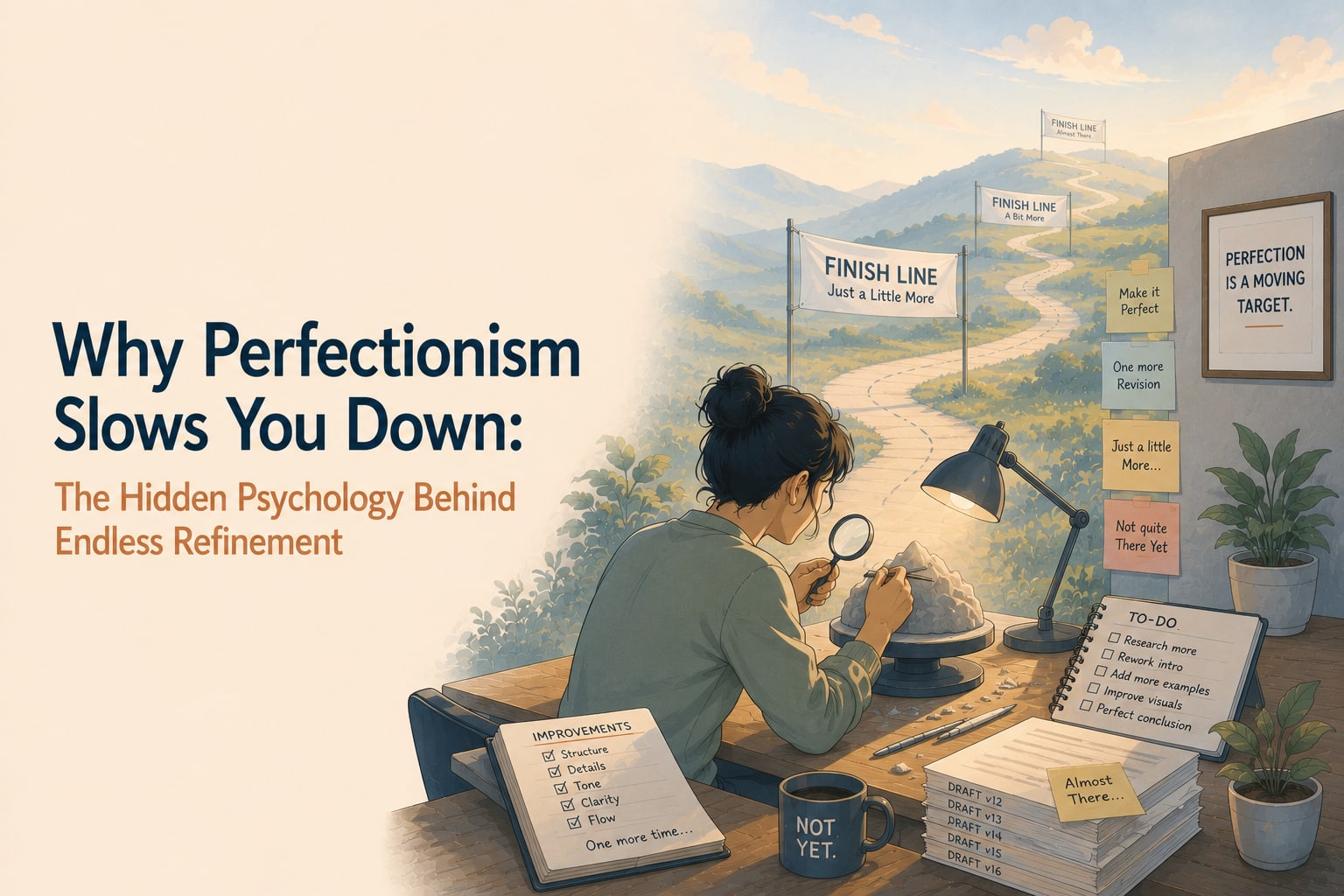
Why Perfectionism Slows You Down
Perfectionism slows you down in ways that are surprisingly difficult to notice.
It rarely announces itself as fear.
Instead, it sounds responsible.
"I just need one more revision."
"I'll launch when it's good enough."
"I'm improving it."
At first, these thoughts seem sensible.
But if you look closely, something interesting appears.
The work keeps improving.
The finish line keeps moving.
Progress becomes slower, not because the task is difficult, but because the standard keeps changing.
That is why perfectionism often becomes one of the quietest forms of delay.
What This Actually Means
Perfectionism is the tendency to believe that work must reach an unusually high standard before it deserves to be seen, shared, or completed.
Healthy excellence asks:
"How can I do this well?"
Perfectionism asks:
"How can I make sure there are no mistakes?"
Those are very different questions.
Excellence focuses on improvement.
Perfectionism focuses on avoiding flaws.
Because no piece of work is ever completely flawless, perfectionism creates a goal that constantly moves.
The result is endless refinement without clear completion.
This is why perfectionism frequently appears inside larger self-sabotage patterns.
The goal is not abandoned.
It is postponed in the name of making it better.
The Behavior Most People Don't Notice
Perfectionism rarely looks like avoidance.
It often looks like commitment.
You rewrite the same paragraph.
You redesign the same presentation.
You edit the same video.
You reorganize your notes.
You keep researching after you've already found the answer.
Each action feels productive.
Individually, none of them seem harmful.
Together, they quietly delay completion.
You might not notice it at first.
Because you're still working.
The hidden shift happens when improvement stops changing the quality of the work and starts delaying the moment someone else can see it.
That is where overthinking loops begin.
The mind stops solving new problems.
It starts revisiting old ones.
Why the Mind Does This
Perfectionism is often less about high standards than it is about emotional protection.
An unfinished project cannot be judged.
An unpublished article cannot be criticized.
An unapplied résumé cannot be rejected.
As long as the work stays private, your potential remains untouched.
The mind understands this without putting it into words.
It quietly concludes that another revision feels safer than exposure.
Several psychological patterns usually sit underneath perfectionism.
Fear of failure
If the work is never finished, failure cannot become real.
Self-doubt
The person questions whether their current ability is enough.
Identity protection
The quality of the work becomes connected to personal worth.
A mistake no longer feels like feedback.
It feels like evidence about who you are.
The brain is trying to reduce uncertainty.
Unfortunately, it often reduces progress instead.
Where This Pattern Appears in Daily Life
Perfectionism is not limited to creative work.
It appears almost everywhere.
Someone delays applying for a job until their résumé feels perfect.
A business owner postpones launching because the website could look better.
A student keeps rewriting an assignment instead of submitting it.
Someone waits until they know everything before starting a new skill.
A content creator records the same video repeatedly without publishing.
The situations change.
The psychological pattern stays remarkably similar.
Opportunity → Improvement → More Improvement → Delay
The person believes they are moving toward readiness.
In reality, readiness keeps moving away.
This often overlaps with fear of failure, procrastination, and self-doubt.
Over time, the work itself becomes emotionally heavier.
The longer you improve something, the more important it feels.
The more important it feels, the harder it becomes to release.
That cycle quietly reinforces itself.
The Hidden Effect of This Pattern
The obvious cost is time.
The hidden cost is lost experience.
Perfectionism delays feedback.
Without feedback, growth slows.
Instead of learning from reality, you continue responding to your imagination.
You improve based on what you think people might say rather than what they actually say.
This creates an illusion of progress.
The project feels active.
The skill develops more slowly.
Confidence also suffers.
Ironically, confidence grows through completed work.
Not endless preparation.
Every finished project teaches your brain that you can handle uncertainty.
Every unfinished project teaches it that uncertainty should be avoided.
That is why perfectionism often becomes self-reinforcing.
The behavior that promises better results quietly prevents the experiences that create them.
What This Reveals About Human Behavior
Perfectionism reveals something important about the human mind.
People are not always trying to create perfect work.
Often, they are trying to avoid imperfect moments.
The focus quietly shifts from creating value to preventing discomfort.
That shift changes everything.
You begin measuring success by how few mistakes you make instead of how much you learn.
But if you look closely, something interesting appears.
Every skilled person you admire became skilled by producing imperfect work repeatedly.
Experience refined what perfectionism tried to achieve through preparation alone.
This is one reason the Start Before Ready Model and the Exposure Ladder Framework are so effective.
They shift attention away from flawless outcomes and toward repeated exposure.
Progress replaces perfection.
Evidence replaces imagination.
The work finally enters reality, where genuine improvement becomes possible.
Final Reflection
Perfectionism promises a better result.
Often, it delivers a later result.
Sometimes, no result at all.
The goal is not to lower your standards.
It is to recognize when higher standards have stopped improving your work and started delaying your growth.
The next time you find yourself making one more adjustment, pause for a moment.
Ask yourself:
Am I improving this because it genuinely needs it… or because I'm trying to avoid being seen?
That question often reveals the difference between craftsmanship and perfectionism.
Q: What is perfectionism in psychology?
A: Perfectionism is a pattern where a person believes work must meet exceptionally high standards before it is acceptable, often leading to delay, overthinking, and avoidance.
Q: Why does perfectionism slow people down?
A: Because the standard keeps changing. Each improvement creates another improvement, delaying completion and real-world feedback.
Q: Is perfectionism connected to overthinking?
A: Yes. Perfectionism often creates Overthinking Loops, where decisions are repeatedly reconsidered instead of completed.
Q: Is perfectionism a form of self-sabotage?
A: It can become one. When endless refinement consistently prevents meaningful action, perfectionism becomes one of the most common self-sabotage patterns.
Related Patterns
If this pattern feels familiar, it often connects to other behaviors.
