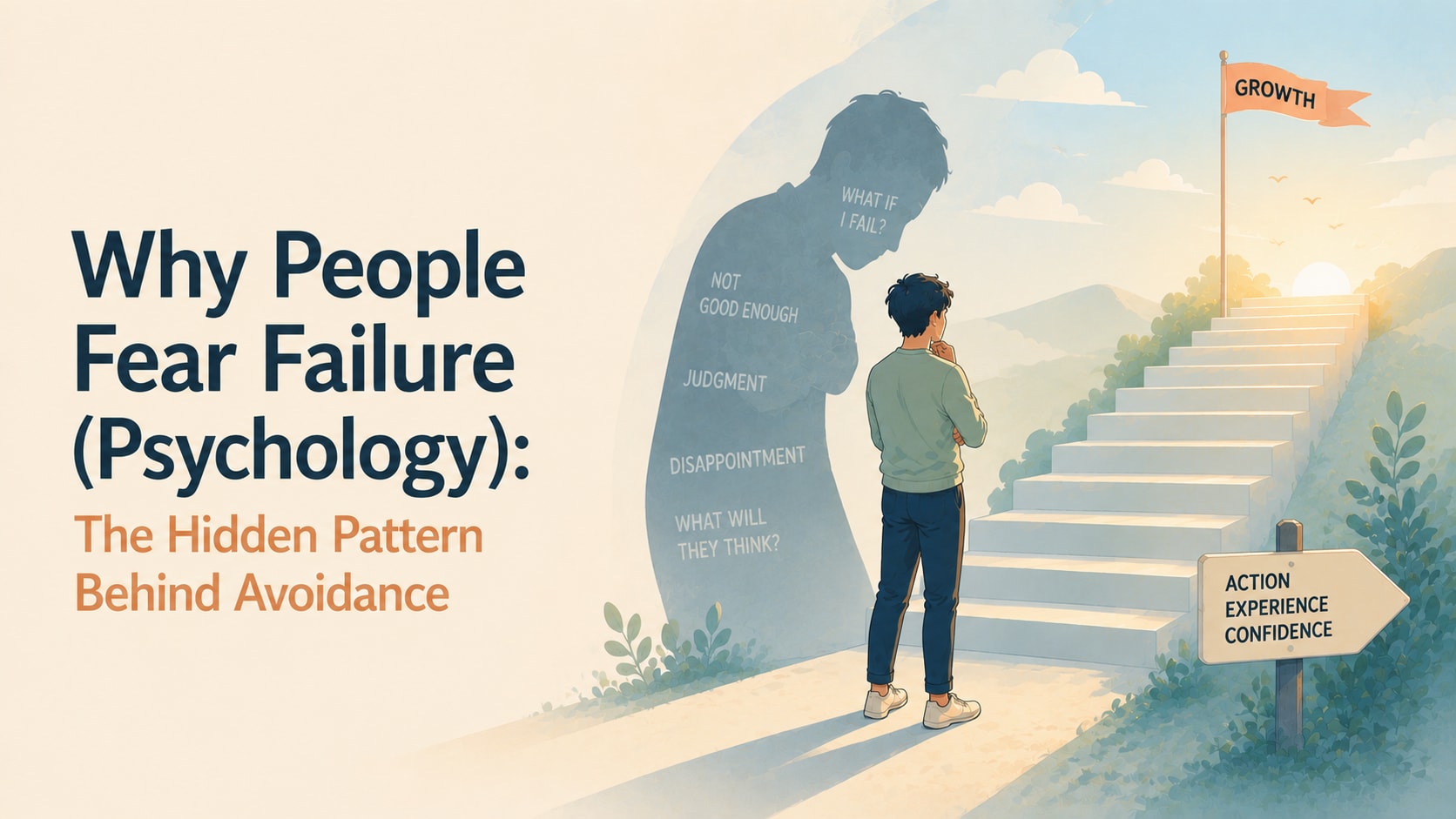
Why People Fear Failure (Psychology)
This has less to do with failure itself than most people realize.
You tell yourself you're waiting for the right moment.
You decide to prepare a little longer.
You postpone sending the application.
You keep refining an idea that was already good enough.
From the outside, these decisions look sensible.
Sometimes they even look responsible.
But if you look closely, something interesting appears.
Very often, the real obstacle isn't failure.
It's what failure seems to mean about you.
That's where the pattern begins.
What this actually means
Why people fear failure in psychology can be understood as the mind's attempt to protect you from emotional pain before it ever happens.
Failure isn't simply an event.
The brain often interprets it as a threat.
Not just to your success.
But to your confidence.
Your identity.
Your reputation.
Your sense of belonging.
Because of this, the mind starts avoiding situations where failure feels possible.
Sometimes it delays action.
Sometimes it encourages endless preparation.
Sometimes it convinces you that waiting is the wiser choice.
Over time, this protective response becomes one of the most common self-sabotage patterns.
Not because you want to fail.
Because your mind is trying to prevent emotional discomfort.
The behavior most people don't notice
Fear of failure rarely sounds like fear.
It usually sounds like logic.
You tell yourself:
"I need more experience."
"I'll wait until I'm more confident."
"I should learn a little more first."
"This isn't the right time."
Each reason sounds reasonable.
And sometimes those reasons are valid.
The pattern appears when they become your automatic response every time something meaningful requires action.
You might not notice it at first.
Because the brain disguises protection as preparation.
Instead of saying:
"I'm afraid this won't work."
It says:
"Let's just wait a little longer."
That small shift makes fear surprisingly difficult to recognize.
Why the mind does this
The brain constantly predicts possible outcomes.
Its primary job isn't to help you succeed.
Its primary job is to help you survive.
When something feels uncertain, the brain begins estimating potential emotional consequences.
What if people judge you?
What if you disappoint yourself?
What if you discover you're not as capable as you hoped?
Instead of taking the risk, the mind searches for safety.
That safety often appears as hesitation.
Preparation.
Delay.
Or excessive thinking.
This is why fear of failure frequently overlaps with overthinking loops.
Thinking creates the feeling of control.
Action creates uncertainty.
Given the choice, the brain naturally prefers what feels safer.
Especially if you've experienced criticism, rejection, or disappointment before.
The pattern isn't irrational.
It's protective.
The problem is that protection can quietly become limitation.
Where this pattern appears in daily life
Fear of failure isn't reserved for major life decisions.
It quietly appears throughout ordinary days.
You hesitate before sending an important email.
You avoid applying for a promotion.
You delay publishing your work.
You postpone difficult conversations.
You keep researching instead of beginning.
You spend hours planning instead of taking the first step.
You wait until you feel completely ready.
Each behavior looks different.
Yet underneath them is the same psychological question:
"What if this goes badly?"
That question doesn't always stop action immediately.
Sometimes it simply slows it.
Sometimes it replaces action with preparation.
Sometimes it convinces you that waiting is productive.
That's why fear of failure often goes unnoticed for years.
The hidden effect of this pattern
Fear of failure doesn't only limit opportunities.
It quietly changes your relationship with yourself.
Every avoided opportunity becomes one less chance to discover that you can handle uncertainty.
The brain receives very little evidence that discomfort is survivable.
Instead, it collects evidence that avoiding discomfort feels better.
For a while, that's true.
Avoidance does reduce anxiety.
Temporarily.
But something else quietly grows.
Self-doubt.
Because confidence rarely comes from thinking.
It comes from experience.
Without experience, uncertainty continues feeling dangerous.
Without action, confidence struggles to grow.
That's why fear of failure often leads to procrastination, perfectionism, and hesitation.
Not because people lack ability.
Because the mind keeps protecting them from experiences that could actually build confidence.
What this reveals about human behavior
Why people fear failure reveals something deeply human.
People don't simply chase success.
They also organize their lives around avoiding emotional pain.
Sometimes those two goals point in opposite directions.
You might not notice it at first.
But if you look closely, something interesting appears.
The opportunity itself isn't always frightening.
The meaning attached to the opportunity is.
If failure becomes proof that you're not good enough...
The stakes become enormous.
If failure becomes information instead...
The same situation suddenly feels different.
The event hasn't changed.
Only its meaning has.
That realization quietly changes everything.
Final reflection
Fear of failure isn't evidence that you're incapable.
It's evidence that your mind is trying to protect something important.
Usually your confidence.
Sometimes your identity.
Sometimes your sense of belonging.
Protection isn't the problem.
The problem begins when protection quietly becomes permission to stay still.
The next time you notice yourself waiting for the perfect moment, pause.
Ask yourself one question.
"Am I avoiding failure... or am I avoiding what I believe failure would say about me?"
The answer may reveal a pattern you never realized was there.
And once you see the pattern, it becomes much harder for it to stay invisible.
Q: Why do people fear failure in psychology?
A: People fear failure because the brain often interprets failure as emotional danger, linking it to rejection, shame, embarrassment, or loss of self-worth.
Q: Is fear of failure a psychological defense mechanism?
A: In many cases, yes. Fear of failure functions as a protective response, encouraging avoidance or hesitation to reduce emotional discomfort.
Q: Is fear of failure related to overthinking?
A: Yes. Fear of failure frequently leads to overthinking because the mind believes more analysis will eliminate uncertainty before action.
Q: Can fear of failure lead to self-sabotage?
A: Absolutely. When fear repeatedly delays action, it often develops into larger self-sabotage patterns that quietly limit growth and opportunity.
Related Patterns
If this pattern feels familiar, it often connects to other hidden behaviors.
