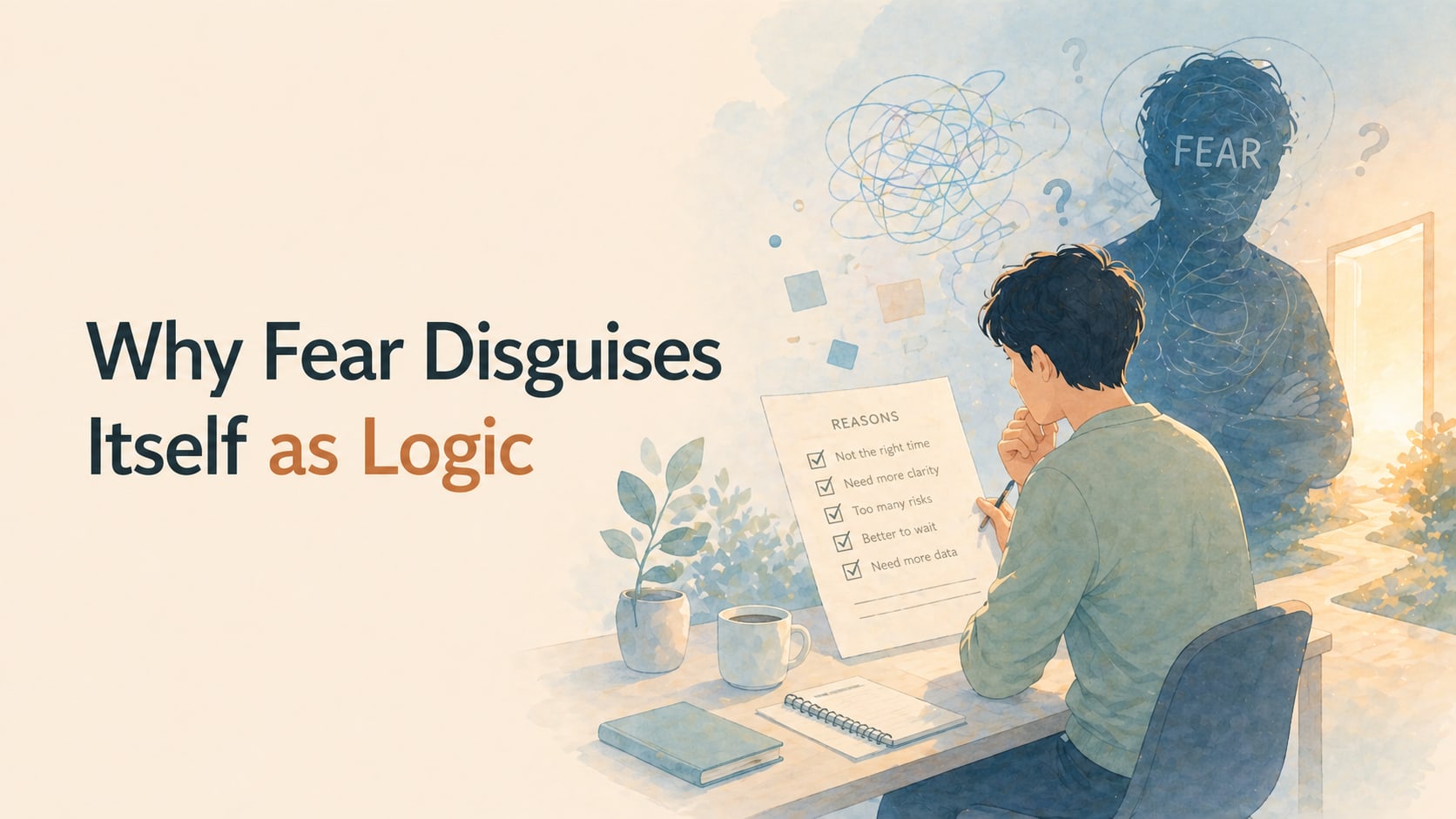
Why Fear Disguises Itself as Logic
This is something you’ve likely experienced… without calling it that.
You decide not to do something.
And your reason sounds reasonable.
“It’s not the right time.”
“I need more clarity.”
“I should think it through properly.”
It feels logical.
Measured.
Responsible.
But if you look closely, something interesting appears.
The logic often arrives after the hesitation.
Not before.
What this actually means
This is a psychological pattern where fear is translated into rational-sounding reasons, making avoidance feel justified.
It doesn’t feel like fear.
It feels like thinking.
You don’t say:
“I’m afraid this might fail.”
You say:
“This might not be the best decision right now.”
The language changes.
But the source stays the same.
This is why it often becomes part of larger:
Not through obvious fear.
But through convincing explanations.
The behavior most people don’t notice
Fear rarely presents itself clearly.
It doesn’t say:
“Don’t do this because you’re afraid.”
It presents alternatives.
Better timing.
More preparation.
More thinking.
You delay action…
But you explain it in a way that feels intelligent.
That’s the part most people don’t notice.
The explanation feels valid.
So the behavior doesn’t get questioned.
Why the mind does this
The brain wants to protect you.
But it also wants to maintain your identity as someone rational and capable.
So it does something subtle.
It converts emotional resistance into logical reasoning.
Fear of failure
Becomes: “I need to be more prepared.”
Fear of judgment
Becomes: “This might not be the right move.”
Self-doubt cycles
Become: “I should think about this more.”
Perfectionism patterns
Become: “It needs to be done properly.”
The emotional signal stays hidden.
The logical explanation takes its place.
This is why the pattern often overlaps with:
Because thinking becomes the acceptable version of fear.
Where this pattern appears in daily life
You see an opportunity…
And decide it’s not the right time.
You want to start something…
But convince yourself you need more clarity.
You hesitate in a conversation…
And tell yourself it’s better to wait.
You delay a decision…
Because you’re “being careful.”
Each moment feels reasonable.
That’s why it repeats.
The behavior doesn’t feel like avoidance.
It feels like good judgment.
The hidden effect of this pattern
At first, nothing feels wrong.
You’re still thinking.
Still considering.
Still aware.
But over time, something changes.
You begin trusting your explanations…
More than your instincts.
Opportunities get filtered out.
Not by rejection.
But by reasoning.
And that reasoning becomes automatic.
You don’t question it.
Because it sounds correct.
This is how hesitation becomes consistent.
And consistency turns into pattern.
What this reveals about human behavior
Why fear disguises itself as logic reveals something important.
The mind doesn’t just avoid discomfort.
It explains the avoidance.
And once it explains it well enough…
You accept it.
You might not notice it at first.
But if you look closely, something becomes clear.
The logic is not always leading the decision.
Sometimes it is following it.
Justifying it.
Making it easier to accept.
Final reflection
Fear doesn’t always feel like fear.
Sometimes it sounds like logic.
Careful.
Measured.
Reasonable.
That’s what makes it difficult to see.
You might not notice it at first.
Because the explanation feels right.
But if you look closely, something interesting appears.
The decision is already made…
Before the reasoning begins.
And once you see that, something shifts.
You start questioning the explanation.
Not rejecting it.
Just noticing it.
And in that moment, something simple becomes visible.
Not every logical reason is clarity.
Sometimes, it’s fear in a more acceptable form.
Q: What does it mean when fear disguises itself as logic?
A: It means fear is expressed as rational reasoning, making avoidance feel justified and harder to recognize.
Q: Why does the brain do this?
A: To protect you from discomfort while maintaining a sense of control and rational decision-making.
Q: Is this related to overthinking?
A: Yes. Overthinking often becomes the logical cover for underlying fear or uncertainty.
Q: How can I tell if my reasoning is actually fear?
A: If your reasons consistently delay action despite clear desire, fear may be driving the logic.
Related Patterns
If this pattern feels familiar, it often connects to other behaviors.
If you look deeper, this pattern connects to something
