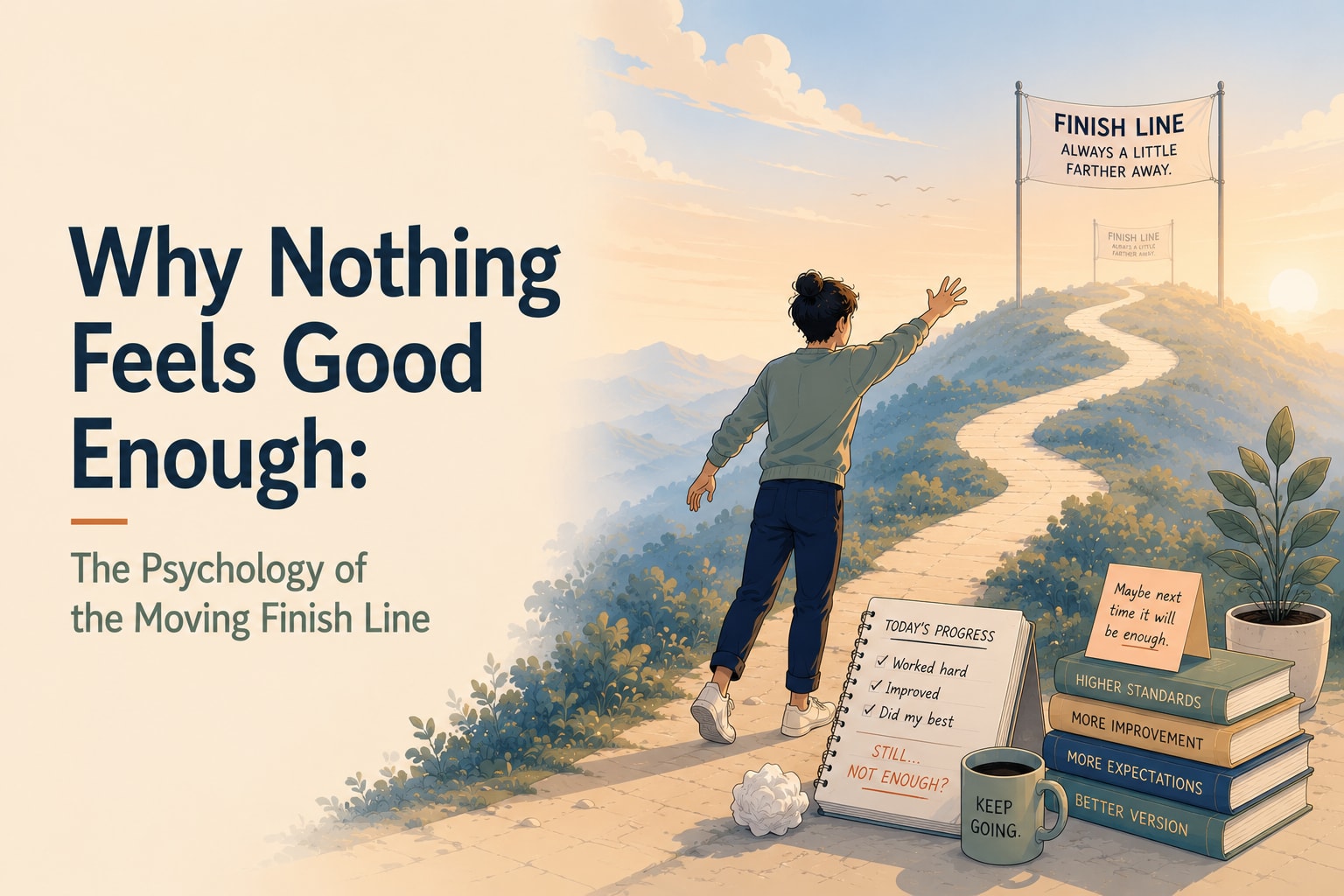
Why Nothing Feels Good Enough
Why nothing feels good enough rarely begins with low confidence.
In fact, it often begins with the opposite.
You care deeply about doing things well.
You want your work to reflect your ability.
You want your decisions to be thoughtful.
You want people to see the best version of what you can create.
At first, that sounds like a strength.
But if you look closely, something interesting appears.
No matter what you achieve, the feeling never lasts.
You finish one goal.
Your mind immediately points toward another.
You receive praise.
You remember the one mistake nobody noticed.
You improve your life.
Yet somehow, it still feels incomplete.
That's where the pattern begins.
The Behavior Most People Don't Notice
Most people believe satisfaction comes naturally after achievement.
They assume that once they accomplish enough, the feeling of "enough" will finally arrive.
But for some people, the standard quietly changes every time they get closer.
You finish the project.
Now it should have been better.
You reach the goal.
Now you should have reached it sooner.
You solve one problem.
Now you notice three more.
The achievement itself is not ignored.
It simply loses its emotional value almost immediately.
The mind moves the finish line before you have a chance to stand on it.
From the outside, this looks like ambition.
From the inside, it feels like permanent dissatisfaction.
This is one of the quieter forms of self-sabotage patterns.
Not because you are preventing success.
Because you are preventing success from ever feeling complete.
Why the Brain Does This
The brain constantly compares.
It compares the present to the past.
It compares reality to expectations.
It compares you to other people.
Comparison helps us learn.
Without it, improvement would be difficult.
But the brain is not naturally designed to stop comparing.
That is something we have to learn.
When perfectionism becomes part of your identity, comparison never ends.
Every achievement immediately creates a new standard.
Every success creates another expectation.
Every improvement reveals another flaw.
Instead of feeling accomplished, you feel unfinished.
Several psychological patterns quietly reinforce this cycle.
Perfectionism tells you there is always another improvement to make.
Self-doubt questions whether your success was actually deserved.
Fear of criticism encourages you to keep improving before anyone else notices a weakness.
Overthinking keeps replaying what could have gone differently.
Together, these patterns create the kind of overthinking loops where satisfaction is interrupted before it has time to settle.
The brain begins believing that constant dissatisfaction is what creates excellence.
It forgets that satisfaction and growth can exist at the same time.
Where This Pattern Shows Up in Daily Life
This pattern rarely announces itself.
It hides inside ordinary moments.
You publish an article.
Instead of enjoying it, you notice three paragraphs you wish you had rewritten.
You complete a major project at work.
By the next morning, your attention has already shifted to everything you did not finish.
You receive a compliment.
Your first instinct is to explain why it was not actually that impressive.
You lose weight.
You immediately focus on the weight you still want to lose.
You save money.
Instead of feeling secure, you worry it is not enough.
You finish cleaning your home.
One untidy corner suddenly feels larger than every room you organized.
The situations are different.
The emotional habit is the same.
Your attention automatically moves away from progress and toward absence.
Not because your life lacks good things.
Because your mind has become trained to search for what is still missing.
The Hidden Effect of This Pattern
The obvious consequence is frustration.
The quieter consequence is disconnection.
You slowly lose the ability to experience your own progress.
Achievements become checkpoints instead of experiences.
Nothing stays meaningful for very long.
The emotional reward disappears almost as quickly as it arrives.
Over time, this affects motivation in surprising ways.
People often believe dissatisfaction keeps them productive.
For a while, it can.
But eventually, constant dissatisfaction becomes exhausting.
When every achievement immediately feels inadequate, effort begins to lose its emotional payoff.
Another hidden consequence is that your relationship with yourself becomes conditional.
You tell yourself you will feel proud...
...when the work is better.
...when you earn more.
...when you finally stop making mistakes.
...when you become more confident.
The conditions keep changing.
The feeling never arrives.
Without realizing it, you postpone your own approval.
What This Reveals About Human Behavior
Why nothing feels good enough reveals something fascinating about the human mind.
The mind rarely measures achievement objectively.
It measures distance.
As long as there is another step available, attention naturally shifts toward it.
That tendency helps people grow.
But without awareness, it also prevents people from appreciating where they already are.
You might not notice it at first.
But if you look closely, something interesting appears.
People who experience genuine satisfaction are not people who stopped improving.
They simply learned where to pause.
They allow themselves to experience completion before chasing another goal.
They understand that progress is built through cycles.
Work.
Finish.
Pause.
Reflect.
Begin again.
That idea also appears in the Start Before Ready Model.
Growth is not created by endless dissatisfaction.
It is created by repeated action, honest reflection, and the willingness to move forward without demanding perfection.
Final Reflection
If nothing ever feels good enough, it does not necessarily mean your life is lacking.
It may mean your attention has become permanently focused on what remains unfinished.
The next time you accomplish something, resist the urge to immediately move the finish line.
Stay with the moment for a little longer.
Notice what you completed before noticing what remains.
Because the mind has an interesting habit.
Whatever it repeatedly searches for becomes the reality it believes it lives in.
If it constantly searches for flaws, life begins to feel full of flaws.
If it occasionally pauses to recognize progress, something changes.
You discover that satisfaction is not the enemy of growth.
Sometimes, it is what gives growth enough meaning to continue.
Q: Why does nothing I accomplish ever feel good enough?
A: This often happens because your mind immediately replaces one standard with another. Instead of experiencing completion, it shifts attention toward the next improvement, making satisfaction feel temporary.
Q: Is feeling like nothing is good enough a sign of perfectionism?
A: Often, yes. Perfectionism creates moving standards that make achievements feel incomplete, even when they meet or exceed reasonable expectations.
Q: Why do I focus on my mistakes instead of my successes?
A: The brain naturally notices problems because identifying flaws has historically helped humans adapt and survive. When combined with self-doubt or perfectionism, this habit can overshadow genuine progress.
Q: Can overthinking make achievements feel meaningless?
A: Yes. Overthinking Loops keep your attention on what could have been better instead of allowing your mind to experience what has already been accomplished.
