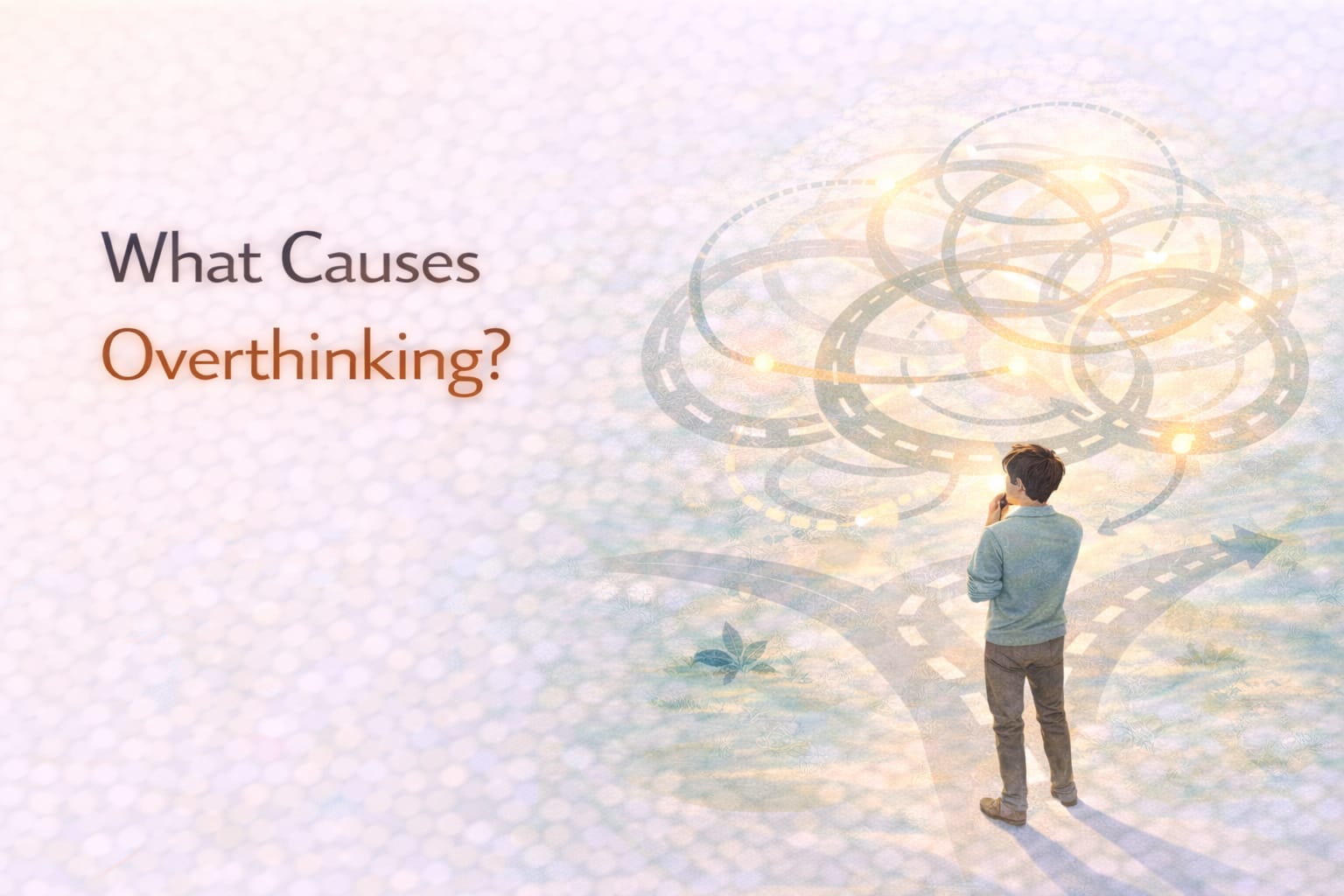
What Causes Overthinking?
What causes overthinking?
It rarely begins as something negative.
It begins as something that feels useful.
You think about a decision.
You replay a moment.
You try to understand something clearly.
At first, it feels like progress.
Like you’re getting closer to the right answer.
But then the thinking continues.
And continues.
And at some point, something changes.
The thinking stays active.
But the clarity stops moving.
You might not notice it at first.
But if you look closely, something interesting appears.
The mind is no longer searching.
It’s repeating.
:contentReference[oaicite:0]{index=0}
What this actually means
What causes overthinking is not simply “thinking too much.”
It is a pattern where the mind keeps returning to the same thoughts because it is trying to reduce uncertainty, avoid mistakes, or feel more certain before acting.
The thinking starts with a purpose.
To understand something.
To make a decision.
To process a situation.
But when the brain cannot reach full certainty, it doesn’t stop.
It continues.
It circles back.
It revisits the same possibilities.
This is where thinking turns into overthinking loops.
You can explore how these loops work here:
The goal quietly shifts.
From understanding the situation…
To trying to feel completely sure about it.
The behavior most people don’t notice
Overthinking doesn’t feel like overthinking.
It feels like responsibility.
You tell yourself you’re being careful.
You want to make the right choice.
You want to think things through properly.
So you continue.
But something subtle changes.
The thoughts stop evolving.
They begin repeating.
Different words.
Same ideas.
Same questions.
Same conclusions.
And yet, it still feels like you haven’t thought enough.
That’s where the pattern hides.
Inside what feels like careful thinking.
Why the mind does this
The brain is designed to protect you.
One of the ways it does that is by trying to reduce uncertainty.
Uncertainty creates discomfort.
It creates risk.
It creates the possibility of being wrong.
So the brain responds by thinking more.
It assumes more thinking will eventually remove uncertainty.
But some situations don’t work that way.
They involve unknown outcomes.
They require decisions without perfect clarity.
When the brain cannot fully resolve these, it keeps trying.
Several deeper patterns drive this.
Fear of failure
If something could go wrong, the brain tries to prevent it by thinking longer.
Self-doubt cycles
If you question your judgment, you rely on thinking instead of trusting your instinct.
Perfectionism patterns
If the answer must feel “right,” the mind keeps searching.
Control illusion
Thinking creates the feeling that you are managing the situation.
Even when nothing is changing.
This is why overthinking often appears as part of larger:
Not through obvious mistakes.
But through hesitation and delay.
Where this pattern appears in daily life
Once you recognize what causes overthinking, you begin to see it everywhere.
You rewrite a message multiple times before sending it.
You replay conversations after they end.
You rethink a decision you already made.
You delay starting something because you’re still “figuring it out.”
You imagine different outcomes before acting.
Each moment feels small.
But the pattern repeats.
The mind stays active.
The situation stays unchanged.
That’s the difference.
Thinking continues.
Movement doesn’t.
The hidden effect of this pattern
Overthinking feels productive.
But over time, something begins to shift.
Decisions become slower.
Actions become delayed.
Confidence weakens slightly.
Not because you lack clarity.
But because you stop trusting it.
The brain begins expecting certainty before action.
But certainty rarely comes through thinking alone.
This is how overthinking becomes a form of quiet self-sabotage.
Not through wrong decisions.
Through delayed ones.
Opportunities don’t always disappear loudly.
Sometimes they pass while the mind is still thinking.
What this reveals about human behavior
What causes overthinking reveals something deeper about how the mind works.
The brain prefers thinking over acting.
Because thinking is safe.
There are no consequences inside your head.
No risk.
No exposure.
Action is different.
Action creates real outcomes.
It introduces uncertainty.
So the brain stays where it feels more controlled.
Inside the loop.
You might not notice it at first.
But if you look closely, something interesting appears.
The answer often arrives earlier than the thinking ends.
The thinking continues not because the answer is missing.
But because the outcome feels uncertain.
Final reflection
Overthinking doesn’t begin as a mistake.
It begins as awareness.
Care.
Attention.
But somewhere along the way, it changes.
The mind stops solving.
And starts circling.
You might not notice it at first.
Because it feels like progress.
But if you look closely, something becomes clear.
The loop begins after the answer is already there.
And once you see that, something shifts.
The next time your thoughts keep going, you recognize it sooner.
Not as clarity.
But as repetition.
And in that moment, something simple becomes visible.
You’ve already thought enough.
Q: What causes overthinking in psychology?
A: Overthinking is caused by the brain trying to reduce uncertainty, avoid mistakes, and feel more in control of outcomes.
Q: Why does overthinking repeat the same thoughts?
A: Because the brain believes more thinking will create certainty, even when the answer is already clear.
Q: Is overthinking related to self-doubt?
A: Yes. Self-doubt often increases overthinking because the mind keeps questioning its own decisions.
Q: How can I recognize overthinking in myself?
A: When your thoughts repeat without adding new clarity or leading to action, you are likely in an overthinking loop.
Related Patterns
If this pattern feels familiar, it often connects to other behaviors.
