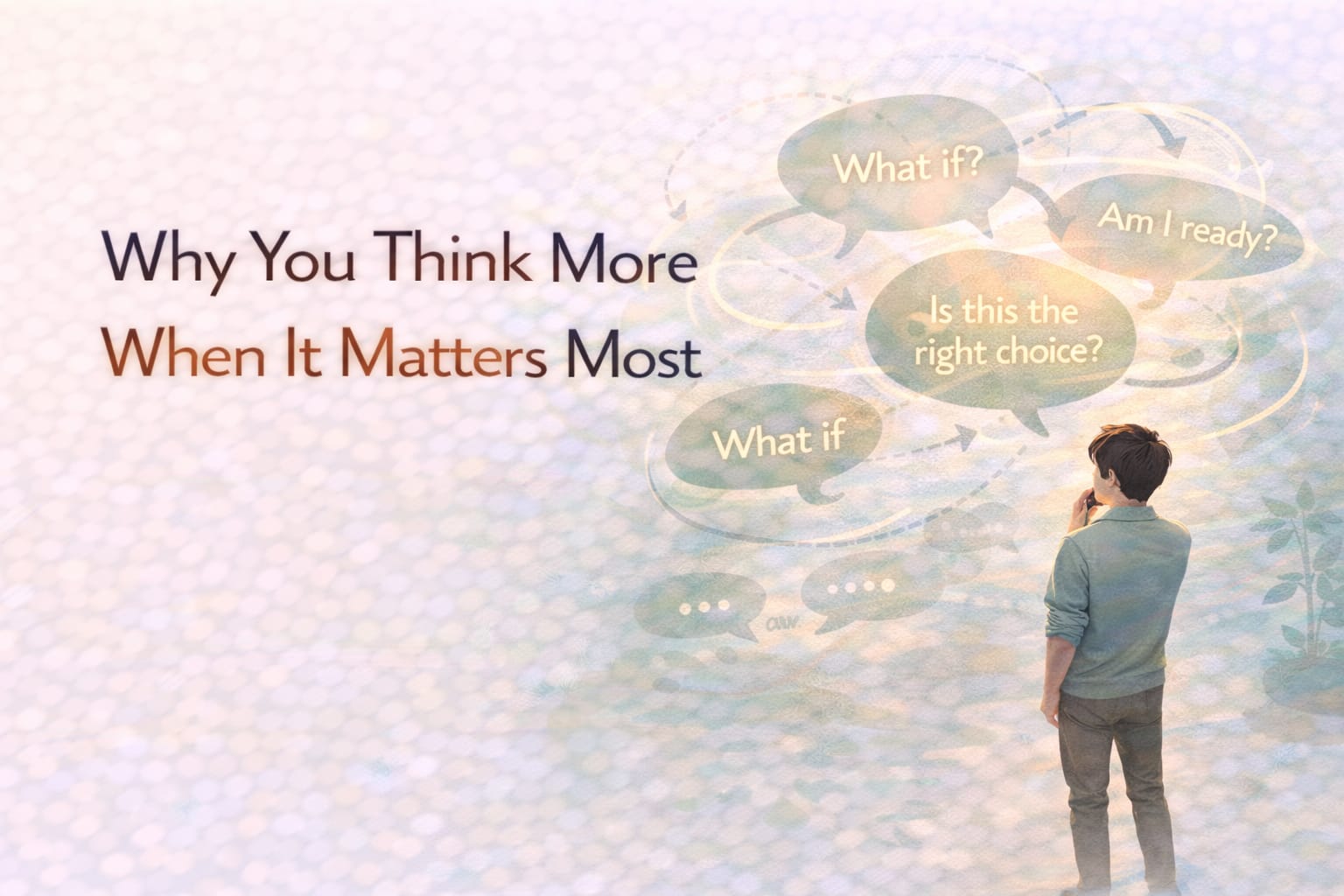
Why You Think More When It Matters Most
Why you think more when it matters most is something you’ve probably noticed without fully naming it.
In small situations, your mind moves easily.
You respond quickly.
You decide without much effort.
You trust your instinct.
But when something matters…
Everything slows down.
You think longer.
You question more.
You hesitate before acting.
The moment becomes heavier.
The decision feels bigger than it did before.
You might not notice it at first.
But if you look closely, something interesting appears.
The importance of the moment changes how your mind behaves.
If this pattern feels familiar, you may be noticing more than one loop at once.
Download The Self-Sabotage Pattern Recognition Guide: Identify the 7 Hidden Behavioral Loops Holding You Back.
What this behavior actually is
Why you think more when it matters most is a pattern where the mind increases analysis in proportion to perceived importance.
The more something feels significant, the more the brain tries to control the outcome.
It does this through thinking.
More possibilities.
More outcomes.
More scenarios.
At first, this seems logical.
If something matters, it deserves more thought.
But something subtle happens.
The thinking stops being useful.
And starts repeating.
You revisit the same options.
You question answers you already had.
You search for certainty that doesn’t fully exist.
This is where the pattern shifts into:
The goal is no longer clarity.
It becomes control.
Why the brain does this
The brain treats important moments differently.
It assigns them more weight.
More consequence.
More risk.
And when risk increases, the brain responds by slowing everything down.
Several internal mechanisms activate at once.
Risk sensitivity increases
The mind becomes more aware of what could go wrong.
Self-doubt cycles intensify
You question your ability to handle the outcome.
Perfectionism patterns appear
The decision must feel right before action.
Fear of failure becomes louder
Mistakes feel more costly in important situations.
So the brain does what it believes will help.
It thinks more.
Not because the answer is missing.
But because the stakes feel higher.
This is where thinking quietly turns into delay.
Where it appears in everyday life
This pattern shows up in moments that feel important to you.
Not necessarily big moments to others.
But moments that carry weight internally.
You think more before sending a message that matters.
You hesitate before speaking in a meaningful conversation.
You delay decisions that could change direction.
You overanalyze situations where the outcome feels significant.
In less important moments, you act quickly.
In important ones, you slow down.
The difference is not the situation.
It’s how your mind interprets it.
The moment feels heavier.
So your thinking becomes heavier too.
The hidden cost
Thinking more when something matters feels responsible.
It feels like care.
Like attention.
Like effort.
But over time, something subtle begins to change.
You begin delaying important actions.
Not because you don’t know what to do.
But because you’re still thinking about it.
Several quiet effects appear.
Action slows where it matters most
The very moments that need clarity become delayed.
Confidence weakens slightly
Because you keep questioning your own answers.
Opportunities feel heavier than they are
Because your mind amplifies their importance.
Momentum disappears
Because important decisions are rarely made quickly.
This is how the pattern connects to:
Not through failure.
But through hesitation in moments that matter.
The pattern most people miss
Most people believe they think more because something is complex.
But often, something else is happening.
They think more because something feels important.
And importance creates pressure.
Pressure creates uncertainty.
And uncertainty triggers thinking.
But if you look closely, something interesting appears.
The answer often arrives early.
The extra thinking doesn’t create clarity.
It creates delay.
The brain is not trying to find the answer.
It is trying to feel certain about the answer.
And certainty is rarely complete.
That’s why the thinking continues.
Not because the answer is unclear.
But because the outcome feels uncertain.
Final reflection
You might not notice it at first.
Thinking more in important moments feels natural.
It feels careful.
Intentional.
Responsible.
But if you look closely, something begins to appear.
The moments that matter most…
Are often the ones where your mind trusts itself the least.
Not because you lack clarity.
But because you’re aware of the stakes.
And once you begin to see that pattern, something changes.
You recognize when thinking is helping.
And when it is repeating.
You begin to see that important moments don’t always need more thinking.
Sometimes, they need trust.
Not certainty.
Just enough clarity to move.
Q: Why do I overthink more when something matters?
A: Because the brain increases risk awareness in important situations, leading to more analysis and hesitation.
Q: Is this related to anxiety or fear?
A: Yes. Fear of failure, judgment, or making the wrong decision often increases thinking in high-stakes moments.
Q: Why does thinking more make decisions harder?
A: Because repeated thinking introduces doubt and reduces trust in your initial clarity.
Q: How can I stop overthinking important decisions?
A: Notice when thinking becomes repetitive instead of useful, and act on your first clear understanding.
