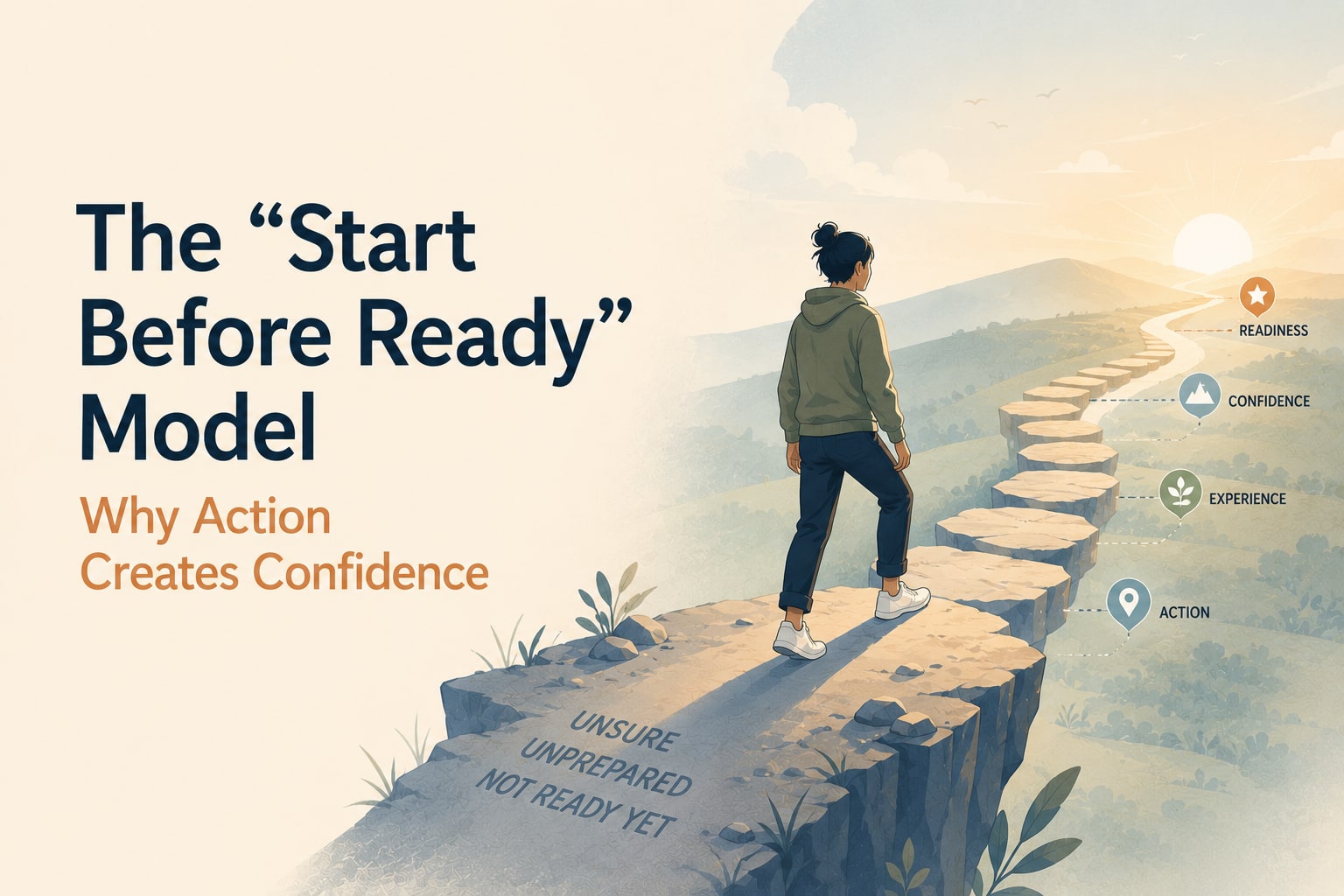
The Start Before Ready model begins with an uncomfortable truth.
You keep waiting to feel ready.
Ready to apply.
Ready to speak.
Ready to begin.
But if you look closely, something interesting appears.
That feeling rarely arrives first.
Most people believe readiness comes before action.
The mind tells you:
"One more day."
"One more course."
"One more plan."
It feels sensible.
It even feels responsible.
But underneath it, another pattern is quietly growing.
Waiting becomes a habit.
You might not notice it at first.
Because waiting often looks productive.
You're researching.
Planning.
Preparing.
Thinking.
But none of those things require exposure.
Action does.
That's why overthinking loops often last much longer than they need to.
The mind keeps preparing for a moment that doesn't exist.
The Start Before Ready model quietly reverses the order.
It doesn't ask you to become confident.
It asks you to move before confidence arrives.
Not recklessly.
Just a little earlier than your mind thinks is comfortable.
Something surprising happens when you do.
The confidence you were waiting for begins appearing afterward.
Not all at once.
One small piece at a time.
The email gets sent.
The conversation happens.
The project finally exists outside your head.
And suddenly, you're no longer imagining what might happen.
You're responding to what actually happened.
That's a completely different experience.
This is why so many self-sabotage patterns survive for years.
They convince you that readiness is a requirement.
When, in reality, readiness is often a result.
The interesting part isn't that action removes fear.
It usually doesn't.
The interesting part is that action gives fear less room to keep negotiating.
The longer you wait, the louder fear becomes.
The sooner you move, the sooner reality replaces imagination.
If you catch yourself thinking,
"I'll start when I feel ready,"
try changing one word.
"I'll start so I can become ready."
It sounds small.
But it changes the direction of the entire pattern.
If you look deeper, this pattern connects to something much larger.
The question isn't whether you feel ready.
The question is whether waiting has quietly become part of the problem.
Related Patterns
If this pattern feels familiar, it often connects to other hidden behaviors.
