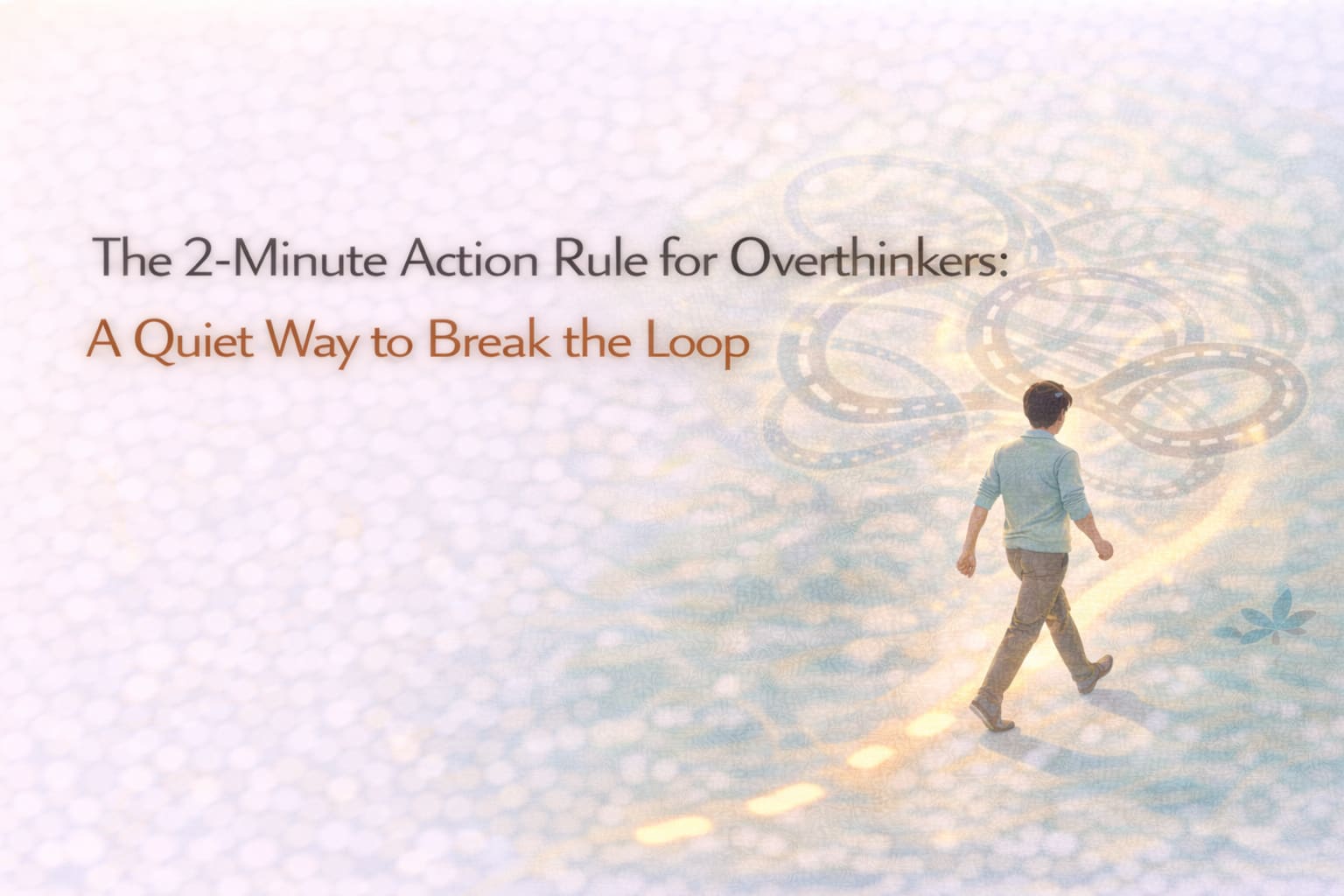
The 2-Minute Action Rule for Overthinkers
The 2-minute action rule for overthinkers sounds simple.
Almost too simple.
Which is why most people ignore it.
But if you look closely, something interesting appears.
It quietly interrupts a pattern your mind repeats every day.
You sit with something you need to do.
It’s not difficult.
You already understand it.
But instead of starting…
You think.
You prepare.
You organize.
You wait until it “feels right.”
That’s where the loop begins.
If this feels familiar, you’re likely noticing more than one loop.
Download The Self-Sabotage Pattern Recognition Guide: Identify the 7 Hidden Behavioral Loops Holding You Back.
The behavior most people don’t notice
Overthinking rarely feels like avoidance.
It feels like preparation.
You tell yourself you’re getting ready.
Thinking it through.
Making sure it’s done properly.
But something subtle is happening.
You’re delaying action…
Without calling it delay.
This is how overthinking loops hide.
They don’t look like hesitation.
They look like effort.
Why the mind creates this pattern
The brain prefers certainty before action.
It wants to feel ready.
Clear.
Confident.
But most actions don’t give you that feeling beforehand.
They create it during.
So the mind stays in thinking.
Because thinking feels safer.
No risk.
No exposure.
No immediate consequence.
Action is different.
Action makes things real.
That’s where the resistance comes from.
And that’s where many self-sabotage patterns quietly begin.
Where this shows up in everyday life
You open your phone to send a message…
Then reread it three times.
You plan to start something small…
Then reorganize everything around it instead.
You know what to say in a conversation…
But wait for the “right moment.”
You tell yourself:
“I’ll start in a minute.”
But the minute stretches.
This pattern isn’t dramatic.
It’s quiet.
And that’s why it repeats.
The hidden effect
At first, nothing seems wrong.
You’re still thinking about the task.
Still aware of it.
But over time, something shifts.
Small actions get delayed.
Then slightly bigger ones.
Then the important ones.
Not because you can’t act.
But because you’re used to thinking first.
And acting later.
That delay compounds.
And slowly, without noticing, momentum disappears.
That’s how procrastination patterns form.
Not from laziness.
From repeated hesitation.
Final reflection
The 2-minute action rule for overthinkers doesn’t try to fix your thinking.
It bypasses it.
It asks something simple:
“What can I do in the next 2 minutes?”
Not perfectly.
Not completely.
Just immediately.
And that’s where something changes.
Because overthinking cannot survive inside action.
It needs stillness.
It needs delay.
It needs space to repeat.
But action interrupts the loop.
Quietly.
Without force.
You might not notice it at first.
But if you look closely, something becomes clear.
You don’t need more clarity to begin.
You need less delay.
Q: What is the 2-minute action rule for overthinkers?
A: It’s a simple approach where you take immediate action on something that can be started within two minutes, instead of thinking about it.
Q: Why does this help with overthinking?
A: Because action interrupts mental loops and reduces the need for repeated thinking before starting.
Q: Is this the same as productivity advice?
A: Not exactly. It’s more about breaking mental hesitation patterns than improving efficiency.
Q: Why do overthinkers struggle to start small tasks?
A: Because the mind looks for certainty before action, even when the task is simple.
Related Patterns
If this pattern feels familiar, it often connects to other behaviors.
Overthinking Loops- Why You Think More When It Matters Most
- Procrastination Patterns (coming soon)
- The Complete Guide to Self-Sabotage Patterns
If you look deeper, this pattern connects to something larger.
